
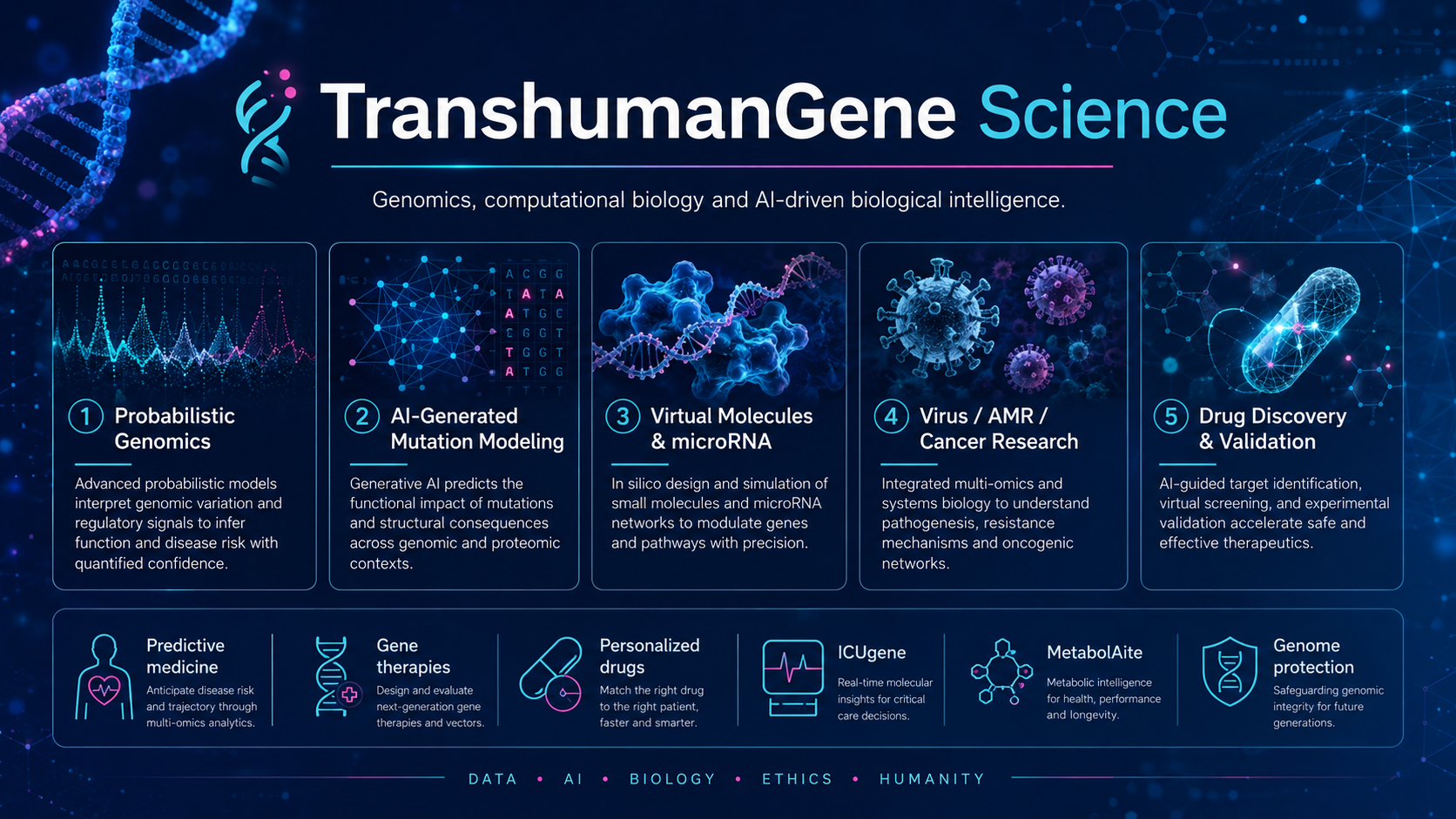
Probabilistic genomics and AI-generated mutation modeling for biological reasoning and intervention hypotheses.
The program is presented as a scientific notebook: architecture, assumptions, applications, validation logic and visual evidence for researchers, innovators, students, professors, commercial partners and philanthropic organizations.
TranshumanGene
PROBABILISTIC GENOMICS
MASSIVE AI-GENERATED MUTATIONS THROUGH PREDICTIVE MODELS
GENERATION OF VIRTUAL MOLECULES AND MicroRNA FOR FIGHTING VIRUSES, AMR, CANCERS,
ENHANCING HUMAN GENOMES,
DISCOVERING AND VALIDATING DRUGS
M.VIVIANI, M.BISOGNI, N.L.BRAGAZZI
,
14,
MASSIVE AI GENERATED MUTATIONS THROUGH PREDICTIVE MODELS
Scientific collaboration model
Research programs are organized around computational hypotheses, validation discipline, experimental caution and ethical review.
Mental health
Our key publications
eep
Qua
li
nd
hys
ca
ct
red
of
en
al
ll
be
ng
Var
ance
dur
VI
oc
down
CL
VID
In
erna
onal
ne
ur
ey
Kha
bel
ch
af
mm
wa
oudi
ar
ou
is
Ha
oua
Micha
lle
ag
niell
w,
Mon
Ahm
ed
Pa
ric
Mu
ler
No
ge
Hs
un
a,
ousr
Moha
Ro
dh
ni
oud
Lai
sa
ir
Do
os
nne
aa
n,
an
Sofi
on
Car
So
buco
Leonard
se
Dos
Mor
Ta
heri
Kh
ad
je
us
Nicol
aga
zz
hl
sh
lb
dreev
ephe
ley
re
Mi
Nich
as
T.
Faie
Lo
ri
Hadj
Sam
C.
na
Eva
eli
Sama
Vasili
see
bdel
Ka
El
Ab
Mo
si
Asma
lou
Sou
tt
Va
er
ijnen
ry
Rie
nn
ure
ie
Delh
Gó
aja,
qu
Eps
ein,
Robber
Sander
Seba
Schul
or
Der
aa,
Fernand
Ferreir
s,
jan
nič
ot
, Saša
, An
dre
agg
ioli
Jü
einac
io
ije
ws
Chri
Ap
lbach
rda
Gle
hare
Cai
rk
Saa
Dri
it
oe
hal
OVID1
Con
ium
Int
Enviro
ubli
lt
2021
Pub
Apr
19.
10.3390/
ijerph
4329
CID
Th
Fa
gue
ogn
ve
rob
fo
Ado
es
ent
ndu
gh
om
Ran
ize
oun
erba
ed,
ver
aam
Sli
Zna
Lui
Sami
Cli
Med
2018
Dec
510.
Pu
De
3.
doi
jc
ff
conf
em
ea
fe
eh
rs
he
ns
VID19
st
dy
ale
Michae
Elle
tlag
Sophi
Carlo
ïme
hler
eev
Jorda
Glenn
ich
Chaari
Evan
oha
ijn
ona
ein
obb
San
Schu
am
Ferre
Stephe
Ba
eina
Cha
ak
Spor
21.
2020
Aug
10.
14/b
ol
.20
20.96857
Search
et
chi
sord
ong
Isr
co
ens
iv
nfod
og
ica
su
vey
da
niel
hrou
m,
Kas
Sha
if
Adi
Gu
Abu
bdu
eerJ
7.
14.
10.7
17/p
eerj.
chol
eq
nf
ID19
ller
chae
le
ic
nie
orda
ert
Jona
obbe
Ac
Jer
ernand
. S
ei
onsor
204.
lin
5.
10.1371/
jou
nal.pon
.02
op
Soc
nfo
Sca
Wit
Add
Men
Sur
il
ase
Noo
haf
ud
evel
Ko
ub
Ji
nh
u,
rou
col
JM
For
Jun
0.
9.
0.2196
Ye
eb
ence
base
ill
eve
ena
Mich
Cos
ilu
Nic
22.
2131
ga
ss
Me
po
Par
Fr
nc
Giov
Ps
2014
1546.
10.4081/
hpr.
014.
Spat
ili
earn
yn
za
ons
era
Ana
ys
Yea
dren
ik
ron
968.
18.
10.33
9/
fpsy
.58
conc
rn
pact
ig
asu
Br
nel
od
bo
phys
act
ra
subje
2017
60.
10.1016/
j.d
b.20
7.06
ehab
cente
ex
roccan
cas
icha
abb
delha
ebb
di
han
Dou
Joë
Cand
rt
iri
nce
eha
ag.
108.
10.21
7/
M.
1174
y,
Str
ss,
and
rnout
ompar
Pro
her
hcare
Wor
ers
Isa
bell
Giu
oi
Gr
eri
Gon
ier
ior
Lochner
(B
635.
ay
27.
0/h
9060635
Tenn
rv
Per
Ram
dan
Rand
d,
ofie
ih
bde
oub
Nu
rien
10.3
90/nu120
1035
S/
Burn
ut
ndr
ers.
bre
Sys
ev
navi
rico
barin
croce
Salv
fina
20.
4361
Sk
rom
Studen
cal
oad
yrin
H’
ida
livie
renne
afaa
Gha
9067.
4.
9067
rns,
ess,
e,
Mus
ue,
rded
ce
ph
2019
118.
17.
10.3390/s
s70501
Exer
ess
rnt
onf
am,
Ya
enab
Mehd
Had
nt
585.
.61
Quar
Pe
lli
verv
Ham
Cyrin
H'
rd
agaz
8.
/fpsy
01708
ep
ew
Sada
Saeed
Shahri
Ahmad
haee
dif
la
Lu
Mey
sri
Mous
ejad
gan
Ghae
oh
Fae
bad
Seyed
sl
epu
25.
10.141
jiri.31
.130
neral
at
abe
by
shor
ues
rev
ly
hi
Soh
bi
haye
diba
hsh
hada
soo
Mir
haed
End
34.
31.
10.1186/s12
hea
Iran
id
Lif
.11
86/
1295
pon
onsh
ween
hy
dd
Ind
dua
iz
ah
Cheou
Chouai
Nico
Liy
Zou
H.
vlic
Fou
our
Feb
121.
0/
life
1102
Funct
on,
hav
Indu
Ins
3194.
3194
pan
how
ma
une
own
nary
pp
oach
ocus
ousfi
216.
10.5114/
20.9
sy
Bahra
Hajar
Mub
aj
ljab
oo
nab
lhare
usu
hr
ami
0131.
26.
10.2375
/ab
.v91i
4.1
opo
hob
new
160.
16.
41386
nk
sc
sona
P5
2013
12.
10.118
/17
Work
rgan
cho
ogy
ome
1919
K.
S.
enau
ob
L.
676.
10.3389/
.59
hron
ease,
Sp
ua
Stud
013.
dera
ear
ress
rab
A.
alh
lja
W.
lha
085.
23.
89/
0.57
Inf
Maj
hra
Adu
esu
rol
Study
ory
lG
ppa
nfl
amm
1445.
15.
0.2147/JI
S30
ega
pac
Part
fact
dw
sm
eonard
go
amal
nn,
ez
Sande
rm
, P
, Ch
, H
n Saa
OVID19
6237
1121
Off
cat
Ott
liel
885.
11.
0885
ses
av
ary
illi
hafe
hafee
hah
shall
390/
92587
Speed,
Young
enn
adan
Fast
zed,
im
Ghari
Nov
29.
1133
Mü
chul
, S
te
lm
ehal
OVI
D1
1583.
28.
1583
oronav
ght
onard
nau
run
iel
Eduardo
Moren
úd
ina
Fab
rcel
ilh
evero
Dohan
952.
10.339
/ijerph
180309
reak
andba
ccordi
ry,
der,
Pos
udy
ouh
Ghal
E.
aw
ren
es,
Schwe
4050
bu
nou
pr
ndre
lelon
ga,
Lib
Cav
chner
Gi
ondo
10.1192/
bj
0.161
att
dj
nns
esso
nop
2012
190.
10.214
7714
urb
nces
Stu
Imp
Moj
ari
Firu
np
Ser
Lan
icc
Zerb
sé
ld
nad
ccò
1011
P6
eds
Psy
ho
Tra
ural
roach
10.40
1/hp
.e
rns
fu
hol
onsu
Occupat
Din
ole
lfred
elm
Nicole
Deba
Du
ndo
1121.
30.
ow
Saha
13.
10.1419
jiri.32
ompos
hout
Exa
epr
sor
Haj
h,
oy
ef
90/nu130
2718
een
brea
Fate
Mbare
2.
.01
rna
gural
esp
Inn
Gl
obal
Phar
s)
Vu
Öz
, Şü
acıo
ui
, Co
a, Edwa
Dove
, L
. F
n, Ch
ci
, E
ug
, Edmu
.D.
Lee
, A
rena
diy
Kaz
oda
iyu
nj
riv
linson,
aye
h, Üm
ICS.
10.1089/
i.20
4.00
udes,
ere
Au
rapy?
hera
Gior
icol
roie
2015
1545.
015.
ruc
Mode
Johnn
ov
202.
fphy
s.2019.00
Up
ocol
unc
Rando
zed
ros
5885
hc
Stra
eg
hn
ears
sea
g,
baioli
iqu
Leon
bl
Carv
lh
3099.
3099
anc
Inc
ebru
anu
Inte
rup
ndan
Saki
hb
ube
hanb
Has
soud
cu
Effec
ode
Sta
uca
ty
Sep
931.
Robotics field photograph
ard
ovascu
Yo
est
Luc
lbuquerqu
ire
nnure
paio
eba
edo
Muño
obar
Cir
Jo
ych
543.
0.58
gy
k”
Max
nce,
ical
nd,
aceb
wes
992.
90/nu110
0992
Aerob
apac
Func
eart
irez
llo
ell
1564.
10.3389
s.2018.015
rocus
vus
ffron
uoxe
rea
lip
Firou
npanah
Firen
cc
erb
305.
1993
ork
epa
Gorji
zi
pou
Seye
ru
Ju
188.
1.
oog
bas
oa
10.2147
S4
bet
oms
phob
ood
ngs
Exp
ora
del
lhaj
Moh
uheji
711.
20711
Kn
ude,
Prac
owa
ds
Pha
lR
Sar
lMuh
was
erda
olicy
10.2147/
HP
S31
ze
lie
barino
291.
20291
ekwon
yperac
sorder
Kad
Fairou
20204
rug
anada
dal
Beh
ors,
ouseho
Food
nse
fro
ge,
sen
Wu
6425
onazep
ono
py
agn
sed
epsy
nle
Epileps
roup
och
CD
1302
10.1002/
28.p
b2
choact
amo
dr
INI,
N.L
I,
EC
P.
E1
E139.
10.151
7/24
4248/
h20
9.60
2.12
Gyn
srup
Art
Kham
5058.
5058
scop
nan
hca
Valen
Carl
D’A
ico
lfr
ecu
Deb
rb
023372.
10.11
6/bm
jop
xual
Lau
ohn
ffu
2016
246.
s.2016.0
oject
ee
Equa
Model
haouach
0126
93.
accult
ura
cop
cont
cac
chroni
nese
ant
Cé
ero
Frie
ões
ndau
che
Res
6.
/J
R.
S1
5449
Ques
udes
rac
nes
onc
van
ves
sile
elo
Ang
ilib
1092.
23750/a
.v
4.113
ar,
ven
Sho
rin
Denh
Gen
6524
/f
repa
BOLG
SEM
GORJ
TI
UIGI
E5
E519.
0.61
4.16
earch
sal
ove
age
Ghanb
Leil
24569.
10.2196
P)
ian
ans
rne
Enc
iccò
Gual
Sil
Ferr
/trop
ed5030117
ayt
portu
4650.
4650
are
nos
now
rr
Gualer
Silvi
Fed
lz
rell
10.23750/a
9573
rke
ped
Know
AP)
ans.
Pre
(201
ZZO
SI,
LERZ
.L
E6
E75.
10.1516
/24
1.11
anguage
vos
we
13154.
24.
10.2196/
3154
151.
/RM
3088
Teacher
Edu
(T
Arab
angu
Jua
456.
.00
Trans
ophob
xp
orat
Fac
Lid
Vill
ild
Mh
Uh
h.9186
annab
Bra
luni
cch
0918
10.1155/
1709
ugs
yoc
epi
1048
83.p
b4
Ebo
web
Goog
ery
vo
Valeri
ccio
ici
54.
10.1186/s4024
adap
yl
You
ne,
ory,
ve,
erac
ed”
ore
Ia
story
ien
refe
359.
38578
cacy
ous
ors
Ethn
1641.
Inj
zod
Guale
Hum
Neu
.33
fnhu
021.
29719
or,
Howa
154.
1732
espo
tc
lor
100.
vel
yer
gn
can
Fre
’a
725.
1.70
hu
rbarin
98.
/spor
s8070098
portun
Shu
ja
3135.
3135
lfat
edh
178.
10.2478/
0097
yg
Upta
Socc
cco
ine
val
ompe
onna
ouan
Sab
rouni
llou
167.
1884
Moro
cognit
ehav
Chady
Sai
ouj
Isma
ouz
135.
1651
ual
xa
Dona
Cri
rini
ern
94.
ir.37
gra
Mod
Soma
PQ)
gran
166.
5393
Info
Scle
9240
1155/2
13/
24029
PMC
NL
Induc
orre
iro
19;18
90/
063194.
0877
C80
40.
ousf
P,
pand
ep;37(
10.51
4/b
20.9512
328795
C7
3333
wi
ht
not
ssoc
eros
but
cant
morta
Rh
32(5
10.101
rh.201
1203
Adawi
ljadef
Cohe
Anx
eu
from
ffec
15;213:3
jad.
017.
2.00
2818
994.
22;18(4
42131.
K,
buc
NL,
hle
SJ
T,
Chaar
GM
LV
aja
F, Š
iol
elbach
Glen
achare
Saad
ek
um.
kdown
180843
1852
0738
hae
Sale
18;16
/s129
4795
C57
99.
Effect
3;7
C6
0693
gor
eas
runel
Mood
MS)
ned
bje
5;13:65
56.
725669
C550
827.
ever
ende
aba
(19
0)
7167
C79
Shahr
vin
Ebad
eyed
nur
25;31
10.1
.1
9951
4776.
croc
/M
Syn
20;18(8
61.
084361.
3924
C8072
81.
bbach
C,
wer
rehab
eso
0:1
284353
C5
9183
renn
arn
deo
den
chnica
4;17
172390
1727
7305
F,
Ass
ion
9;5(6
2728
10.219
/27
80.
3402
8191
earnt
5;12:61
10.338
1.61
402549
C81
1539.
nier
Sau
MD
Lochne
nx
Trau
Bur
out
deg
nge
's
wr
ehe
ileps
31;18
l)
27;9(6
/he
906063
3407
C8229
58.
uba
9;12
/nu
1035.
2283
C72
1086.
The
cyto
sch
zop
268:46
psych
s.2018.0
.04
3013
859.
ynam
sual
18;12:58
1.58
422059
C82
9578.
Zo
vli
AH,
Cheo
F.
spo
rance
Incre
nhea
sel)
5;11(2
/life
11020121.
3562
4556.
Fari
HMS,
jor
Resu
4:14
S3
6315.
3883
C805
288.
Rama
nda
proa
uni
97(10
1095
1103.
1691
37.
80:1
43.
1016/
j.yeb
h.2
17.10
002.
1454
Gizun
McGon
rden
onw
ased
15;243
431.
018.09
075.
302689
hat
eop
ve"
a?
36(8
10.100
/s100
4624
Inv
gg
fen
21;2
hpr.20
14.15
3942
C4
6858
posal
16;7
10.2
S41386.
7679
C40
42.
eady
12;8:4.
6/17
3849
0773.
L,
ke,
gue,
Stre
bef
re,
aft
vanc
17;7
s7050118
9004
5718
General
Guy
985536
C59
4362.
V,
ett
Steinac
38(1
.51
/b
20.96857.
337959
9637
una
P, S
iu
equ
CLB
5;15(11
0204.
/journal.pon
40204.
4394
aq
n.
202013
10.23
50/a
4.103
2521
68.
Inter
sr
urv
14;6
07.
10.771
/peerj.450
5769
5857
71.
General and Personalized Drugs
Validation of genetic studies
Longevity enhancing techniques
SPECIALIZED STARTUPS
VIRUS VARIANT: Predictive medicine
Predictive Virus Mutations
Validation of existing Drugs and Vaccines
Gene Therapies
Side effects genomic link
SPAIRT: Genetic evaluation of the athlete (both professional and amatorial). Possible pharmacological correction to lack in genetic mechanisms.
Health Sphere: a device that keeps tracking of your genetic characteristics.
ICUGENE: Genetic evaluation of admitted patients in ERs and ICUs.
This evaluation determines the best set of drugs to apply, given the patient’s genetic profile. Reduces collateral effects of multiple medications.
METABOLAITE: Genetic cures and optimized drugs for various forms of diabetes
GENEPROTECTOR: Providing monitoring and cures to the deterioration of human DNA and tissues caused by radiations in Space and hazardous environments on Earth.
AMR Antimicrobial resistance: Assessing and preventing antibiotic resistance and proposing genetic solutions.
OPENAIMED: Educational Project to support TranshumanGene and the other Startups in their market expansion. The project aims to help disadvantaged students from all over the world learn new genetic techniques.
WHAT WE HAVE DONE SO FAR
*AI4Omics =
Parallel
OS for
accelerating
normalizing
processes
and data
analysis
MetabolAite
= Solution for
diabetes
cures
10,120 h
drugs and your genome: a reliable predictor of side effects
SARS CoV2 - Viruses - Bacteria: we predict them reliably and fight them efficiently (gene therapies) before they occur
Core business
Human
genome
reliable
prediction
drugs
collateral
effects
Elimination of the side effects of drugs for each person analyzed thanks to the computation of our system that allows you to choose the best drug (personalized medicine) exactly
computation
lethal
Virus/
Bacterium
generated
sequence
Computation and reliable prediction of the lethal genomic sequences that are produced during replication of the virus/bacteria due to the mutations that occur and that our system calculates exactly
Creation of kits/swabs (patentable) to test for the presence of such lethal mutations
Creation of the best enzymes / MicroRNAs as vaccines (patentable) for the given sequences to immunize before getting infected and avoid suffering/death
What is a “Virus Variant”?
V.V. is a
predictive tool
applied to the present virus strands and can tell you the most probable evolution of the virus itself. It’s beneficial to produce efficient vaccines and test the existing ones
TranshumanGene is an AI division specialized in pharmaceutical "in silico" and "in vitro“ R&D
Definition
In Silico: produced using computer modeling or computer simulation
Other critical applications are
ICU – Gene
, a predictive tool that shows the effects of a vaccine on a specific subject or a homogeneous population
Vaccines editing
the production in vitro of compounds that can be added to vaccines to make them more effective
VIRUS VARIANT
The predictive tool for better vaccines
Manaus population seemed to have reached herd immunity. However, given the massive transmission of the so-called Brazilian VOC, it was overwhelmed by the 2 and 3 COVID-19 waves.
Studying and modeling the mutational landscape of SARS-CoV-2 is of paramount importance given the urgent need to predict whether anti-COVID-19 vaccines will be effective or not on the so-called variants of concern (VOCs).
Including compounds able to fight future virus variants could end the pandemic.
Drugs under validation
Abstract
We are working on drugs validations; data will be released after journals publications
has developed a predictive AI-based multi-factorial platform (Virus Variant) that computes all the possible mutations of genomes in viruses and other living forms.
Our priority is the generation of virtual molecules and microRNA essential for fighting viruses, validating vaccines, and foresee the effects on patients.
VirusVariant
works?
Covid-19
Virus DNA
Variants
Calculation
Predicted
Variations
Antigens
mRNAs
Actual
mRNA
Vaccine Procedure
Antigen
mRNA Vaccine
Target Virus
With the help of supercomputers,
calculate
most
likely
mutations
of the virus.
this
could
efficient
. For
reason
apply
a reverse engineering
process
Phase
Predicting
Virus
Since
by the
require
extensive
screening
assessing
their
toxicity
, to be
faster
similar
approach
to
determine
the target
Antigenes
Calculating
Antigene
Virus Antigene
(Reverse engineering)
Mutated
Genetic
Proteomic
database
validation
After the
, the
resulting
will
associated
with the
Viruses
find
optimal
matches
artificial intelligence-based biophysics
(artificial intelligence + computational biology = computational intelligence)
AI drugs from design in silico to in vitro to trials
What we have achieved
WHAT WE HAVE DONE SO FAR: IN SILICO TO IN VITRO
We have already successfully crystallized an insulin sequence, with an excellent resolution, one of the highest obtained results. This enables us to shed more light on the mechanisms of insulin action at a cellular and molecular level, studying its genetic variants and the primary pathogenic mechanisms leading to diabetes.
Systemic lupus erythematosus (SLE) is a complex, multi-factorial and multi-system autoimmune disease, which imposes a dramatically relevant clinical and societal burden. Steroids (including methylprednisolone) represent the gold-standard option in terms of pharmaceutical treatment, even though their administration can result in side-effects, also serious and life-threatening ones (like malignancies, immune dysregulation/impairment and metabolic syndrome). Molecules obtained and extracted from helminths can be as effective as steroids, if not even superior in terms of pharmacological efficacy, sparing steroid doses and curbing the likelihood of developing severe adverse events. Among the different molecules,
tuftsin
phosphorylcholine appears to be particularly intriguing in that it finely tunes and modulates several immunological cascades and pathways. Utilizing a murine model of SLE nephritis (lupus-prone
NZBxW
/F1 mice) we were able to demonstrate the effectiveness of this novel helminth-based compound. Proteinuria grade, levels of anti-dsDNA autoantibodies and splenic cytokines (like pro-inflammatory cytokines interferon IFN-γ, interleukin IL-1β and IL-6) significantly decreased after administration of
phosphorylcholine, whereas the concentration of anti-inflammatory cytokine IL-10 increased. Summarizing,
phosphorylcholine seems to be a promising pharmacological treatment, even though the investigations conducted so far are preliminary and further research, including randomized clinical trials, is warranted
WHAT WE HAVE DONE SO FAR: IN SILICO TO IN VITRO TO TRIALS
AI4OMICS by TRANSHUMANGENE
A platform for geneticists,
researchers, physicists,
etc
Case Study: AFRICA
We are operating with patients of African origin.
"Africa needs not only its genetic library but also a calibrated set of genetic tools."
with
TFRecordWriter
os.path.join
hparams.out_dir
, _TRAIN))
train_out
, \
# We consider four possible scenarios for each read and adjust start/end
# indices to only include portions of read that overlap the window.
# 1) Read extends past 5' end of window
# 2) Read extends past 3' end of window
# 3) Read extends past 5' and 3' ends of window
# 4) Read falls entirely within window
window_start
==
window_end
!=
hparams.window_size
read_start
pileup_range.start
read_position
read_end
None
* ((
len
read_ints
))
pileup_range.end
base_counts
window_start:window_end
] +=
one_hot_read
read_start:read_end
# Use fractions at each position instead of raw base counts.
/=
np.expand_dims
np.
sum
, axis=
),
# Save counts/fractions for each base separately.
features =
example.features
range
(_ALLOWED_BASES))
key =
'%
s_counts
% _ALLOWED_BASES[
features.feature
[key].
float_list.value.extend
list
[:,
]))
ref_sequence
].int64_list.value.extend(
[_
ALLOWED_BASES.index
(base)
pileup_ref
])
flank_size
//
true_base
'label'
].int64_list.value.append(
Optimization Tool for Omics
The Problem
A multitude of instruments is available in omics and genomics laboratories around the world and it's difficult to get uniformity in datasets. This is one of the biggest problems when it comes to applying AI to aggregate data or simply comparing aggregate data.
Data we are dealing with tend to be complex, big, and scattered. Consequently, solution patterns are often lost in multiple big foggy data clusters.
Most research procedures take a long time to complete, and the results are generally poorly organized. Hence, it takes extra time and resources to run formal algorithms.
The Solution - 1
There are three ways to solve this limiting factor
build a tool capable of harmonizing different data sets (third party management)
create of a platform that allows scientists and researchers to enter and access data in a customized database that has already been structured
create an AI-OS that mediates between these two approaches
AI4Omics
BDM (Basic Data Management)
features
The software is essential in genetic laboratories for running harmonized data analysis.
AI4Omics, will provide the best quality in terms of
arranging genomic data,
measuring or comparing DNA sequence format,
gene expression,
functional annotations,
identifying genes (position, role, and expression domain)
def
has_allowed_alignment
read
"""Determines whether a read's CIGAR string has the allowed alignments."""
return
all
([
c.operation
_ALLOWED_CIGAR_OPS
read.alignment.cigar
is_usable_example
reads
ref_bases
"""Determines whether a particular reference region and read can be used."""
# Discard examples with variants or no mapped reads.
False
# Use only examples where all reads have simple alignment and allowed bases.
(read)
any
(base
_ALLOWED_BASES
read.aligned_sequence
# Reference should only contain allowed bases.
True
The Solution - 2
The BDM embedded in AI4Omics is five to one hundred times more effective than typical parallel programs. We can eliminate errors and bad syncs with enhanced computational power for quicker autonomous algorithms.
In addition to this, we can organize and format heterogeneous data from a variety of sources and store them efficiently in several databases.
It represents a new step in parallel programming, deep learning, reinforcement learning, and machine learning providing new opportunities in science
simulations,
DNA sequencing,
big data analysis,
autonomously generated algorithms,
precision and personalized medicine,
disanguibication
of different data,
friendly interaction with different standards,
integration with existing genomic apps to plan and execute complex tests.
Executive Summary
Ai4Omics' team has a long experience in parallel programming, deep learning, and genomics, creating new possibilities for achieving more significant results in science in general: simulations, DNA sequencing, big data
Ai4Omics has also developed a new Operating System for supercomputers and running on high-end laptops
This OS is called BDM (Basic Data Management)
Ai4Omics’ BDM makes optimization of data complexity
class
BaseHparams
object
"""Default hyperparameters."""
init
self
total_epochs
learning_rate
0.004
l2
0.001
batch_size
window_size
ref_path
'hs37d5.fa.gz'
vcf_path
'NA12878_calls.vcf.gz'
bam_path
'NA12878_sliced.bam'
out_dir
'examples'
model_dir
ngs_model
log_dir
'logs'
.total_epochs
.learning_rate
.l2 = l2
.batch_size
.window_size
.ref_path
.vcf_path
.bam_path
.out_dir
.model_dir
.log_dir
Extrapolation Tool for Omics
An essential feature of AI4Omics
The platform can run both on high-standard commercial computers and supercomputers.
he operator inserts data into our cyber-secure environment, and AI4Omics generates machine learning algorithms that classify, organize the data, forming new data aggregates and structures. The second step is the “hunt” in these classes of patterns useful to create new therapies, drugs, and treatments.
Once we have reached a sufficiently big cluster of data, we can abstract a virtually infinite number of artificial genomes, delivering preventive cures to the real world even before the critical point of illness has arisen. (Predictive Medicine)
Our platform would accelerate the research time for vaccines in the order x 12+
generate_tfrecord_datasets
hparams
"""Writes out
TFRecords
files for training, evaluation, and test datasets."""
os.path.exists
os.makedirs
# Fraction of examples in each dataset.
train_eval_test_split
= [
0.7
0.2
0.1
num_train_examples
num_eval_examples
num_test_examples
# Generate training, test, and evaluation examples.
, _EVAL))
eval_out
, _TEST))
test_out
all_examples
make_ngs_examples
example
r =
random.random
()
r <
train_out.write
(proto=example)
+=
elif
] +
eval_out.write
else
test_out.write
'# of training examples: %d'
'# of evaluation examples: %d'
'# of test examples: %d'
"""Generator function that yields training, evaluation and test examples."""
ref_reader
fasta.IndexedFastaReader
input_path
hparams.ref_path
vcf_reader
vcf.VcfReader
hparams.vcf_path
read_requirements
= reads_pb2.ReadRequirements()
sam_reader
sam.SamReader
hparams.bam_path
OMICA, a platform for genomic analysis
Applied to African descendent patients.
To face the21st century challenges
Health management Africa needs not only its
Own genetic library but also a calibrated set of genetic tools.
Lately, there have been lots of efforts in creating
libraries of genetic information about the population of Africa.
Some projects have worked on how genetic mutations among Africans contribute to conditions like sickle-cell disease and hearing impairments utilizing a limited number of genomes.
Case Study – Cont.
African genes hold a wealth of genetic variation, beyond that, observed by
scientists in Europe and elsewhere.
Too little of the knowledge and applications from genomics has benefited the global south because of inequalities in healthcare systems.
Leading causes of such inequality are high costs in accessing to non-African institutions and small local research workforce due to lack of funding.
Only about 2% of the genomes mapped globally are African, and a good proportion of these are African American. This comes from a lack of prioritizing funding, policies, and training infrastructure, but understanding genetic medicine is partial. And this has enormous consequences.
For example, estimates of genetic risk scores for people of African descent that predict, say, the likelihood of cardiomyopathies or schizophrenia can be unreliable or even misleading using tools that work well in the West or Asia.
The number of three million is the minimum to accurately map genetic variations across Africa, considering that Africa has 1.3 billion inhabitants.
This also affects the variety of diagnostic tests. The gaps in the availability of genomic information relevant to local populations also don’t allow fine-tuning of the tests. For example, it may find a genetic mutation in someone and not know if that variation is associated with a disease or other causes.
Because of the limited data sets of the African genome designed for a Caucasian and Asian population that may or may not have much of an effect on the African people.
OMICA wants to be a flexible platform that allows to store and analyze African genomes and as well fine-tuning such tools.
OMICA utilizes a mix of Open Sources and Proprietary programs to make the platform easy to access, cheap to run, and highly customizable.
Major Actors in the Vaccine and
Drug Discovery world,
requiring
advanced AI
Very few AI companies/
StartUp
, operating in this field, make large use of Supercomputers
Perspective Clients
Harvard University
Stanford University
Johns Hopkins Uni.
University of Oxford
University of Cambridge
University of Basel & Zurich
Top Universities
Other Institutions
Contract research organizations (CRO)
Laboratories
Hospitals
National Health Organizations
TranshumanGene main field of interaction
fewer target molecules
definition of the optimal ones
in few weeks instead of years
Our Omni-comprehensive approach requires heavy use of AI and Supercomputers
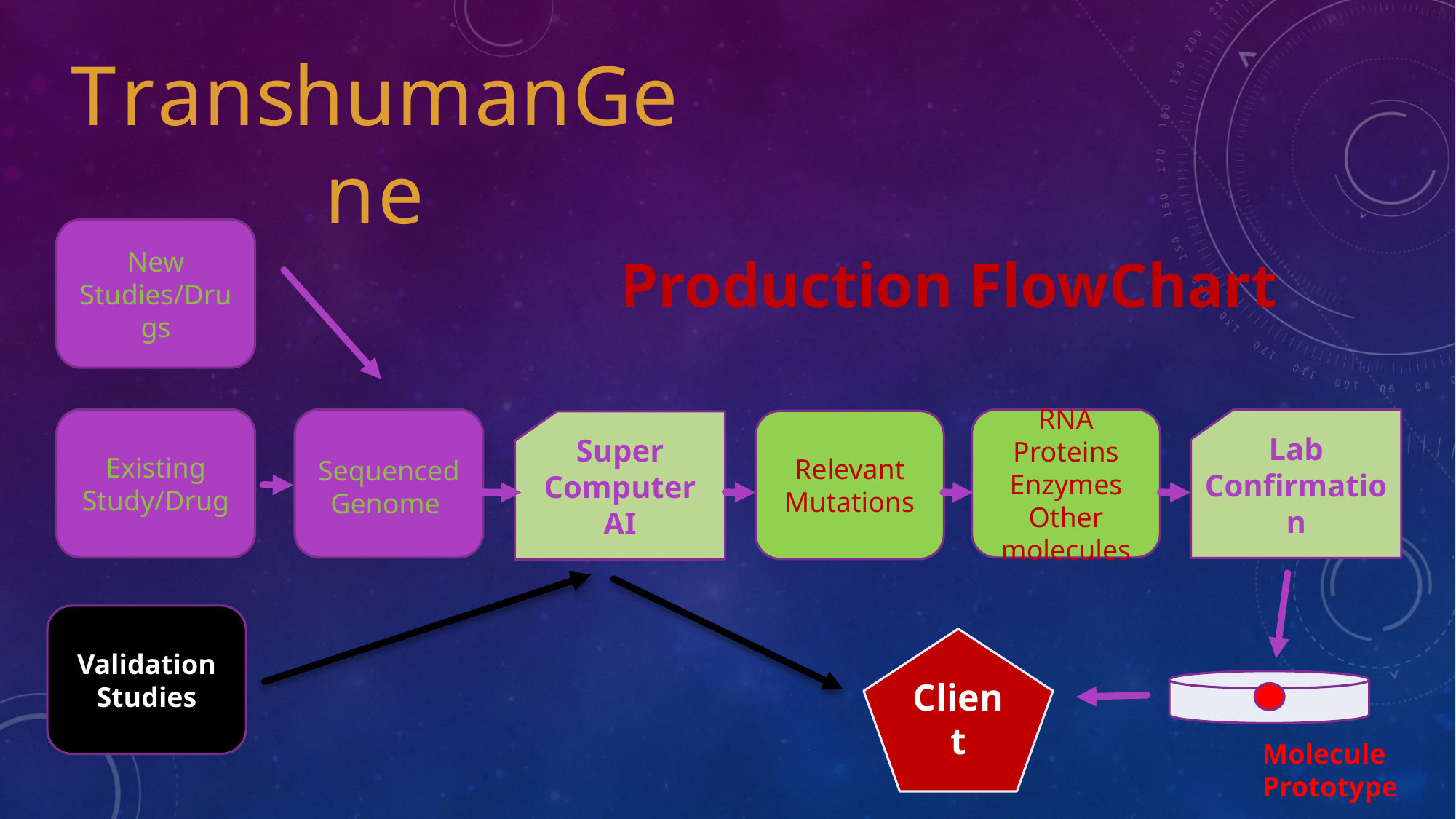
What We Do: Drugs and Vaccines
Production
FlowChart
Sequenced
New Studies/Drugs
Existing Study/Drug
Studies
Super
Computer
AI
Relevant Mutations
Proteins
Enzymes
Other molecules
Lab Confirmation
Molecule
Prototype
Client
BIO-Digital Engineer Syllabus: OPENAIMED
TRANSHUMANGENE ACADEMIC BIO-Digital Engineering: OPENAIMED
FH Carinthia
The university of applied science in Carinthia has a far-reaching fundament in different expertise. The study program is focused in three sections
Engineering & IT, Health, and Management.
Also they have some special programs in Innovation and a center for further education.
https://www.fh-kaernten.at/en/
https://www.lakeside-labs.com/
Medical University Graz
FH-PROF. MAG.A DR.IN
ASTRID PAULITSCH-FUCHS
Biomedical Analyze
DI Dr. Erich Alois Hartlieb
Entrepreneurship Mastermind
Priv.
Doz
. Mag.
Dr.rer.nat
Gernot
Zarfel
Microbiology
Mag.rer.nat
. Dr.
Klemens Kittinger
TRANSHUMANGENE ACADEMIC BIO-Digital Engineering Syllabus: OPENAIMED
TU Wien
At TU Wien, we have been conducting research, teaching and learning under the motto 'Technology for people' for over 200 years. TU Wien has evolved into an open academic institution where discussions can happen, opinions can be voiced and arguments will be heard. Although everyone may have different individual philosophies and approaches to life, the staff, management personnel and students at TU Wien all promote open-mindedness and tolerance. Also
they have some special programs in Innovation and a center for further education. In Vienna has the university different places and a renowned worldwide reputation on the technical research field.
https://www.tuwien.at/en/tu-wien/
https://www.tuwien.at/en/tu-wien/about-tu-wien/facts-and-figures/rankings/
https://www.imw.tuwien.ac.at/cps/team/sebastian_schlund/
FH Technikum Wien
With around 13,000 graduates thus far and 4,400 students, the University of Applied Sciences
Technikum
Wien is Austria’s only purely technical university of applied sciences. The educational offerings consist of 12 bachelor’s and 18 master’s degree programs, which are offered as full-time, part-time and/or distance study programs. Four degree programs are taught in English. The educational offerings are based on a solid scientific foundation and are also practice-oriented. At UAS
Wien, emphasis is not only placed on providing a high-quality technical education, but also on subjects with a focus on business and personal development. Close ties and collaborations with business and industry give students and graduates excellent career opportunities. The combination of theory and practical application is of central importance in both research and
instruction.The
research and development activities at UAS
Wien have grown significantly in recent years and currently concentrate on our research focuses: Embedded Systems & Cyber-Physical Systems,
Renewable Urban Energy Systems,
Secure Services, eHealth & Mobility,
Tissue Engineering & Molecular Life Science Technologies,
Automation & Robotics.
https://www.technikum-wien.at/en/
Univ.-Prof. Dr.-Ing. Dipl.-Ing.
Sebastian Schlund
Cyber
Physical
Systems
York University
York University (French
Université
York) is a public research university in Toronto, Ontario, Canada. It is Canada's third-largest university and it has approximately 55,700 students, 7,000 faculty and staff, and over 325,000 alumni worldwide.
A community of changemakers working to create a better future: York believes that our diverse community, excellent learning and research, and commitment to collaboration allows us to address complex global challenges to create positive change in the local and global communities we serve. Our staff, students and faculty are passionate about building a more innovative, just and sustainable world.
https://www.yorku.ca/
https://liam.lab.yorku.ca/person/dr-nicola-luigi-bragazzi/
Dr. Nicola Luigi
Bragazzi
BSc
, MD, PhD,
MSc
, MPH
articles
4235
citations
, H-index 30 (
Scopus
Reviewer
scholarly
journals
National/International
Prizes
Young Knight
Italian
Republic
2005,
Guidoniani
Prize 2018, USERN Prize 2019, MAI Prize 2020
International Journal
Functional
Nutrition, Editor
Medicina
Section
Board Member and Editorial Board Member
Environmental Research and Public Health,
Board Member
Current
Autoimmunity
, Editorial Board Member
Epidemiologia
Laboratory
Industrial and Applied
Mathematics
(LIAM)
Department
Statistics
Toronto, ON, Canada
WHERE WE COME FROM: SUPERCOMPUTING ai Applied to
genomics
fighting
diseases
senescence
AI4OMICS)
Mutant*: Proteins impact (IN COLORS) on predicted mutations (SPHERE)
On internal layers (three-dimensional) is possible to represent temporal and cyclical variables (timing and number of mutations)
*mutant = ai engine
MUTANT IS A COMPLEMENTARY TOOL FOR
ProjectING
and VALIDATING DRUGS
Mutant: from many years to few months OF DRUGS development
AGGREGATE THE MUTATIONS
CREATE AND LIST MUTATIONS
Transhumangene Output
How MUTANT works
NORMALIZATION
AGGREGATION
DRUG
At present, there is no common standard for representing genomic data. Each sequencer tends to have its own. For this reason, a normalization tool of genetic data is essential.
Our Software detects and simulates Mutations in DNA/RNA data.
The Aggregation of data obtains the process of analysis. Our AI will calculate every possible pattern on which a molecule can optimize the wanted result. Such outcomes are rarely unique.
AI4OMICS NORMALIZATION OF GENOMICS DATA
Time and cost saving
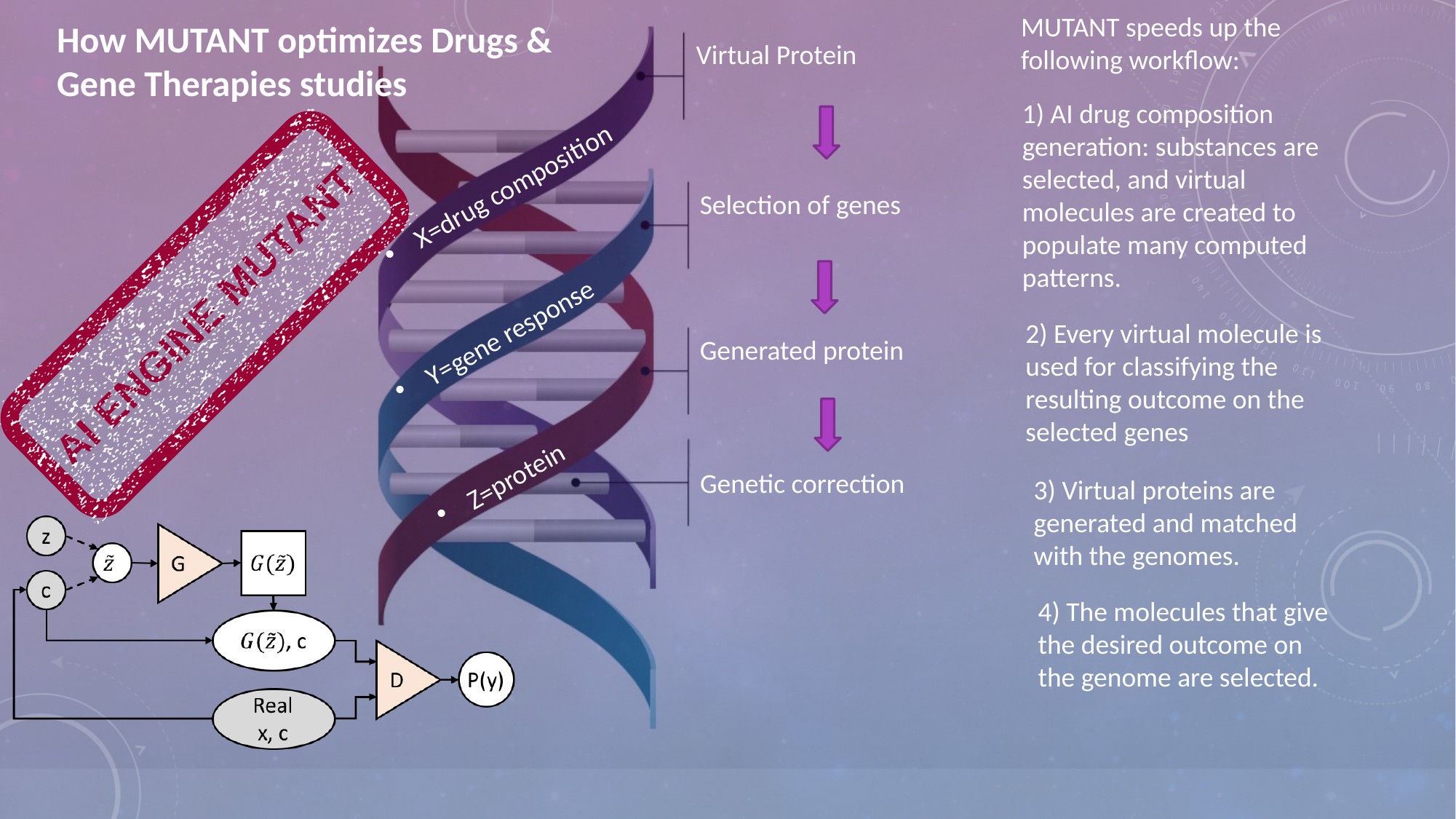
AI ENGINE MUTANT
Genetic correction
protein
Selection of genes
Virtual Protein
X=
composition
Y=gene
response
Z=
1) AI drug composition generation: substances are selected, and virtual molecules are created to populate many computed patterns.
How MUTANT
optimizes
& Gene Therapies studies
2) Every virtual molecule is used for classifying the resulting outcome on the selected genes
3) Virtual proteins are generated and matched with the genomes.
4) The molecules that give the desired outcome on the genome are selected.
MUTANT speeds up the following workflow
correction
validated
Check of
known
genes
expressions
Check of the AI
projected
MicroRNA
enzyme
Genes stimulating enzymes and microRNA are virtually built and locked to Mutant database
and check for
Mutant database mines the resulting genes expressions computing the collateral effects
AI created molecules (drug) are kept into consideration or discharged and another cycle restarts in every case
Enzyme research
MicroRNA Deep Sequencing
TranshumanGene ACCELERATES studies IN changes OF genomic response to alterations (Collateral effects)
CANCER STUDY AND PREDICTED MUTATIONS
Antimicrobial resistance
Attributable deaths and disability-adjusted life-years caused by infections with antibiotic-resistant bacteria in the EU and the European Economic Area
The Value of Vaccines in the Avoidance of Antimicrobial Resistance
FROM AI4OMICS TO mutant
MUTANT generates machine learning algorithms that classify and organize data, forming new data aggregates and structures.
Once we have reached a sufficiently big cluster of data, we can abstract a virtually infinite number of artificial genomes, facilitating personal preventive cures even before the critical point of illness has arisen. (Predictive Medicine)
MUTANT would accelerate the research time for drugs and vaccines of a factor of 10+
This system is handy for running subsequent AI analysis
Best quality in arranging genomic data,
Measurement or comparison of DNA sequence,
Structural variation,
Functional annotation,
Gene’s biological identity (position, role and its expression domain)
Since the Mutant AI engine runs on big data (which needs optimization), a supercomputer is required, but best results can be reached with Quantum Computers, when available.
MUTANT: normalization ENGINE
MUTANT: Optimization Tool for Omics
MUTANT practical APPLICATIONS
MUTANT
enhances computational power for organizing and giving a standard data format from different sources.
It exerts its utility in
Simulations
Genome sequencing
Big data analysis
Autonomously generated algorithms
Precision and personal medicine
Disambiguation of different data
Friendly interaction with different standards
Integration with existing genomic apps
Planning and execution of complex tests
Proofs of concepts and case study COVID-19
TransHumanGene, Drugs and Vaccines, Artificial Intelligence and Supercomputing
”, by
Nicola Luigi Bragazzi, Maurizio Bisogni and Maurizio Viviani
TransHumanGene and SARS-CoV-2: navigating the mutational landscape by means of Artificial Intelligence and Supercomputing
”, by Nicola Luigi Bragazzi
, Maurizio Bisogni and Maurizio Viviani
TransHumanGene, Senescence, Artificial Intelligence and Supercomputing
” by Nicola Luigi Bragazzi
TransHumanGene, Cancer, Artificial Intelligence and Supercomputing
” by
“How Big Data and Artificial Intelligence Can Help Better Manage the COVID-19 Pandemic”
by Nicola Luigi Bragazzi,
Haijiang
Dai, Giovanni Damiani, Masoud
Behzadifar
, Mariano Martini and
Jianhong
Int. J. Environ. Res. Public Health 2020, 17(9), 3176; doi.org/10.3390/ijerph17093176
Medical education refers to education and training delivered to medical students in order to become a practitioner. In recent decades, medicine has been radically transformed by scientific and computational/digital advances-including the introduction of new information and communication technologies, the discovery of DNA, and the birth of genomics and post-genomics super-specialties (transcriptomics, proteomics,
interactomics
, and metabolomics/
metabonomics
, among others)-which contribute to the generation of an unprecedented amount of data, so-called 'big data'. While these are well-studied in fields such as medical research and methodology, translational medicine, and clinical practice, they remain overlooked and understudied in the field of medical education. For this purpose, we carried out an integrative review of the literature. Twenty-nine studies were retrieved and synthesized in the present review. Included studies were published between 2012 and 2021. Eleven studies were performed in North America: specifically, nine were conducted in the USA and two studies in Canada. Six studies were carried out in Europe: two in France, two in Germany, one in Italy, and one in several European countries. One additional study was conducted in China. Eight papers were commentaries/theoretical or perspective articles, while five were designed as a case study. Five investigations exploited large databases and datasets, while five additional studies were surveys. Two papers employed visual data analytical/data mining techniques. Finally, other two papers were technical papers, describing the development of software, computational tools and/or learning environments/platforms, while two additional studies were literature reviews (one of which being systematic and bibliometric).The following nine sub-topics could be identified: (I) knowledge and awareness of big data among medical students; (II) difficulties and challenges in integrating and implementing big data teaching into the medical syllabus; (III) exploiting big data to review, improve and enhance medical school curriculum; (IV) exploiting big data to monitor the effectiveness of web-based learning environments among medical students; (V) exploiting big data to capture the determinants and signatures of successful academic performance and counteract/prevent drop-out; (VI) exploiting big data to promote equity, inclusion, and diversity; (VII) exploiting big data to enhance integrity and ethics, avoiding plagiarism and duplication rate; (VIII) empowering medical students, improving and enhancing medical practice; and, (IX) exploiting big data in continuous medical education and learning. These sub-themes were subsequently grouped in the following four major themes/topics: namely, (I) big data and medical curricula; (II) big data and medical academic performance; (III) big data and societal/bioethical issues in biomedical education; and (IV) big data and medical career. Despite the increasing importance of big data in biomedicine, current medical curricula and syllabuses appear inadequate to prepare future medical professionals and practitioners that can leverage on big data in their daily clinical practice. Challenges in integrating, incorporating, and implementing big data teaching into medical school need to be overcome to facilitate the training of the next generation of medical professionals. Finally, in the present integrative review, state-of-art and future potential uses of big data in the field of biomedical discussion are envisaged, with a focus on the still ongoing "Coronavirus Disease 2019" (COVID-19) pandemic, which has been acting as a catalyst for innovation and digitalization.
Big Data for Biomedical Education with a Focus on the COVID-19 Era: An Integrative Review of the Literature
https://pubmed.ncbi.nlm.nih.gov/34501581/
Rola
Khamisy
Farah
Peter
Gilbey
Leonardo B Furstenau
Michele Kremer
Sott
Raymond Farah
Maurizio Viviani
Maurizio Bisogni
Jude
Dzevela
Kong
Rosagemma
Ciliberti
Nicola Luigi Bragazzi
“Artificial neural networks can be effectively used to model changes of intracranial pressure (ICP) during spinal surgery using different non invasive ICP surrogate estimators” by
Watad
A, Bragazzi NL,
Bacigaluppi
Amital
S, Sharif K,
Bisharat
B, Siri A,
Mahamid
A, Abu Ras H, Nasr A,
Bilotta
Robba
M. J
Neurosurg
Sci. 2018 Feb 23.
10.23736/S0390-5616.18.04299-6
“Artificial neural networks allow response prediction in squamous cell carcinoma of the scalp treated with radiotherapy” by Damiani G,
Grossi
Berti
E, Conic RRZ, Radhakrishna U,
Pacifico
Piccinno
R, Linder D. J Eur
Acad
Dermatol
Venereol
. 2020 Jun;34(6):1369-1373.
“How Big Data and Artificial Intelligence Can Help Better Manage the COVID-19 Pandemic” by Bragazzi NL, Dai H, Damiani G,
M, Martini M, Wu J. Int J Environ Res Public Health. 2020 May 2;17(9):3176.
“From Rheumatology 1.0 to Rheumatology 4.0 and beyond: the contributions of Big Data to the field of rheumatology” by Bragazzi NL, Damiani G, Martini M.
Mediterr
Rheumatol
. 2019 Mar;30(1):3-6.
SleepOMICS
How Big Data Can Revolutionize Sleep Science” by Bragazzi NL,
Guglielmi
O,
Garbarino
S. Int J Environ Res Public Health. 2019 Jan 21;16(2):291.
"Systematic review and meta-analysis of
case-control
studies from 7,000 COVID-19 Pneumonia patients suggests a beneficial impact of Tocilizumab with benefit most evident in non-corticosteroid Exposed Subjects" by Abdulla
, Charlie
Bridgewood
, Muhammad Mansour,
Naim
Mahroum
, Matteo
Riccò
, Ahmed Nasr, Amr Hussein, Omer Gendelman, Yehuda
Shoenfeld
Merav
Lidar, Howard
Amita
Wu, Dennis
McGonagle
SSRN Papers abstract number 3642653
"Rationale for Evaluating PDE4 Inhibition for Mitigating against Severe Inflammation in COVID-19 Pneumonia and Beyond" by
C, Damiani G, Sharif K,
Bragazzi NL
Quartuccio
Savic
D.
Med Assoc J. 2020 Jun;22(6):335-339. PMID: 32558435
"Canada needs to rapidly escalate public health interventions for its COVID-19 mitigation strategies" by
Scarabel
Pellis
, Wu J. Infect Dis Model. 2020;5:316-322.
10.1016/j.idm.2020.03.004.
Epub
2020 Mar 31. PMID: 32518882
"Modeling the impact of mass influenza vaccination and public health interventions on COVID-19 epidemics with limited detection capability" by Li Q, Tang B,
, Xiao Y, Wu J. Math
Biosci
. 2020 Jul;325:108378.
10.1016/j.mbs.2020.108378.
2020 May 16. PMID: 32507746
"Quantifying the role of social distancing, personal protection and case detection in mitigating COVID-19 outbreak in Ontario, Canada" by Wu J, Tang B,
, Nah K, McCarthy Z. J Math Ind. 2020;10(1):15.
10.1186/s13362-020-00083-3.
2020 May 26. PMID: 32501416
"Effects of COVID-19 Home Confinement on Eating
Behaviour
and Physical Activity: Results of the ECLB-COVID19 International Online Survey" Ammar A, Brach M,
Trabelsi
Chtourou
Boukhris
Masmoudi
Bouaziz
B,
Bentlage
E, How D, Ahmed M, Müller P, Müller N,
Aloui
Hammouda
Paineiras-Domingos
LL,
Braakman
Jansen A, Wrede C,
Bastoni
S, Pernambuco CS,
Mataruna
L, Taheri M,
Irandoust
Khacharem
Chamari
K, Glenn JM, Bott NT,
Gargouri
Batatia
H, Ali GM, Abdelkarim O,
Jarraya
M, Abed KE,
Souissi
N, Van
Gemert-Pijnen
L, Riemann BL, Riemann L,
Moalla
W, Gómez-Raja J, Epstein M,
Sanderman
R, Schulz SV,
Jerg
A, Al
Horani
R, Mansi T,
Jmail
M, Barbosa F, Ferreira-Santos F,
Šimunič
Pišot
R,
Gaggioli
A, Bailey SJ,
Steinacker
JM,
Driss
Hoekelmann
A. Nutrients. 2020 May 28;12(6):E1583.
10.3390/nu12061583. PMID: 32481594
"Point-of-Care Diagnostic Tests for Detecting SARS-CoV-2 Antibodies: A Systematic Review and Meta-Analysis of Real-World Data" by
M, Ferraro P,
Gualerzi
Ranzieri
S, Henry BM, Said YB,
Pyatigorskaya
NV,
Nevolina
E, Wu J,
, Signorelli C. J Clin Med. 2020 May 18;9(5):1515.
10.3390/jcm9051515. PMID: 32443459
"De-Escalation by Reversing the Escalation with a Stronger Synergistic Package of Contact Tracing, Quarantine, Isolation and Personal Protection: Feasibility of Preventing a COVID-19 Rebound in Ontario, Canada, as a Case Study" by Tang B,
, McCarthy Z, Glazer M, Xiao Y, Heffernan JM,
Asgary
A, Ogden NH, Wu J. Biology (Basel). 2020 May 16;9(5):100.
10.3390/biology9050100. PMID: 32429450
"SARS-CoV-2 infection and air pollutants: Correlation or causation?" by
Balzarini
Corradi
M. Sci Total Environ. 2020 Sep 10;734:139489.
10.1016/j.scitotenv.2020.139489.
2020 May 16. PMID: 32425256
"Stop playing with data: there is no sound evidence that
Bacille
Calmette
Guérin
may avoid SARS-CoV-2 infection (for now)" by
. Acta Biomed. 2020 May 11;91(2):207-213.
10.23750/abm.v91i2.9700. PMID: 32420947
"Point-of-Care diagnostic of SARS-CoV-2: knowledge, attitudes, and perceptions (KAP) of medical workforce in Italy" by
F, Signorelli C. Acta Biomed. 2020 May 11;91(2):57-67.
10.23750/abm.v91i2.9573. PMID: 32420926
"COVID-19 knowledge prevents biologics discontinuation: Data from an Italian multicenter survey during RED-ZONE declaration" by
Malagoli
Kridin
Pigatto
P, Damiani G. Dermatol
Ther
. 2020 May 16:e13508.
10.1111/dth.13508. Online ahead of print. PMID: 32415727
"Continuous hydroxychloroquine or colchicine therapy does not prevent infection with SARS-CoV-2: Insights from a large healthcare database analysis" by Gendelman O,
Chodick
G.
Autoimmun
Rev. 2020 Jul;19(7):102566.
10.1016/j.autrev.2020.102566.
2020 May 5. PMID: 32380315
"Ensuring adequate health financing to prevent and control the COVID-19 in Iran" by
Ghanbari
MK, Bakhtiari A,
. Version 2. Int J Equity Health. 2020 May 6;19(1):61.
10.1186/s12939-020-01181-9. PMID: 32375787
"How Big Data and Artificial Intelligence Can Help Better Manage the COVID-19 Pandemic" by
, Dai H, Damiani G,
10.3390/ijerph17093176. PMID: 32370204
"Biologics increase the risk of SARS-CoV-2 infection and hospitalization, but not ICU admission and death: Real-life data from a large cohort during red-zone declaration" by Damiani G,
P. Dermatol
. 2020 May 1:e13475.
10.1111/dth.13475. Online ahead of print. PMID: 32356577
"Novel Coronavirus Infection (COVID-19) in Humans: A Scoping Review and Meta-Analysis" by Borges do Nascimento IJ,
Cacic
Abdulazeem
HM, von Groote TC,
Jayarajah
Weerasekara
Esfahani
MA, Civile VT,
Marusic
Jeroncic
Carvas
Junior N,
Pericic
TP,
Zakarija-Grkovic
Meirelles
Guimarães
SM,
Luigi Bragazzi N
, Bjorklund M, Sofi-Mahmudi A,
Altujjar
M, Tian M,
Arcani
DMC,
O'Mathúna
DP,
Marcolino
MS. J Clin Med. 2020 Mar 30;9(4):941.
10.3390/jcm9040941. PMID: 32235486
"The effectiveness of quarantine and isolation determine the trend of the COVID-19 epidemics in the final phase of the current outbreak in China" by Tang B, Xia F, Tang S,
, Li Q, Sun X, Liang J, Xiao Y, Wu J. Int J Infect Dis. 2020 Jun;95:288-293.
10.1016/j.ijid.2020.03.018.
2020 Apr 17. PMID: 32171948
"An updated estimation of the risk of transmission of the novel coronavirus (2019-nCov)" by Tang B,
, Li Q, Tang S, Xiao Y, Wu J. Infect Dis Model. 2020 Feb 11;5:248-255.
10.1016/j.idm.2020.02.001.
eCollection
2020. PMID: 32099934
"Estimation of the Transmission Risk of the 2019-nCoV and Its Implication for Public Health Interventions" by Tang B, Wang X, Li Q,
, Tang S, Xiao Y, Wu J. J Clin Med. 2020 Feb 7;9(2):462.
10.3390/jcm9020462. PMID: 32046137
Article
tu
Andrew
Senior
1,4
*,
Richard
Evans
John
Jumper
,James
Kirkpatrick
Laurent
Sifre
Tim
Green
Chongli
Qin
Augustin
Žídek
,Alexander
Nelson
Alex
Bridgland
Hugo
Penedones
Stig
Petersen
Karen
Simonyan
Steve
Crossan
Pushmeet
Kohli
David
Jones
2,3
Silver
Koray
Kavukcuoglu
Demis
Hassabis
structureprediction
canbe
used
three-dimensionalshapeof
its
amino
acid
problem
fundamental
importance
the structure
protein largely determines its function
however,
structures
canbe difficultto
determineexperimentally. Considerableprogress
recentlybeenmadeby
leveraging
geneticinformation.
possibleto
infer
which
residues
contact
analysing
covariation
homologous
sequences,
aidsin
the prediction
Hereweshowthatwe
can train
neural network
make
accurate predictions
the distances between
pairs
residues,
whichconveymore
information about
structurethancontact
predictions.
Using
information,
weconstruct
apotential
meanforce
that
accuratelydescribetheshapeof
protein. Wefind that
resultingpotentialcanbe
optimized
simple
gradient descent
algorithm
generate
without
complex
sampling
procedures.
resultingsystem,
named
AlphaFold,
achieves
high
accuracy,
even
sequences
withfewer
sequences.
Inthe
recent
Critical
Assessment
Structure
(CASP13)—ablindassessmentof
state
field—AlphaFold
created
high-accuracy
structures (with template modelling
(TM)
scores
higher)
freemodelling
domains,
whereasthe
next best method, which used sampling
contact information,
achieved
such
mai
Alpha
nside
adva
in protein-structureprediction.
Weexpectthis
increased accuracyto enable
insights
into
function
malfunction
proteins,
especially
cases
proteinshave
beenexperimentallydetermined
core
biological
processes.
intermediate
(FM/TBM)
category.
Figure
1a
shows
AlphaFold
dependent
structure,
understanding
struc
predicts
more
FM
domains
accuracy
than
other
system,
tures
been
grand
challenge
biology
decades.
Although
particularly
0.6–0.7
TM
score
range.
score—ranging
several
experimental
determination
techniques
have
between
1—measures
degree
match
overall
(back
developed
improved
they
remain
difficult
time
bone)
shape
proposed
native
structure.
assessors
consuming
result,
decades
theoretical
attempted
ranked
participating
groups
summed,
capped
predict
structures,
separated
according
CASP
biennial
blind
summed
52.8
category
(best-of-five)
compared
community
benchmark
progress
36.6
next
closest
group
(322).
Combining
TBM/FM
accuracy.
2018,
joined
around
world
categories,
scored
68.3
48.2.
entering
CASP13
Each
submitted
predictions
able
previously
unknown
folds
(Fig.
1b
).
experimentally
determined
Despite
only
templates,
were
sequestered.
divided
also
well
TBM
assessors’
scoring
classified
being
amenable
template
mula
0-capped
score,
ranking
fourth
top-one
first
based
modelling
(TBM,
best-of-five
models.
Much
due
homologo
modified
distance
predictions,
evident
accordance
differences)
free
precision
corresponding
1c
ling
(FM,
available),
Extended
Data
Fig.
2a).
https://doi.org/10.1038/s41586-019-1923-7
Publishedonline
15January
DeepMind,London,
UK.
Francis Crick Institute, London, UK.
University
College
London, London, UK.
These
authors contributed equally: Andrew
Senior,
Richard Evans,
Jumper,
James
Kirkpatrick,Laurent
Sifre.
andrewsenior@google.com
atu
Nature
Vol
January
most-successful
approaches
thus
far
9–11
relied
frag
neural network.
jointly predicting
many distances,
network
ment
assembly.
approaches,
through
propagate distance
information
respects
covariation,
local
stochastic sampling
process—such
simulated
annealing
residue identities
nearby residues. The
minimizes
statistical
potential
derived
summary
probability
distributions
combined
form
simple,
principled
extracted
Bank
(PDB)
fragment
protein-specific
potential.
show
gradient
descent,
assembly,
hypothesis
repeatedly
modified,
typically
set
torsion
angles
changing
short
while
retaining
changes
lower
limited
sampling.
whole
chains
potential,
ultimately
leading
low
structures.
Simu
simultaneously,
avoiding
need
segment
long
lated
requires
many
thousands
moves
must
hypothesized
modelled
independently
repeated
times
good
coverage
low-potential
common
practice
(see
Editorial methods).
years, the
structure predictions
The central
component
convolutional
neural
use
evolutionary
found
sets
trained
PDB
distances
related
target
ij
atoms
pairs,
protein.
searching
large
datasets
basis of
representation
of the
amino acid
sequence,
DNA
sequencing
aligned
target sequence
MSA(
network,
multiple
alignment
(MSA).
Correlated
posi
those
image-recognition
tasks
tions
two
across
MSA
discrete
distribution
every
might
contact.
Contacts
pair
×64
region
matrix,
shown
defined
occur
when
β-carbon
within
2b
full
constructed
of one
another.
methods
including
networks
such predictions
that covers the entire distance
map
have been used
of residues is
termed
distogram (from distance histogram). Example distogram
computed
MSAs.
one
protein,
T0955,
3c,
incorporated
modifying
modes
3c
seen
closely
guide
folding
satisfy
3b
11,2
24,25
residue
(residue
29)
3d
geometry
correlate
. Neural
predictions without
covari
3e
Furthermore, the
models
uncertainty
ation
pairwise
f).
s.d.
low,
dependent statistical
used to rank
accurate.
also evident in
, in
hypotheses.
addition,
QUARK
pipeline
template-based
confident
(higher
distance-profile
restraint
TBM.
peak
distribution)
tend
accurate,
study,
present
deep-learning
close
peak.
Broader,
less-confidently
ture
prediction,
stages
illustrated
2a
still
assign
correct
value
possible
construct
learned,
training
accurate
consequently
c)
comes
com
about
given
bination
factors
design
training,
itself
accurately
minimizing
augmentation,
feature
representation,
auxiliary
losses,
cropping
descent
c).
include
backbone
curation
residues.
conform
predictions provide more
specific
smooth
fitting
spline
provide
richer
signal
negative
log
probabilities,
summing
.0
.8
.6
.4
.2
T0953s2-D3
T0968s2-D1
T0990-D1
T0990-D2
T1017s2-D1
T0990-D3
0.3
0.4
0.5
0.6
0.8
0.9
1.0
FM/TBM
domain
count
FM FM/TBM
1 do
2 do
cisi
(%)
Number
/1
/2
/5
1|Theperformanceof
intheCASP13assessment.
of FM
(FM
+FM/TBM)
domains predicted for
given TM-score threshold for
the other 97 groups.
For the six
folds identified
CASP13 assessors, the
score of AlphaFold
compared with the other
groups,
together
available
publication.
Precisions for
long-rangecontact
probable
contacts,
where
length
domain. The distance distributions used
AlphaFold in
CASP13,
thresholded
contact predictions,
compared with the submissions
the two
best
methods in
498 (RaptorX-Contact
032 (TripletRes
‘all groups’ targets,
updated domain definitions for
T0953s2.
parameterized
pti
miz
ati
ampled
nitializations
build
differentiable
pool
further
=G
compute
coordinates,
initializations
sampled,
added
noise
inter-residue
distances,
=||
||,
(‘noisy
restarts’),
to be
pool.
express
After
few
hundred
cycles,
optimization
converges
accumulates
terms
marginal
distribu
lowest
chosen
candidate
tion
overrepresentation
prior,
2e
best-scoring
subtract
reference
over
restarts
process,
domain.
ing
iterations
converged.
Noisy
|length)
independent
enable
slightly
higher
small
version
continuing
sample
same
input
features.
(average
0.641
versus
0.636
test
set,
separate
output
head
4).
4a
distogram
(measured
)).
von
Mises
distribution,
difference
(lDDT
Meth
term,
Finally,
ods)
correlates
final
realized
prevent
steric
clashes,
score2_smooth
Rosetta
4b
construction
incorporates
Waals
term.
multipli
Removing
entirely
gives
0.266.
cative
weights
three
Reducing
resolution
below
six
bins
combination
noticeably
outperformed
equal
weighting.
averaging
adjacent
causes
degrade.
in the
total
potential, reference
degrades
functions
respect
slightly.
‘relaxation’
(side-chain
packing
variables
descent.
Here
L-BFGS
leaved
descent)
initialized
values
Talaris2014
fit
reference-corrected
2c
illustrates
single
trajectory
adds
side-chain
atom
yields
showing
greedy
leads
average
improvement
score.
increasing
large-scale
conformation
changes.
sec
carefully
designed
system
ondary
partly
initialization
vide
angle
distributions.
(TM
score)
improves
represents
quickly
steps
Furthermore,
converged
optimum
achieve
.7
.5
.3
1,000
1,200
ts
Iteration
.d
(Å)
Sequen
A features
on distribution
l network
2D
covariation features
quen
r.m.s.d.
Nat.
1 10
2|Thefolding
processillustrated
T0986s2.
probabilities
the network
the uncertainty in
target T0986s2,
=155,
6N9V.
Steps of structure prediction.
The torsion
angle predictions
(as
−1
fitted
network predicts the entire
distogram based on
features,
predictions for
).While
step of gradient descent greedily lowers
accumulating
×64-residue
regions.
global
effected,
(1,200
steps)
shown,
root
mean
well-packed
chain.
submission
overlaid
square
deviation
(r.m.s.d.)
plotted
against
step
five
snapshots
(in
grey).
(across
=377)
the structure. The secondary structure (from
SST
is also shown (helix
blue, potential
against the
repeats of gradient
descent per
strand
red)
along
secondary
(Nat.),
secondary target
(log
scale).
Whereas
rarely
experi
performance
template-modelling
mental
templates
starting
reach
needed
unprecedented
method
hope
oba
ty (
QTKCEKKKCVCENCERSTYL
KF
ror
3|Predicted
distancedistributions
comparedwith
truedistances.
=41,
5W9F.
structure showing
under
highlighting
bin
highlighted
red,
drawn
black.
green,
non-contacts
blue.
T0
=552,
predicted distance
residue pairs
≤22
Å,
excluding distributions
>3.5
=28,678).
±s.d.
calculated
1Å
bins.
error
the distance
distributions,
excluding
>22
=61,872).
0.25
matrix
distogram for
T0990
2b,
+R
x Downsample
e2_
No torsions
e No
2 3
6 12
2 C
P1
0 10 20 30 40 50
|TM
distogram,
dependency
histogram
on different
components
score versus
used when
downsampling
distogram, compared with
lDDT
Pearson’s
correlation
coefficients,
both
CASP13 different components of the potential,
adding Rosetta relaxation.
=500
decoys
T0999)
datasets.
science
Onl
methods,
additional
references,
Research
reporting
tributions
competing
interests
statements
code
availability
Dill,
A.,
Ozkan,S.
B.,
Shell,
Weikl,
T.R.
problem.
Annu.
Rev.
Biophys
289–316(2008).
MacCallum,J.
Theprotein-foldingproblem,
yearson.
1042–1046(2012).
Schaarschmidt,
J.,
Monastyrskyy,B.,
Kryshtafovych,
Bonvin,
J.
contactpredictions
CASP12:co-evolution
deep
learning
coming
age.
Kirkwood,
mechanics
fluid
mixtures.
Chem.
300–313(1935).
Schwede,
T., Topf,
M.,
Fidelis,
Moult,
Critical assessment
(CASP)—Round
XIII.
1011–1020(2019).
Zhang,
Y.&
Skolnick,
function for
automated assessment
quality.
702–710(2004).
Y.
Protein structure
useful?
Curr.
Opin.
Struct.
Biol
145–155(2009).
13th
(CASP13).
1141–1148
(2019).
Das,R.
Baker,
Macromolecular
modeling
Rosetta.
Rev.Biochem
363–382(2008).
Jones,
D.T.Predicting
novel
byusing
FRAGFOLD.
127–132
(2001).
C.,
Mortuza,S.
He,
Wang,
Y.Template-basedand
free modeling
of I-TASSERand
QUARK pipelines
usingpredicted
contactmaps
CASP12.
136–151(2018).
Kirkpatrick,S.,
Gelatt,
D.Jr
Vecchi,
annealing.
ank
2000
Altschuh,
D.,
Lesk,
Bloomer,
Klug,
co-ordinatedamino
substitutions
tobacco
mosaic
virus.
Mol.
693–707(1987).
Ovchinnikov,
S.,
Kamisetty,
Robust
interactions
interfaces
information.
eLife
e02030
described
applied
benefit
areas
Seemayer,
Gruber,
M.&
Söding,J.
CCMpred—fast
precise
residue–residue
mutations.
Bioinformatics
3128–3130
(2014).
Morcos, F.
al.
Direct-coupling analysis
coevolution
captures
protein families.
Proc.
Natl
Acad.
Sci.
USA
E1293–E1301
(2011).
Jones,D.T.,Buchan,
D.W.,
Cozzetto,
D.&
Pontil,
PSICOV
structural
sstructure
inverse
covariance
estimation
on large
maries,
source
data,
supplementary
Skwark,
Raimondi,
D.,Michel,
Elofsson,
recognition
like
contactpatterns.
PLOSComput.
e1003889(2014).
acknowledgements,
peer
review
details
author
Jones,D.T.,Singh,
T.,
Kosciolek,
T.&
Tetchner,S.
MetaPSICOV:combining
hydrogen
bonding
proteins.
,999–1006(2015).
Sun,
Li,
Z.,
Xu,
Accuratedenovo
byultra-deeplearning
model.
,e1005324(2017).
Jones,D.T.&
Kandathil,
contactprediction using
fully
minimal
3308–3315(2018).
novo
CASP11
incorporating
ote
Aszódi,A.
Taylor,W.
Estimating polypeptide
α-carbon
sequencealignments.
Math.
Chem
167–184(1995).
Zhao,
position-specific
distance-dependentstatistical
study.
1118–1126(2012).
distance-basedprotein
structure prediction
bydeep
P13
1069
Aszódi,A.,
Gradwell,
Globalfold
restraints.
J.Mol.
308–326(1995).
Greener,
Jones,D.T.Prediction
interresidue
contactswith
DeepMetaPSICOVin
CASP13.
1092–1099(2019).
K.,
X.,
Ren,
residual
learning for
image
recognition.
IEEEConference
Visionand
Pattern
770–778(2016).
Simons,
T.,Kooperberg,
Huang,
E.&
Assembly
tertiary
from fragments
with similar
Bayesian
functions.
209–225(1997).
ceda
BF
th.
03–52
Y.,Zhang,
Bell,
W.,
Yu,D.-J.&
Y.Ensembling multiple
raw
coevolutionary
features with
networks for contact-map prediction
1082–1091
Konagurthu,A.
Allison,
Minimummessage
inference
structure from protein coordinate
data.
i97–i105
(2012).
Publisher’s
note
Springer Nature remains neutral with regard
jurisdictional claims
ffili
Author(s),
exclusive
licence
Springer
tru
ool
60521.
results
dataset
‘all
groups’
chains,
files,
definitions.
tact
accuracies
recomputed
submissions
files),
abilities
obtained
distograms
eac
tr
searched
train
ing sequence
similar protein
sequences in
Uniclust30
HHblits
returned
profile
position-specific substitution probabilities for
features—the
parameters
regularized
pseu
dolikelihood-trained
Potts
CCMpred
uses
Frobenius
norm
parameters,
feed
(1
feature)
(484
features)
predictioncenter.org/casp13/zscores_final.cgi?formula=assessors
1ashows
involved
construction,
extraction,
prediction.
network.
architecture
two-dimensional
dilated
Previously,
preceded
one-dimensional
following
tools
versions
bedding
layers
tem
subsequent
experiments
March
CATH
throughout
blocks
convolutions
v.3.0
beta.3
(three
iterations,
=1×10
−3
block,
1b,
consists
HHpred
server
2017-10
PSI-BLAST
v.2.6.0
nr
interleave
batchnorm
15December
2017)
1×1projection
×3
convolution
layer
(March
2019)
BioPython
v.1.65
v.3.5
PyMol
2.2.0
exponential
linear
unit
(ELU)
nonlinearities.
Successive
cycle
dilations
1,
2,
4,
pixels
allow
propagation
informa
cropped
region.
layer,
position
bias
used,
biases
indexed
offset
(capped
32)
number.
extract non-redundant
dom
ains
utilizing
35%
trained with stochastic gradient descent using
sequence sim
ilarity
cluster representatives. This
31,247
cross- entropy
loss. The target
quantification
split into
and test
(29,427
1,820
the C
residues (or C
glycine).
divide
respectively),
keeping
2–22
superfamily
(H-level
classification)
partition.
array
uperf
concatenation
CASP12
excluded
set.
took—at
random—a
homologous superfamily
Individual training runs
cross-validated with early
stopping
create
subset
presented
here.
selected
cross-validation
domains.
pages
networkhyperparameters
channels,
cycling
synchronized
stochastic
Batch
size
crops
GPU
workers.
loss
0.005
accessible
face
area
0.001.
losses
cut
factor
steps.
rate
decayed
50%
150,000,
200,000,
250,000
days
,0
explicitly
represent
gaps
deletions
SA.
distograms.
constrain
memory
usage
avoid
overfit
better
shallow
MSAs,
ting,
always
tested
regions
take
half
is,
before
computing
MSA-based
consecutive
another
contains
samples
extract
domain,
entire
split
nto
non-overlapping 64
crops.
off-diagonal crops,
trained with the follow
interaction
between residues
apart than 64
(with
indicated
brackets).
modelled.
crop
consisted
alignments
(scalar).
represented
juxtaposition
64-residue
fragments.
Sequence-length
1-hot
type
(21
needs
profiles
features),
(22
context
window.
note that
to the
non-gapped
bias,
(30
diagonal
=j
encode
deletion
fea
governed
ture)
index
(integer
number,
fragments
ranges
except
multi-segment
encoded
least-significant
crop.
Augmenting
inputs
on-diagonal
bits
scalar).
correspond
provides
Sequence-length-squared
features: Potts
odel parameters
of each fragment
them.
Nesterov
entum
0.99,
reweighting)
(for
instance,
confidently
gap
(1feature).
helices
sheets),
then
strongly
ratio
conditional
ntar
uat
2)
Randomizing
Torsions
kelihood
augmentation
dicted
predic
tein
different
examples.
tions,
multimodal,
jointly
enhanced
adding
proportional
ground
optimize
torsions.
unify
mass,
cost
truth
variation
fidelity
multimodal
unimodal
distances.
(MSA
subsampling
coordinate
noise),
dropout
prevents
overfitting
(Supplementary
equation
(3)).
term
introduced
Rosetta’s
(top)
combined.
edge
effects,
tilings
produced
offsets
averaged
together,
heav
weighting
near
centre
improve
further,
ensemble
four
Structure realization
by gradient
realize
models,
hyperparameters,
minimize
together.
examples
ideal
geometry,
giving
coordinates
complete
three-domain
target,
minimized
distance,
As the
a r
ich representation capable
incorporat
Supplementary equation
(4)).
there is no
argue
guarantee
potentials
equivalent
scale,
scaling
param
directly.
eters
pooling
activations
practice,
penultimate
separately
lead
results.
eight-class
labels
DSSP
angles,
initial
sampled
Q3
(distinguishing
marginals,
helix/sheet/coil
classes)
84%,
comparable
descent algorithm,
state-of-the-art
The relative
accessible surface
on the
initial conditions,
repeat the
optimi
(ASA)
predicted.
zation
initializations.
pooled
lowest-potential
maintained
once
full,
initialize
Ramachandran
|S
,MSA(
)),
indepen
90%
trajectories
30°
dently
residue,
approxi
(the
remaining
10%
mated
10°
(1,296
bins).
during
distributions).
5,
distograms,
runs
change
ASA.
taken
second
longer
ASA
optimize,
load
balanced
(50
)/2
torsions,
former
thoroughly
validated.
curves
important
accu
time,
comparing
racy
with contact
restarting
previous
systems)
eff
effective
MSA,
discounting
redundancy
62%sequence
identity
level,
compare
indication
amount
measure
metrics
_TS
measures
geometric
Distance potential.
distogram probabilities
estimated for
candidate structure
and the
alterna
therefore,
tive
interpolated
cubic
spline.
Because
percentage
of native
15Å,
mass
beyond
greater
harder
accurately,
tolerance
value,
toler
(determined
cross-validation),
constant
ances
0.5,
(without
stereochemical
checks),
extrapolation
thereafter.
(bottom)
(5)).
varying
histograms
introduce
dis
togram
DDT
(DLDDT),
directly
Sup
dataset.
conditioned
plementary
(6)).
nearby
account
often
short,
easier
binary
αβ
indicate
whether
determining
fold
topology,
=12,
considering
glycine
(C
atom)
separation
≥12.
protein. we
is created
the negative
likelihood
of DLDDT using
3a
DLDDT
(Pearson’s
=0.92
CASP13)
(1)).
state,
becomes
log-likelihood
pot
gro
deliver
Full chains without
segmentation.
Parameterizing proteins
most accurate predictions.
Although AlphaFold
able to
dimension
some
outperform
space
grows
thus,
example,
T0981-D5,
72.8
GDT_TS,
T0957s1-D2,
88.0
uch
difficult.
Traditionally
TBM-hard
addressed
splitting
pieces—termed
12GDT_TS
submission),
domains—that
independently.
segmentation
targets
lags
behind
alone
error-prone.
detailed
hard
avoided
folded
chains.
molecular
Typically,
MSAs
replacement, another study
reported
that the
sliding
window
approach,
full-chain
(raw
B-factors)
led
marginally
baseline
full-sequence
distogram.
gain
group,
indicating
subsequences
chain,
trying
windows
64,
128,
assist
phasing
X-ray
crystallog
multiples
64.
gave
rise
individual
raphy.
corresponded
We averaged
all of these
weighted
Interpretation
distogram neural network.
produce
would
understand
arrives
found.
assessment,
relaxed
tance
and—in
particular—to
relax
+0.2
(weighting
deter
affect
mined
cross-validation)
derstanding
mechanism
suggest
improvem
ents
However, deep
neural networks
nonlinear
inputs,
attribution
difficult,
specified
and an
on-going
topi
research.
Even so,
there
systems,
Integrated
Gradients
location
paper
T0975,
network’s
particular
(and
40-bin
distance.
distributions)
used.
T0975
onward,
newly
64-bin
9,
plots
absolute
Gradi
ent,
,(defined
equations
(7)–(9))
runs)
T0986s2
10,
(five
runs).
top-10
highest
eight
top
AlphaFold.
run)
maps
highly
structured,
reflecting
(top-one)
in-contact
(1,
3,
5),
fifth
pair(s)
members
submis
of.
1,the
helix
connections
sions
0999
strands
follow
either
helix,
5a
submission,
strain
helix.
connect
‘back-fill’
strands,
mixture
inter-strand
T0975.
5b
salient.
involve
later
performed
elements
method,
Fig
non-contacting
pair,
5c
compares
geometrically
322.
expert
visual
inspection
choose
themselves
nearly
twice
tasked
spatial
input,
patterns
discover
impor
relevance
wide
tant
channelling
refine
ments,
generally
configurations
binding
Reportingsummary
alone can
instance, to
on research design
in the Nature
destabilize
linked
paper.
exceeds
Figs.
6–8,
Dataavailability
improvements
interpretations
splits
(CATH
codes)
(Extended
Data Fig.
6)
interface
for pro
https://github.com/deepmind/deepmind-research/tree
tein–protein
7)
master/alphafold_casp13
public
8)
replacement
2018-03-15
2018-03-16
crystallography.
December
2017).
46.
Abriata,
Tamo,
Peraro,
leap
Codeavailability
prompts
routes
future
assessments.
47.
1100–1112(2019).
isualization
non-covalentcontacts
usingthe
yi
kc
networks,
Atlas.
185–194(2018).
48.
Croll,
T.I.
Evaluation
1113–1127
non-com
ercial
https://github.com/deepm
nd/deepmind
49.
Sundararajan,
Taly,
Yan,Q.
Axiomatic
networks.
34th
research/tree/master/alphafold_casp13
International
Conference
Machine
Vol.
3319–3328(2017).
open
libraries
nduct
experiments,
50.
Abadi,
Tensorflow
system for
learning.
12th
USENIXSymposium
Operating
Designand
Implementation
(OSDI
16)
265–283
machine-learning
framework
Tensor
(2016).
Flow
https://github.com/tensorflow/tensorflow
Ten
51.
Söding,
Biegert,
Lupas,
TheHHpred
interactive
homology
sorFlow
library Sonnet
https://github.com/deepmind/sonne
t), which
detection
Nucleic
Acids
W244–W248(2005).
52.
Cong,
Q.
automatic
CASP9
ls
3371
2011
license.
53.
TM-align
TM-score.
2302–2309(2005).
Tovchigrechko,A.,
Wells,
Vakser,I.
Docking
Sci
Dawson,
expanded
resource
function through
1888–1896(2002).
sequence.
D289–D295(2017).
55.
Audet,
Crystal
misoprostol
bound
labor
inducer
prostaglandin
abas
ann
alignments.
D170–D176
(2017).
Remmert,
Hauser,
lightning-fast
iterative
HMM–HMM
alignment.
173–175
Acknowledgements
thank
Meyer
assistance
preparing
B.
Coppin,
O.
Vinyals,
Barwinski,
Elkin,
Dolan,
for their
contributions
Altschul,
Gapped BLAST
generation
of protein database
support
Ronneberger for reading
the paper; the rest of the
DeepMind team for their
programs.
Nucleic Acids
3389–3402(1997).
organisers
experimentalists
whose
enabled
Yu,F.
Koltun,
V.Multi-scalecontext aggregation
convolutions.
Preprint
assessment.
Oord,
Wavenet
generative
audio.
arXiv
https://arxiv
R.E.,
J.J.,
J.K.,
L.S.,
A.W.S.,
C.Q.,
T.G.,A.Ž.,
A.B.,
H.P.and
K.S.
org/abs/1609.03499
built
system with
advice
from D.S.,
K.K.
D.H.
D.T.J.
provided
Clevert,
D.-A.,Unterthiner,
Hochreiter,
guidance
methodology.
S.P.
contributed
software
units
(ELUs).
https://arxiv.org/abs/1511.0728
engineering.
S.C.,
A.W.R.N.,K.K.and
managed
project.
(2015).
P.K.
J.J.
analysed
A.W.S.
J.K.
wrote
Srivastava,
N.,
Hinton,
G.,
Krizhevsky,
Sutskever,
I.
Salakhutdinov,
contributions from
T.G.,A.B.,
A.Ž.,
D.T.J.,P.K.,K.K.and
team.
way
overfitting.
Mach.
Learn.
1929–1958
T.G.,
H.P.,
K.S.,
A.Ž.
A.B.
filed
Kabsch,
Sander,
C. Dictionary
provisional patent applications relating
machine learning for predicting
protein structures.
hydrogen-bonded
geometrical
Biopolymers
Theremaining
authors
declarenocompeting
interests.
2577–2637(1983).
Yang
xt
fiv
uc
stretch?
Briefings
Bioinf
482–494(2018).
https://doi.org/10.1038/s41586-019
Zemla,
Venclovas,
Processing
CASP3
1923
22–29(1999).
Correspondenceandrequestsfor
materials
should
ede,
hank
revie
er(
pee
wo
2722–2728(2013).
Reprintsandpermissions
http://www.nature.com/reprint
Extended Data Fig. 1|Schematicsofthefoldingsystemandneuralnetwork.
system.
extraction
(constructing
mp
yellow; the
structure-prediction
network in
realization
block
residual convolutional network. The dilated convolution is
reduced
dimension.
the representation
the previous
layer.
The bypass
connections of the
residual network
enable gradients
pass
back
undiminished,
permitting
very
distance distributions
(AF)
best-ranked contact
(RaptorX-Contact
(TripletRes
2|CASP13contact
precisions.
Precisions
in groups’
targets,
updated
domain definitions for
T0990.
divides
chain
(D3
inserted
D2)
39,
alignments,
respectively
(from
website).
a)
decoys for domains excluding T0999)
coefficients.
normalized
=377).
number of
effective sequences correlates
=0.634).
measures,
=377),
forms
Top,
the potential,
the effect
relax.
‘P’
significance of
3|Analysisof
structureaccuracies.
‘Full’,
two-tailed
paired
test.
‘Accuracy’).
predicts ‘Bins’ shows the number of bins
the spline before extrapolation
(particularly
medium
long-range
distribution.
splines
Bottom,
original 64-bin distogram predictions
repeatedly downsampled
afactor
bins,
case
Å (the
last quarter
The two-level potential
the final
row,
contact predictions, is constructed
the probability
mass below
constant extrapolation beyond
Å. The
this table
Extended Data Fig. 4
per-target computation
computed asan
averageover
thetestset.
Structure realization requires
modest
budget, which
parallelized
mach
ul
s (o
(blue).
measured
product
(CPU-based)
machines
elapsed
largely parallelized.
targets take longer
optimize. Figure
crea
rep
=377.
5|AlphaFold
the five AlphaFold CASP13 submissions
shown. Simulated annealing with
assembly entries
shown in blue. Gradient-descent entries
yellow.
later,
left
black
line
rad
9 (1,589
residues)
manually segmented based on HHpred
matching.
=104
domains),
submitted, the
best-of-fivemodel
(submission
GDT_TS),
of full-chain gradient descent
(a
for T0975
back-fill for earlier targets)
run of fragment
domain segmentation (using
descent submission for T0999).
The formula-standardized
scores of the
GDT
+QCS
=31)
=12)
competitor
(group
322),
coloured
category. AlphaFold
performs
=0.0032,
tailed
statistic
test).
Extended Data Fig. 6
|Correct
fold identification by structural
CATH.
inferred
finding
homologous proteins
of known function. Here
show that the FM predictions of AlphaFold give
accuracy in
structure-based
for homologous domains
database. For
the FM
domains, the top-one
30,744
S40
non
redundant
ground-truth
(score
>0.5),
show the percentage of
results)
>0.5.
next-best
matching
accurately.
Extended Data Fig. 7
|Accuracy
of predictions for interfaces.
protein interaction is
domain for understanding protein
hitherto
largely
moderate
success
predicted structures
6 Å r.m.s.d.
This figure
shows that the predictions
the interface
hetero-dimer
probably better
candidates
docking,
did
isolated
rather
complexes.
all-groups
heterodimer
full-atom
(residues
inter-chain heavy-atom
<10
Å)
for the chain submissions of all groups
(green),
relative
the target complex. Results
>8
Å are
not shown. AlphaFold (blue)
achieves consistently
and,
out of
erf
Extended Data Fig. 8
|Ligand
pocket visualizations for
T1011.
T1011
(PDB
6M9T)
EP3
receptor
misoprostol-FA
ligand
pocket.
(78.0
TS)
made
knowledge
ligand,
(322,
68.7
the helices close
the ligand
pocket and
visualized with the
interior
position.
Extended Data Fig.
9|Attribution
mapof
distogramnetwork.
The contact
T0986s2,
Gradient,
,of
expected
):(1)
contact,
(2)
strand–strand
(3)
medium-range
strand contact,
(4)
non-contact
(5)
long-range strand–strand
dots
diagrams.
Darker
colours
weight.
|Attribution
on predicted structure.
0.8),
input pairs, including
self-pairs,
weight
lines
(or
spheres
self-pairs)
sensitivity,
lighter
sensitive,
blue
line.


