
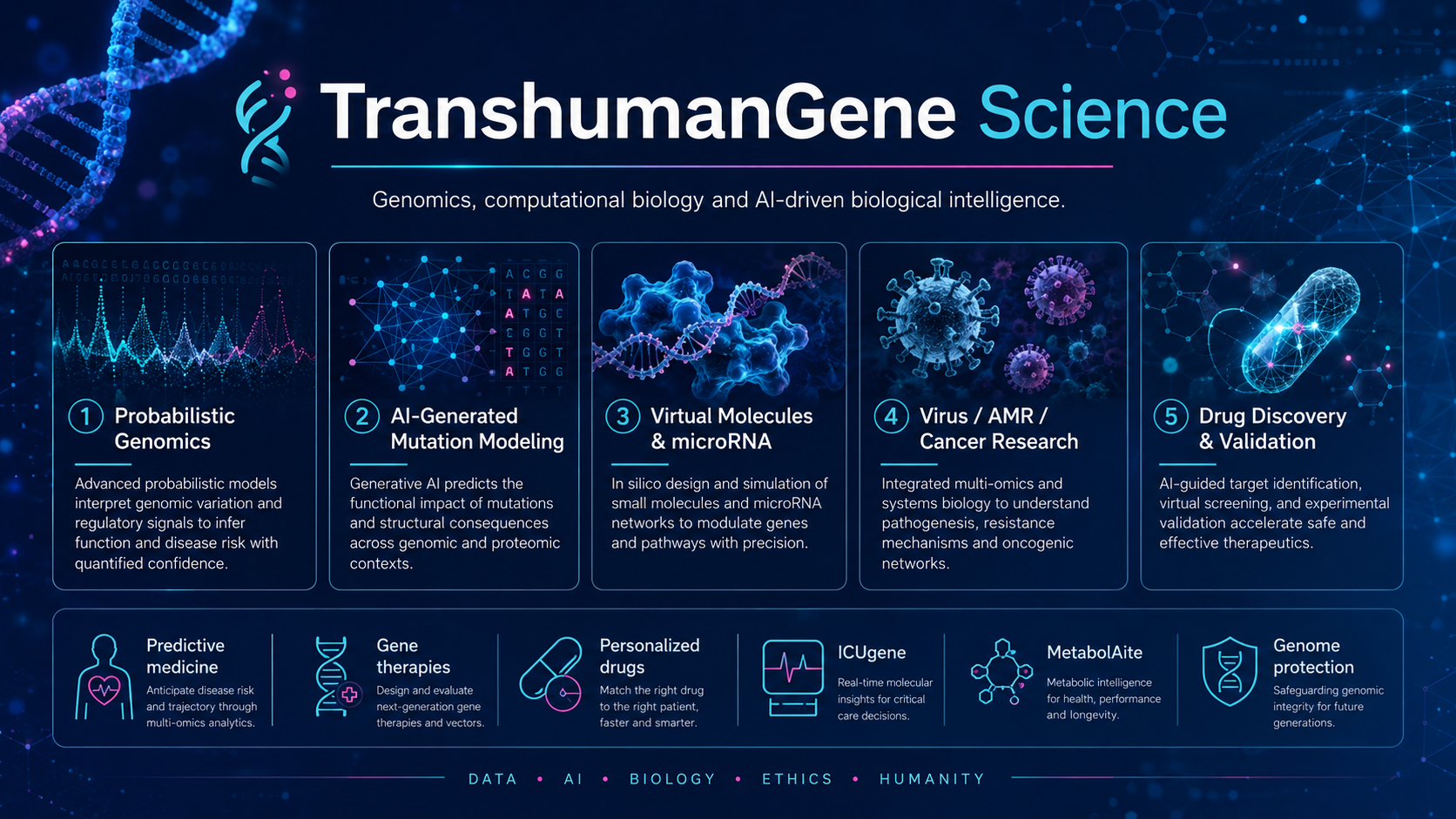
TranshumanGene is presented on Robotics as a computational bioscience program centered on probabilistic genomics, AI-assisted mutation modelling, virtual molecule generation and evidence-based validation pipelines. The material on this page has been rebuilt from the uploaded presentation “02 Science of TranshumanGene.pptx” and reorganized into a clearer scientific narrative.
Program focus
The core proposal is to reduce the time between genomic observation and actionable biomedical hypotheses. Instead of treating omics data as static archives, TranshumanGene frames them as computable substrates for simulation, ranking and laboratory follow-up. The program combines genomic normalization, mutation aggregation, virtual proteins, microRNA design and AI-guided candidate selection.
Probabilistic genomics
In the presentation, probabilistic genomics is described as the ability to generate, classify and compare large numbers of plausible mutations and biological responses. This enables systematic exploration of viruses, antimicrobial resistance, cancer biology, rare-disease variants and human-genome enhancement scenarios while maintaining a scientific distinction between in silico prediction and laboratory confirmation.
MUTANT and AI4OMICS
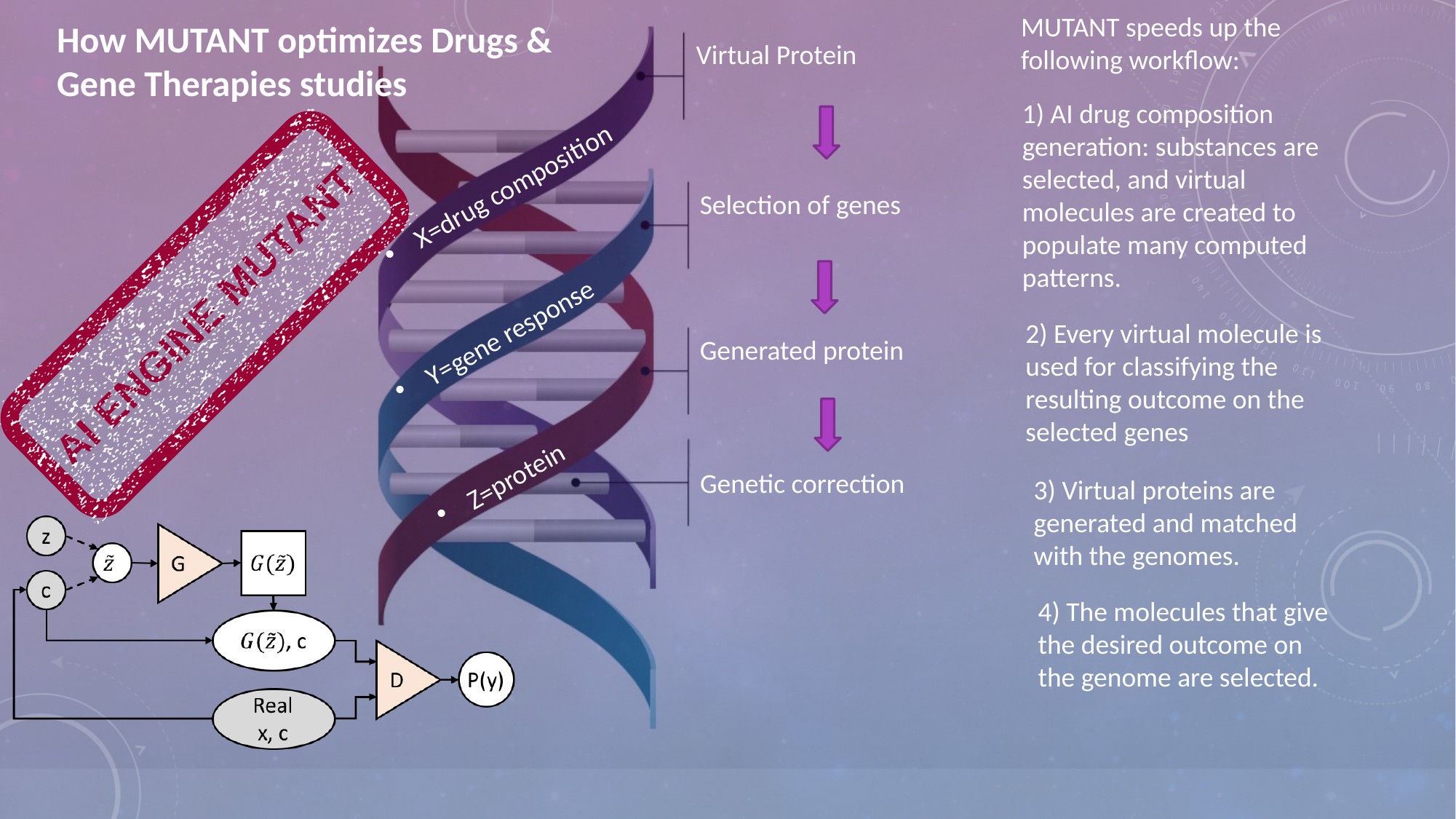
A central theme of the deck is the MUTANT engine, built on the earlier AI4OMICS direction. Its role is to normalize heterogeneous genomic datasets, simulate mutations, aggregate patterns, propose candidate molecules or gene-therapy paths, and check expected versus collateral effects. The objective is not to replace experimental science, but to improve prioritization, reproducibility and speed.
Scientific applications
The presentation highlights applications in drug and vaccine discovery, AMR analysis, cancer studies, protein-level reasoning, microRNA generation and public-health-oriented genomics. It also emphasizes that different populations require better calibrated genomic baselines, with specific mention of the need for broader representation in African genomic datasets.
Education and translational engineering
TranshumanGene is also connected to the OPENAIMED bio-digital engineering syllabus. In this framing, bioscience, AI, data engineering, supercomputing and ethical review are taught together so research teams can move from sequencing and simulation to validation, quality control and deployment-ready biomedical workflows.
What is added on Robotics
To make the project easier to navigate, Robotics now includes dedicated pages for the program architecture, the MUTANT pipeline, and the educational/translation layer. These pages do not duplicate the presentation verbatim: they reorganize its concepts into a web-readable structure while keeping the original scientific themes intact.