
OMIXOS byMaurizio Viviani Transhumangene
AQUA VITAQUE
+1 (650) 764-1430
PART I: Water Purification Technology in the Fight Against Antimicrobial Resistance
Abstract
Introduction
Materials and Editorial methods
Results
Discussion
Conclusion
Improving the Omixos System
Abstract
The increasing prevalence of antimicrobial-resistant bacteria in water sources poses significant health risks and environmental integrity risks
The Omixos system introduces a groundbreaking approach to detect, analyze, and selectively neutralize antimicrobial-resistant bacteria and their potential mutations while removing residual antibiotics from water systems
This paper details the Omixos technology and discusses its potential to transform water purification practices by integrating advanced genomics, probabilistic modeling, and AI-driven analytics
Introduction
Importance of addressing waterborne antimicrobial resistance
Brief overview of current technologies and their limitations in detecting and neutralizing resistant bacterial strains
Introduction to the Omixos system: a synopsis from concept to technology using program materials 1-69 as a foundation
Materials and Editorial methods
Description of the Omixos system components and operational phases
Detailed explanation of the system's core capabilities: detecting bacteria and antibiotics, predicting bacterial mutations, and deploying targeted chemical treatments
Technical description of the AI and genomic technologies employed to predict and combat potential super-bacteria formation
Results
Case studies or simulated results showcasing the system's effectiveness in identifying and neutralizing target bacteria and their mutations
Comparative analysis of water quality before and after treatment with Omixos
Discussion of the system's efficacy in removing antibiotics from water to prevent downstream impacts on human health and biodiversity
Discussion
Analysis of the Omixos system's advantages over traditional water purification and AMR management strategies
Potential challenges and limitations in deploying the Omixos system at scale
Future implications for public health, environmental policy, and water management practices
Conclusion
Summarization of the Omixos system's contributions to modern water purification technologies
Reflection on the system's role in global efforts to combat AMR
Call for further research and development to enhance the system's capabilities and integration into existing infrastructure
Improving the Omixos System:
Scalability and Adaptation: Explore technologies that can scale the system for use in various environmental conditions and different scales of water systems, from rural to urban
Integration with Renewable Energy: To reduce operational costs and increase sustainability, integrating renewable energy sources could be explored
Advanced AI Models: Implementing more sophisticated AI models that can learn from a broader dataset to enhance predictive accuracy and reduce false positives
Enhance Real-Time Data Processing: More robust real-time data analytics could improve pathogen identification and mutation prediction speed and accuracy
The OMIXOS consists of three cartridges, a tank, two pipe connectors, and a network system to transfer data
Each Cartridge performs a different task:
Biological analysis of the sled to detect DNA and RNA
Chemical Analysis to detect antibiotics
Resolution tank that eliminates/precipitates chemicals and dangerous bacteria and organics
In the tank, detection and precipitation can be performed several times until the water is considered safe. Our AI models will make these processes more efficient
Detection and forecasting are the keys
Omixos System Manual
Introduction
System Overview
Detailed Operational Guidelines
AI and Machine Learning Framework
Implementation of Improvements
Maintenance and Troubleshooting
Case Studies and Applications
Future Directions
References
Introduction
The Omixos system represents a breakthrough in water purification technology, addressing the urgent need to effectively combat antimicrobial resistance (AMR)
It combines cutting-edge genomics, artificial intelligence (AI), and advanced chemistry to purify water and preemptively manage the risks associated with microbial mutations that lead to superbacteria
The increasing prevalence of antimicrobial resistance (AMR) poses significant global challenges to public health and environmental sustainability
Traditional water treatment systems often fail to address the complexity and dynamism of microbial ecosystems, particularly the evolution of super-bacteria capable of resisting conventional treatments
The Omixos system introduces a revolutionary approach to water purification that harnesses advanced technologies in genomics, artificial intelligence (AI), and chemistry to detect and neutralize AMR threats in water sources
Omixos aims to remove contaminants and prevent the formation and proliferation of AMR through predictive analytics and targeted chemical interventions
This system represents a paradigm shift in how water purification and microbial risk management are approached by integrating continuous monitoring, data-driven predictions, and precise treatment dispensations within a single framework
This holistic strategy ensures that water sources are safe for consumption and maintain ecological balance, preserving beneficial bacteria while eliminating harmful pathogens and pollutants
System Overview
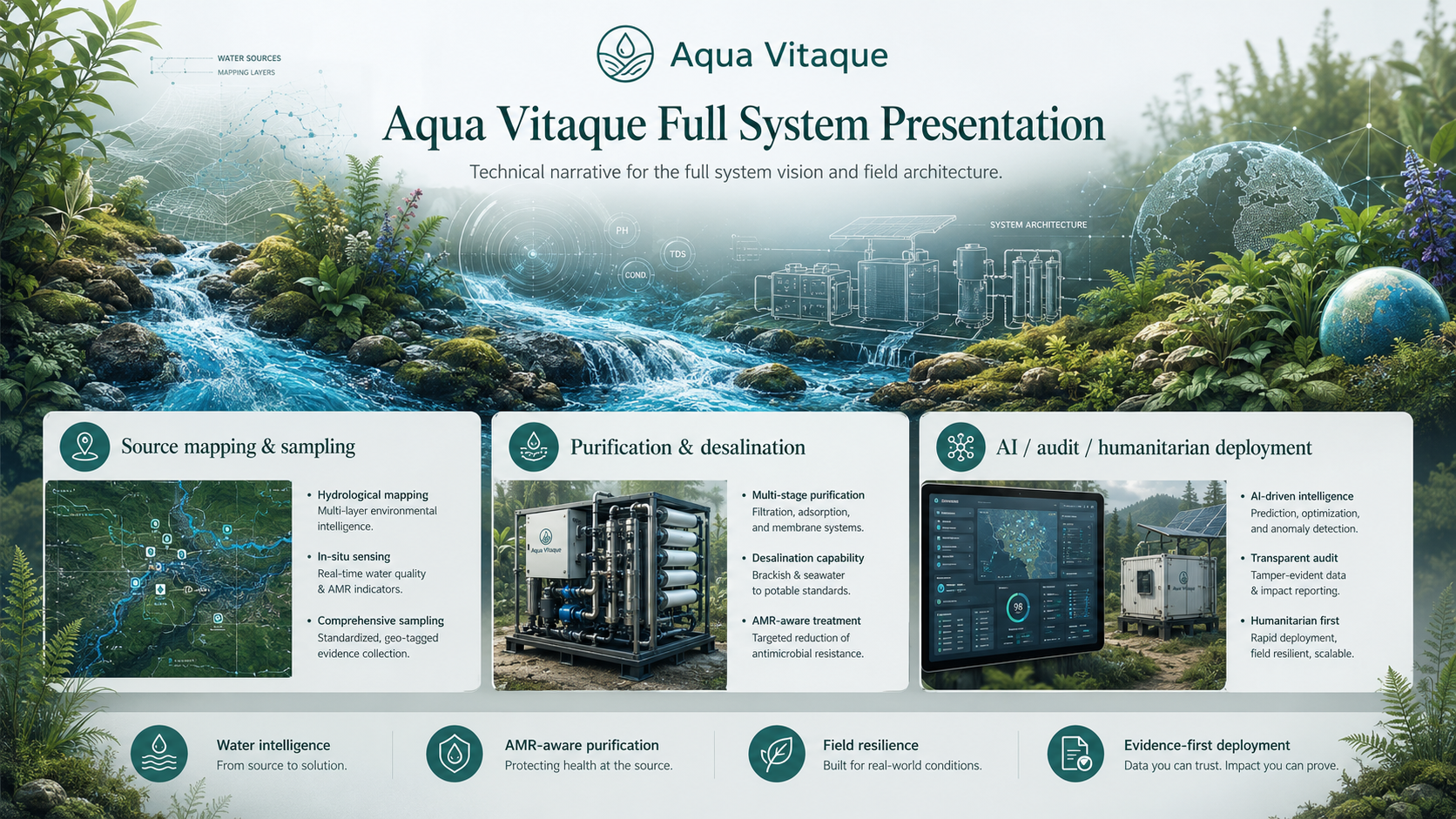
Omixos operates through integrated modules that detect contaminants, predict microbial mutations, and apply targeted treatments to eradicate pathogens and degrade harmful chemicals like antibiotics in water sources
The Omixos system is designed as an integrative solution comprising several interconnected modules that seamlessly provide real-time water analysis and treatment
The system's architecture is built around a central AI analytics platform that receives data from distributed sensor networks deployed across the water supply chain
These sensors are equipped with the latest bio-detection technology, capable of accurately identifying microbial DNA and chemical signatures
Once data is collected, it is transmitted to the AI platform, where advanced algorithms assess the quality of the incoming data, filter out noise, and standardize the data for further analysis
The AI then applies machine learning models to identify known pathogens, predict potential mutation pathways that could lead to AMR, and determine the presence of antibiotic compounds
Based on this comprehensive analysis, the system calculates the optimal mix and concentration of treatment agents required to neutralize the detected threats effectively
Detailed Operational Guidelines
Sensor Deployment
Deploy sensors at strategic points within the water supply chain. These sensors are designed to detect bacterial DNA and antibiotic residues using fluorescence and spectroscopy-based methods
Strategic deployment of sensors is crucial for effectively monitoring water quality across various points in the supply chain
Sensors should be placed at upstream locations to detect contaminants early and at critical junctures within the distribution network to monitor water quality as it moves toward consumption points
This distributed sensor network allows for a granular understanding of water quality dynamics and provides the data necessary for proactive management
Data Collection and Analysis
Data collected by sensors are transmitted in real time to the central Omixos AI platform. The platform performs initial data cleansing and normalization to prepare for detailed analysis
Sensor data are transmitted to the Omixos central system in real-time via secure networks
The data undergoes rigorous preprocessing to ensure accuracy, involving normalization and cleansing processes that remove irrelevant or corrupt data, enhancing the reliability of subsequent analyses
Bacteria and Antibiotics Detection
Utilizing machine learning models, the system identifies known bacterial strains and antibiotic signatures from the normalized sensor data, classifying each according to its potential health impact
The system uses refined genomic sequencing techniques and spectral analysis to identify bacterial strains and antibiotic residues
This dual-detection capability allows for a comprehensive understanding of the microbial and chemical landscape of the water, which is critical for effective treatment and prevention strategies
Predictive Models for Mutations
Omixos employs probabilistic genomics to predict possible mutations that could transform existing bacteria into superbacteria. This model uses historical mutation data, current environmental factors, and ongoing epidemiological insights
Utilizing historical and real-time data, the Omixos AI develops probabilistic models that predict how bacterial strains could evolve into superbacteria
These models consider various factors, including genetic predisposition, local water conditions, and known mutation pathways, providing a predictive outlook on potential future threats
Deployment of Treatment Agents
Based on the AI's recommendations, specific antimicrobial and chemical agents are mixed in precise dosages to target detected bacteria and their potential mutations without affecting the microbial flora necessary for ecological balance
Upon identifying the threats and predicting potential future risks, the system calculates and dispenses a customized cocktail of antimicrobial and chemical agents
This targeted approach ensures that only necessary chemicals are used, minimizing environmental impact and preventing the treatment process from contributing to AMR
AI and Machine Learning Framework
The core of the Omixos system is its advanced AI and machine learning framework, designed to learn and adapt continuously from incoming data
The AI model is trained on vast datasets encompassing various microbial genomes and antibiotic resistance profiles
This training enables the system to recognize and respond to multiple pathogens and contamination scenarios
Training the AI Model
Train the AI using a vast database of genomic sequences, mutation records, and outcomes of various treatment methods. Continuous learning algorithms adjust the predictive models based on new data and outcomes
The training process involves both supervised learning from labeled data and unsupervised learning to identify patterns not previously encountered
The AI models are rigorously validated against independent datasets to ensure accuracy and robustness
Predictive Accuracy and Model Updates
Evaluate the model's accuracy regularly by comparing predicted and actual outcomes, using these insights to continually refine and update the models
The AI models are regularly updated with new data and insights from ongoing operations and scientific research to maintain high predictive accuracy
This iterative learning process allows the system to stay ahead of evolving AMR patterns and adapt to new challenges
Implementation of Improvements
Real-Time Processing Enhancements
Upgrade computational infrastructure to enhance the speed and efficiency of real-time data processing and reduce the latency between detection and treatment
Omixos takes a step further in data processing with the integration of edge computing technologies into its sensor networks
This enhancement allows data processing at or near the data source, reducing latency and enabling faster response times
The practical implication of this is that the system can detect and respond to water contamination in real-time, significantly improving the efficiency and effectiveness of the purification process
Scalability Solutions
Develop modular system components that can be easily integrated into different sizes and types of water treatment facilities, from small community systems to large municipal plants
As the demand for clean water escalates globally, the scalability of water purification systems becomes crucial. The Omixos system is designed with scalability at its core, using modular components that can be adapted for different sizes and types of water treatment facilities. These modules can be easily integrated into existing infrastructures or configured as standalone systems for more remote or underserved areas
To ensure seamless scalability, the system architecture supports cloud-based data management and AI processing, allowing the central system to coordinate multiple installations across various geographies without losing performance or efficiency. Additionally, using standardized components and interfaces simplifies maintenance and upgrades, enhancing the system's scalability
Integration with Renewable Energy
Design system components powered by renewable energy sources, such as solar panels, to decrease operational costs and increase sustainability
Integrating renewable energy into the Omixos system addresses environmental sustainability and operational cost-efficiency. By designing the system's components to be powered by solar, wind, or hydroelectric energy, Omixos can reduce its dependence on conventional power supplies and minimize its carbon footprint.
Photovoltaic panels and small wind turbines can be installed at treatment facilities to provide a direct power supply or to charge battery storage systems that support 24/7 operations. This ensures the system remains operational in areas with unreliable power infrastructure and aligns with global efforts toward greener technologies
Advanced AI Predictive Models
Implement deep learning and neural networks to enhance the system's predictive capability, particularly in identifying and reacting to novel bacterial strains
Advancements in AI and machine learning are continually leveraged to enhance the predictive capabilities of the Omixos system. By incorporating deep learning and neural network algorithms, the system can improve its analysis of complex datasets, leading to more accurate predictions of bacterial behavior and resistance patterns
These models are trained on a broader range of data, including genomic information from global databases and real-time environmental factors, to predict better how bacteria might evolve. Furthermore, implementing reinforcement learning could allow the system to dynamically adjust its operational strategies based on feedback from its effectiveness in real-world scenarios, continuously optimizing its performance
Maintenance and Troubleshooting
Provide detailed procedures for regular maintenance checks, troubleshooting common issues, and guidelines for emergency responses
Ongoing maintenance and timely troubleshooting are essential for the sustained operation of the Omixos system. Operators are provided with a detailed maintenance schedule that includes daily, weekly, and monthly checks to ensure that sensors and other critical components function correctly
The system software includes diagnostic tools that automatically detect and report faults or inefficiencies, prompting preventive maintenance or repairs. A 24/7 support line and a network of trained technicians can assist with more complex issues, ensuring minimal downtime and consistent water purification performance
Case Studies and Applications
Document several use cases where Omixos has successfully identified and mitigated AMR threats, detailing the operational settings, challenges faced, and outcomes
Several case studies illustrate the effectiveness of the Omixos system. For instance, in Milan, Italy, the system successfully identified and neutralized a developing strain of E. coli resistant to traditional treatment methods
Another application in a rural community in India demonstrated the system's ability to operate efficiently with solar power while significantly reducing incidents of waterborne illnesses
These examples showcase the system's versatility across different environmental and operational contexts and its impact on enhancing public health and ecological conditions
Future Directions
Discuss potential technological advancements, upcoming features, and strategic partnerships that could enhance the Omixos system's capabilities
The future development of the Omixos system is poised to revolutionize pathogen detection. Enhanced sensor technologies will enable us to identify pathogens at the single-cell level, a once unimaginable capability
This breakthrough could significantly improve our ability to combat AMR and other waterborne diseases, instilling a sense of optimism in our stakeholders
The development of the Omixos system is supported by extensive research and collaboration with leading experts in microbiology, water treatment, and AI
References and further readings include publications in journals such as Water Research, Journal of Antimicrobial Chemotherapy, and AI in Healthcare
These sources provide foundational knowledge and ongoing insights into the technologies and methodologies integrated within the Omixos system, ensuring it remains at the forefront of scientific and technological advancements in water purification and AMR management
DESALINATION
Integrating Green Desalination into the Omixos System
Incorporating a sustainable desalination module into the Omixos system addresses two pressing challenges: the global scarcity of fresh water and the environmental concerns associated with traditional desalination methods, such as the generation of brine waste that can harm marine ecosystems
This integration aims to create a holistic water treatment solution that purifies and disinfects water and efficiently converts seawater into potable water without the adverse byproducts typical of conventional desalination processes
Design of the Green Desalination Module
The innovative desalination module for the Omixos system utilizes a combination of forward osmosis (FO) and membrane distillation (MD) technologies enhanced with solar thermal energy
This design minimizes energy consumption and eliminates the production of toxic brine residues
Forward Osmosis (FO) Stage
This initial stage draws seawater across a semi-permeable membrane towards a higher concentration draw solution
Unlike reverse osmosis, which requires high pressure, FO operates under minimal pressure differentials, significantly reducing energy demands
The draw solution, typically consisting of a benign concentrated salt solution, is engineered to be reusable and easily detachable from the freshwater produced
Technical Aspects
Membrane Selection: High-flux, low-fouling membranes ensure efficient water transport and prolonged operational durability
Draw Solution: The composition of the draw solution is critical. It should have high osmotic pressure yet be non-toxic and easy to regenerate using low-energy processes
Membrane Distillation (MD) Stage
Following FO, the diluted draw solution undergoes membrane distillation, where heat (ideally sourced from solar thermal panels) evaporates water through a hydrophobic membrane
This stage recovers and concentrates the draw solution while producing high-purity distilled water
Technical Aspects
Heat Source: Integration with solar thermal panels to supply the required heat, enhancing the system's sustainability
Membrane Technology: Hydrophobic membranes that repel the liquid phase but allow vapor to pass through, ensuring efficient separation and high water recovery rates
Energy and Waste Management
Solar energy drives the thermal processes required for MD, supplemented by photovoltaic cells to power other system components, ensuring the entire operation is renewable-powered
The innovative aspect of this integrated system is the management of the byproducts
Brine Concentration
Instead of discharging highly concentrated brine, the system recovers salts through crystallization processes, which can be repurposed as raw materials for industrial use
Zero Liquid Discharge (ZLD)
Implementing ZLD techniques to ensure that all waste products are either reused or safely disposed of, thereby preventing environmental harm
Integration with Omixos System
The integration of this green desalination module into the existing Omixos system requires several adaptations
Data and Control Integration
Seamless integration of the desalination module's control system with the Omixos AI platform to ensure optimal performance and real-time adjustments based on predictive analyses
Process Synchronization
Coordinating the operation of the desalination module with the microbial and chemical treatment processes of the Omixos system to enhance overall efficiency and effectiveness
Monitoring and Maintenance
Expanding the existing sensor network to monitor the desalination process's performance, detecting potential issues such as membrane fouling or efficiency drops
Conclusion
Adding a green desalination module represents a significant advancement for the Omixos system, transforming it into a more comprehensive solution for water scarcity by combining water purification and desalination
This integration addresses the need for fresh water in regions affected by scarcity and does so in an environmentally sustainable manner that aligns with global sustainability goals
This enhancement ensures that the Omixos system remains at the forefront of technology in water treatment, offering a scalable, effective, and green solution to water-related challenges worldwide
Forward Osmosis (FO) Stage in the Omixos System
The Forward Osmosis (FO) stage is a crucial component of the integrated green desalination module within the Omixos system, designed to efficiently and sustainably convert seawater into potable water
This section delves into the technical details of the FO stage, explaining its operation, the selection of materials, and the system configuration
Operational Principle
Forward Osmosis: A Unique Water Purification Process. Unlike other methods that require high pressure, Forward Osmosis uses a semi-permeable membrane to facilitate the natural diffusion of water from a less concentrated solution (in this case, seawater) to a more focused draw solution across the membrane
This reliance on the osmotic pressure gradient between the two solutions drives water transfer, resulting in lower energy requirements and reduced mechanical stress on the system
Key Components and Design
Semi-Permeable Membrane:
Material: The membranes used in FO are typically made from thin-film composite materials that provide high water flux and low solute passage. These membranes are engineered to resist fouling and chlorine damage, extending their operational lifespan and efficiency
Pore Size: The membrane's pore size is crucial; it must be small enough to prevent the passage of salts and other contaminants while allowing the free flow of water molecules
Key Components and Design
Draw Solution:
Composition: The draw solution is typically a high osmotic pressure solution such as magnesium or sodium chloride. It is specifically chosen for its ability to be easily removed in subsequent processing stages (such as the Membrane Distillation stage)
Regeneration: The draw solution is recirculated within the system. After it collects water from the seawater, it moves to the MD stage, where water is extracted as clean vapor, and the draw solution is reconcentrated for reuse
Process Flow
Seawater Intake:
Seawater is pre-filtered to remove particulates and large contaminants before entering the FO module
This pre-treatment is vital for protecting the membrane's integrity
Osmotic Filtration
Seawater is then introduced to one side of the FO membrane, and the draw solution is circulated on the opposite side
The osmotic gradient causes water molecules to naturally migrate from the seawater (low solute concentration) to the draw solution (high solute concentration), pulling purified water through the membrane
Flow Management
The seawater and draw solution flow rates are carefully controlled to maximize water extraction efficiency while minimizing the potential for membrane fouling
Cross-flow filtration dynamics are often used to reduce the fouling potential further
Energy Efficiency and Sustainability
Energy Use:
The primary energy requirement for the FO stage comes from the pumping systems that circulate the draw solution and seawater
Because the osmotic pressure difference drives the filtration, the energy requirements are significantly lower than those for pressure-driven processes like reverse osmosis
Environmental Impact
The FO stage of the Omixos system is designed to operate with minimal environmental impact
Using a benign draw solution and the system's ability to operate at lower pressures reduce the risk of membrane damage and extend the system's operational life, thereby decreasing waste
System Integration and Monitoring
Integration:
The FO stage is fully integrated with the AI management system of the Omixos platform, which monitors and adjusts flow rates, pressure levels, and the concentration of the draw solution in real-time to optimize performance
Monitoring
Sensors integrated into the FO module provide continuous feedback on water quality, flow rates, and osmotic pressure levels, ensuring the system operates within optimal parameters and quickly identifies maintenance issues
The Forward Osmosis stage of the Omixos system exemplifies a sophisticated approach to sustainable water treatment
It leverages natural osmotic forces to achieve efficient desalination without the high energy costs and environmental burdens associated with traditional methods
This stage is a cornerstone in the system's ability to provide clean, safe drinking water that is sustainable and eco-friendly
Membrane Distillation (MD) Stage in the Omixos System
The Membrane Distillation (MD) stage is an integral component of the integrated green desalination module within the Omixos system
It is designed to purify the water extracted further during the Forward Osmosis (FO) stage
This section provides a detailed technical overview of the MD stage, focusing on its operational principles, system configuration, materials used, and role in achieving zero liquid discharge (ZLD)
Operational Principle
Membrane Distillation (MD) is a thermally driven separation process in which only vapor molecules transfer through a hydrophobic membrane
The driving force behind MD is the vapor pressure gradient created by different temperatures on either side of the membrane. In the context of the Omixos system, the MD stage is employed to distill the water from the diluted draw solution obtained from the FO stage, thereby recovering both the purified water and reconcentrating the draw solution for reuse
Key Components and Design
Hydrophobic Membranes
Material: The membranes used in MD are made from hydrophobic materials, such as polytetrafluoroethylene (PTFE) or polypropylene, which prevent liquid water from passing through but allow water vapor to permeate
Pore Size: These membranes typically have a pore size ranging from 0.2 to 0.5 micrometers, which is optimal for preventing liquid passage while facilitating vapor flux
Temperature Control
Heating System: A solar thermal system is utilized to heat the diluted draw solution on one side of the membrane, creating a high vapor pressure
Cooling System: The other side of the membrane, where the distillate (purified water) collects, is kept at a lower temperature to condense the vapor back into liquid form
Process Flow
Heating the Draw Solution
The diluted draw solution from the FO stage is heated using solar thermal energy
This heating elevates water vapor pressure in the solution, driving the vapor through the membrane
Vapor Transmission
As vapor passes through the hydrophobic membrane, salts, and other non-volatile components are left behind
This step effectively separates pure water vapor from the draw solution
Condensation
The water vapor condenses on the cooler side of the membrane, forming distilled water that is collected as the product water
Reconcentration
Simultaneously, the draw solution becomes reconcentrated as water is removed, allowing it to be recycled back into the FO stage
Energy Efficiency and Sustainability
Thermal Efficiency:
Using solar thermal energy to drive the MD process significantly reduces the dependency on electrical power, enhancing the system's sustainability
Waste Heat Utilization:
The Omixos system is designed to utilize waste heat from other industrial processes further to enhance the MD stage's thermal efficiency
Environmental Impact
Zero Liquid Discharge (ZLD):
By recovering nearly all the water as distillate and reconcentrating the draw solution, the MD stage contributes to the Omixos system's goal of achieving ZLD, thereby eliminating the discharge of harmful brine into the environment
Salt and Mineral Recovery
The salts and minerals concentrated in the remaining draw solution can be harvested as byproducts, potentially providing a source of raw materials for various industrial applications
System Integration and Monitoring
Integration with FO Stage
The MD stage is seamlessly integrated with the FO stage, ensuring that the flow rates, temperatures, and concentrations are optimally managed to maximize efficiency and water recovery
Real-Time Monitoring
Sensors integrated into the MD module monitor temperature, vapor pressure, and flow rates to ensure the process operates within specified parameters
This data is fed into the Omixos AI platform, which continuously analyzes and adjusts real-time process variables to optimize performance
The MD stage of the Omixos system exemplifies an innovative approach to sustainable water purification
It leverages solar energy and advanced membrane technology to produce high-purity water without generating waste
This stage enhances the efficiency of the water purification process and supports the system's environmental sustainability goals by moving towards zero liquid discharge
Energy and Waste Management in the Omixos System
The Energy and Waste Management component of the Omixos system is crucial for ensuring the sustainability and environmental friendliness of the integrated green desalination module
This section delves into the technical details of how the system manages its energy requirements and waste products, emphasizing efficiency, reuse, and minimal environmental impact
Energy Management
Energy Sources
Solar Power:
Solar power is the primary energy for the Omixos system. Solar photovoltaic (PV) panels generate electricity that powers the system's pumps, sensors, and electronic control systems
Additionally, solar thermal collectors are explicitly employed in the Membrane Distillation (MD) stage to provide the thermal energy needed to heat the draw solution
Waste Heat Utilization
Where available, waste heat from nearby industrial processes is captured and used to supplement the heating requirements of the MD stage
This not only improves the system's overall energy efficiency but also helps reduce the carbon footprint of industrial operations by utilizing their by-product heat
Energy Efficiency Measures
Energy Recovery Devices
In stages where high-pressure pumps are required, such as in the initial feed of seawater, energy recovery devices are implemented to recycle energy from the system's process flows, reducing overall energy consumption
Automated Energy Management
The system's AI platform optimizes energy use by continuously monitoring consumption and adjusting operational parameters in real-time to ensure energy is used most efficiently
Waste ManagementZero Liquid Discharge (ZLD) Approach
Brine Management:
Traditional desalination processes often produce brine as a by-product, which can be harmful if released into the environment. In the Omixos system, the MD stage concentrates the draw solution, which is treated further to extract usable salts and minerals
The goal is to achieve zero liquid discharge, where every component of the waste is either reused or safely disposed of
Solid Waste Utilization
The salts and other minerals recovered from the brine are processed for industrial applications, such as chemical manufacturing or as raw materials in construction, thereby converting potential waste into valuable resources
Chemical Waste Minimization
Selective Chemical Use:
The system uses chemicals for treating water only when necessary and in exact amounts needed, calculated by the AI based on real-time water quality data. This precision dosing reduces the amount of chemical waste produced
Chemical Recycling:
Where possible, chemicals used in the purification process are recovered and recycled within the system. For instance, acids or bases that adjust pH are neutralized and reused
Environmental Impact Reduction
Eco-Friendly Operational Practices:
Sustainable Material Use:
All components of the Omixos system, including membranes and filters, are selected based on sustainability criteria, favoring materials that are durable, recyclable, and have a minimal environmental footprint
Lifecycle Assessment:
Regular lifecycle assessments evaluate the system's environmental impact throughout its operational life, leading to continuous improvements in system design and operation
Monitoring and Compliance
Environmental Monitoring:
Continuous monitoring of the system's environmental impact, including emissions, energy use, and waste production, ensures compliance with local and international environmental standards
Regulatory Adherence:
The system is designed to meet or exceed all applicable environmental regulations, ensuring its operation contributes positively to environmental sustainability goals
The Energy and Waste Management strategies embedded within the Omixos system highlight its commitment to operational efficiency and environmental stewardship
By integrating advanced technologies and thoughtful design, the system not only provides an effective solution for water purification and desalination but does so in a manner that respects and protects the natural environment
Integration with Omixos System
Integrating the various components within the Omixos system-spanning forward osmosis (FO), membrane distillation (MD), and the innovative energy and waste management modules-is crucial for ensuring seamless operation, high efficiency, and optimal performance
This section details the technical strategies and mechanisms employed to achieve effective system integration, highlighting the coordination of operations, data flow, and management protocols
System Components and Integration Points
Modular Design:
The Omixos system is designed modularly, where each component (FO, MD, energy systems, etc.) functions as a standalone unit and as part of a more extensive integrated system
This modular approach allows for flexibility in installation and scalability, catering to different sizes and types of water treatment requirements
Control System Integration:
A centralized control system powered by advanced AI and machine learning algorithms orchestrates the operations of all modules
This system manages the flow rates, temperatures, chemical dosages, and energy consumption, ensuring that each module operates in sync with others for optimal water purification and energy efficiency
Data and Control Flow
Real-Time Data Exchange:
Sensors throughout the Omixos system collect data on water quality, flow rates, temperature, energy usage, and chemical levels
This data is transmitted in real-time to the central AI platform, which processes and analyzes it to make informed decisions about system operations
AI-Driven Decision Making:
The AI platform utilizes predictive analytics to forecast system needs and potential issues. Based on these predictions, it dynamically adjusts operational parameters across modules
For example, if the AI predicts an increase in the concentration of contaminants, it can preemptively adjust the FO and MD processes to handle this change
Operational Coordination
Coordinated Process Flows:
The FO and MD stages are tightly integrated to ensure that the water and draw solutions flow optimally between them
The FO module's output directly feeds into the MD module, where further purification and solute concentration occur with minimal time delay or loss of efficiency
Feedback Mechanisms:
Feedback loops are established between all system components. For instance, if the MD module experiences a drop in efficiency, possibly due to scaling or fouling, this information is immediately relayed to the FO module to adjust the feed water quality or flow rate
Energy and Resource Optimization
Energy Management Integration:
The AI platform manages integrating solar energy systems and waste heat recovery. It optimizes energy use based on real-time data from the energy production and consumption modules
This ensures that the system uses the minimum necessary energy, switching between energy sources based on availability and cost-efficiency
Waste Management Coordination:
Waste outputs from the MD process, such as concentrated brine, are managed to minimize environmental impact
The system's AI assesses the best use of these outputs, whether directing them to mineral recovery systems or controlling them through environmentally safe disposal processes
System Maintenance and Upgrades
Predictive Maintenance:
The integration also extends to maintenance operations. The AI system continuously monitors the health and performance of all components, predicting when maintenance is required
This predictive maintenance helps minimize downtime and extend the lifespan of system components
Seamless Upgrades:
As new technologies or improvements become available, the system is designed to allow for seamless upgrades
Integration protocols include standardized interfaces and software compatibility checks, ensuring new components can be integrated without disrupting existing operations
The comprehensive integration strategy within the Omixos system enhances the functionality and efficiency of each component and ensures that the system operates more effectively and sustainably
This integration is vital for the system's robustness in addressing complex water treatment and antimicrobial resistance management challenges
Reverse Osmosis in the Omixos System Dual Desalination Approach:
Complementing Existing Editorial methods:
Reverse Osmosis could be integrated as a parallel desalination method alongside the existing Forward Osmosis (FO) and Membrane Distillation (MD) stages
This would offer a dual approach where RO can be used for its efficiency in salt rejection and high throughput, while FO and MD can be applied for their energy efficiency and minimal environmental impact
Optimal Resource Utilization:
The RO module can specifically handle high-volume water streams that require significant desalination, while FO and MD can be reserved for treating the brine or more concentrated solutions, optimizing the overall energy usage and treatment efficacy
Improved Water Recovery
High Recovery Rates:
RO systems are known for their ability to achieve high recovery rates of purified water from saline sources
Incorporating RO into Omixos could enhance the system's capacity to generate more potable water from seawater or brackish water sources, which is particularly beneficial in regions experiencing severe water scarcity
Enhanced System Flexibility
Variable Salinity Management:
RO can be effectively used in scenarios where the salinity of the input water varies significantly
Integrating RO provides the Omixos system with greater flexibility to adjust to different feed water qualities and salinity levels without compromising the output water quality
Benefits of Introducing Reverse Osmosis
Increased Purification Capacity:
By adding RO, the Omixos system can handle a wider range of contaminants, including smaller ions and molecules that may not be fully retained by FO or MD. This is crucial for regions where water sources contain a diverse mix of chemical pollutants
Robust Contaminant Removal:
RO membranes are effective barriers to bacteria, viruses, salts, and other contaminants. This level of filtration can be particularly beneficial for providing safe drinking water that meets stringent health standards
Scalability and Adaptability:
RO systems are scalable and can be designed to handle different volumes from small-scale setups to large municipal plants. This adaptability makes it an excellent addition to the modular nature of the Omixos system
Technical Considerations for Implementation
Energy Consumption:
Although RO is energy-intensive compared to FO and MD, modern advances in membrane technology and energy recovery devices can mitigate some of the energy costs
Integrating these technologies within the Omixos system could help maintain overall energy efficiency
Brine Management:
The integration of RO will need to address the management of brine, which is more concentrated than the effluents from FO and MD
The Omixos system's existing focus on zero liquid discharge and waste minimization can be extended to incorporate sustainable brine management strategies, such as mineral recovery or brine treatment technologies
System Integration and Monitoring:
The introduction of RO will require adjustments in system control and monitoring to seamlessly integrate with the existing modules
The Omixos AI platform would need to be calibrated to manage and optimize the operations across different purification technologies
By incorporating Reverse Osmosis into the Omixos system, the overall effectiveness and scope of the system's water purification capabilities can be significantly enhanced
This addition would not only expand the system's operational flexibility but also strengthen its position as a comprehensive solution to global water treatment challenges
Conclusion: Enhancing the Omixos System with Green Desalination
Integrating the green desalination module into the Omixos system marks a pivotal enhancement, significantly broadening the system's capabilities and impact
This innovative addition addresses critical global challenges, offering a sustainable and technologically advanced solution to water scarcity issues that many regions face today
Below, we detail the transformative aspects of this development and its alignment with global sustainability goals
Comprehensive Water Solution
The inclusion of green desalination technology within the Omixos system extends its application from merely purifying water to generating potable water from seawater
This dual functionality makes the system uniquely comprehensive, as it can now serve a broader range of needs-from removing contaminants and pathogens in freshwater sources to providing a reliable supply of fresh water in areas where only seawater is available
Sustainability and Environmental Impact
The green desalination module employs forward osmosis (FO) and membrane distillation (MD) processes powered primarily by renewable energy sources, such as solar power
This approach significantly reduces the carbon footprint traditionally associated with desalination, which typically relies on high-energy-consuming reverse osmosis processes
Furthermore, the system's design towards achieving zero liquid discharge (ZLD) exemplifies a commitment to environmental stewardship
By minimizing waste and repurposing by-products, the Omixos system conserves natural resources and prevents the ecological degradation associated with the disposal of saline brine and chemical pollutants
Alignment with Global Sustainability Goals
Enhancing the Omixos system with green desalination technology directly supports several United Nations Sustainable Development Goals (SDGs), including Clean Water and Sanitation (SDG 6), Affordable and Clean Energy (SDG 7), and Responsible Consumption and Production (SDG 12)
By providing an efficient and environmentally friendly water purification and desalination solution, the Omixos system helps bridge the gap between technological advancement and ecological conservation, fostering sustainable development across various regions
Technological Leadership
Incorporating advanced FO and MD and RO techniques and AI-driven operation and energy management ensures that the Omixos system remains at the cutting edge of water treatment technology
The system's ability to predict and respond to changes in water quality and consumption needs places it ahead of traditional water treatment and desalination technologies in terms of efficiency and adaptability
Scalability and Global Application
The Omixos system's modular design, including its green desalination component, allows for scalable and flexible deployment
This adaptability makes it suitable for various scales of operation, from small, remote communities to large urban centers, and adaptable to different geographical and climatic conditions worldwide
Whether addressing acute water scarcity in arid regions or improving water quality in polluted watersheds, the Omixos system provides a scalable solution tailored to meet diverse global water needs
Conclusion
The strategic enhancement of the Omixos system with a green desalination module represents a significant step forward in addressing the intertwined challenges of water scarcity, environmental sustainability, and global health
By merging cutting-edge water purification technologies with sustainable desalination processes, the Omixos system sets a new standard for integrated water solutions, demonstrating that technological innovation can go hand-in-hand with environmental conservation
This development reinforces the system's position as a leader in water treatment technologies. It exemplifies a viable, scalable, and sustainable approach to solving one of the most pressing challenges of our time-ensuring access to clean water for all


