
What this page explains
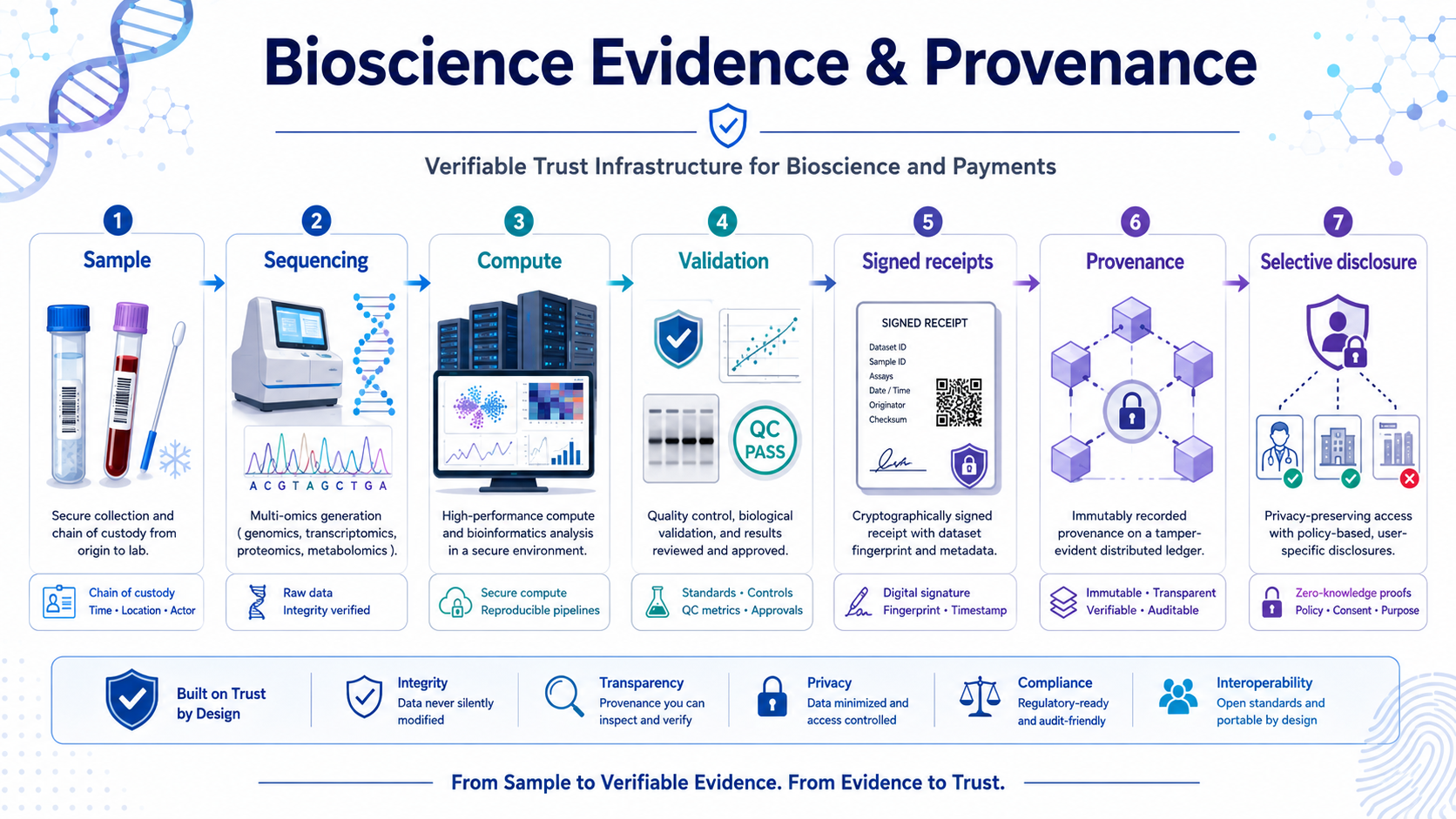
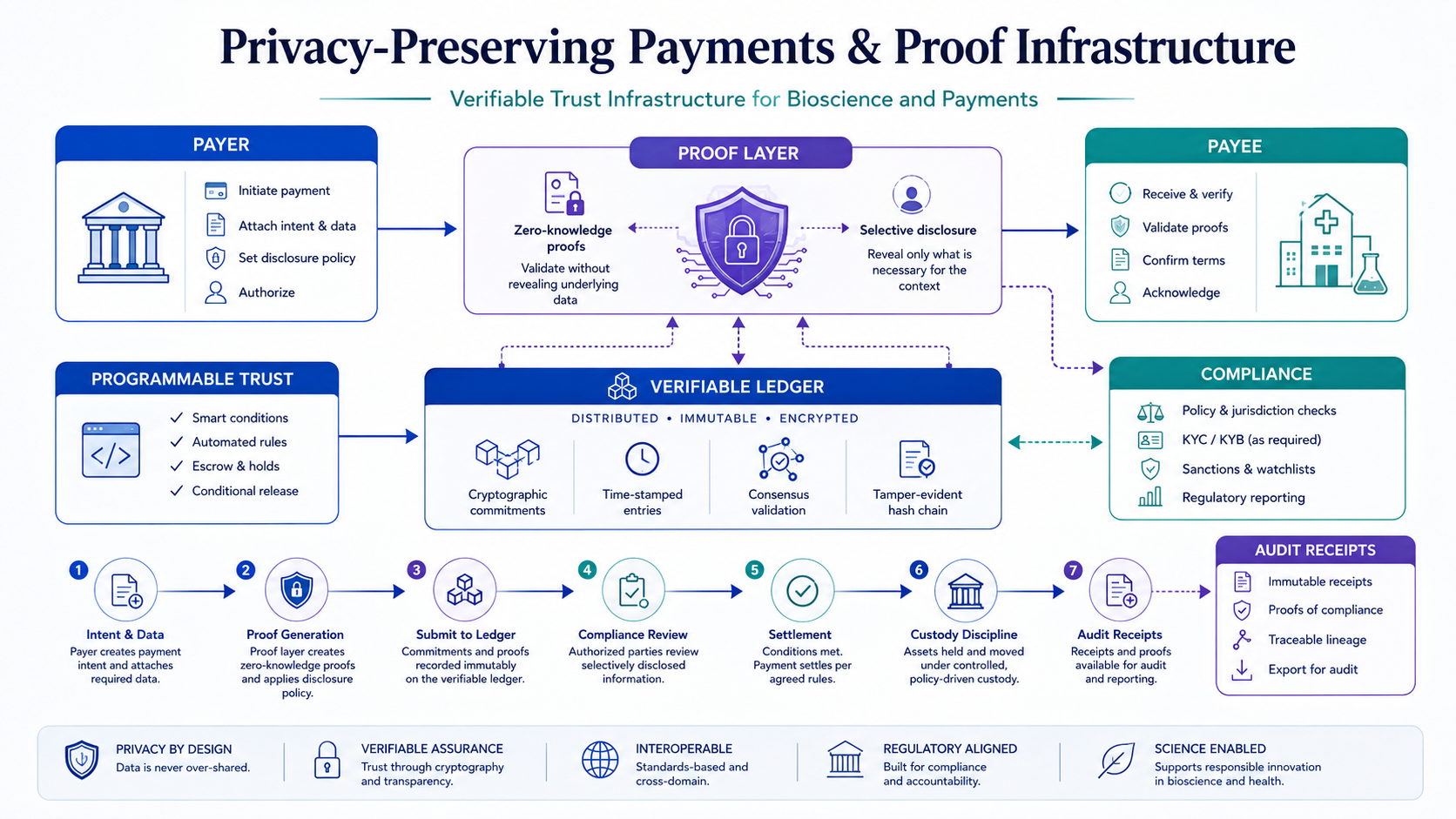
This research page brings together two domains that usually remain disconnected: bioscience evidence management and privacy-preserving digital payments. The common engineering problem is trust. In both cases, critical events must be recorded, verified, selectively disclosed and audited without weakening privacy or operational usability.
On the bioscience side, the infrastructure is designed to preserve provenance across samples, datasets, computational results and validation steps. A trustworthy scientific workflow needs to show where data came from, which process transformed it, which evidence supports a claim and who is authorized to inspect or reuse that evidence.
On the payments side, the same logic becomes proof infrastructure: transaction receipts, attestations, selective disclosure, identity controls and cryptographic audit trails. The goal is not surveillance, but high-assurance verification where a user or institution can prove that a payment event is valid while exposing only the information that is genuinely needed.
Together, these layers define a broader trust stack for Robotics: computation, provenance, privacy and proof. This is why the page matters strategically. It is not simply a manifesto about blockchain or bioscience; it is an architecture for making sensitive scientific and economic systems reliable under real operational conditions.
MAURIZIO VIVIANI
VERIFIABLE TRUST INFRASTRUCTURE
for Bioscience & Privacy-Preserving Payments
From Supercomputing & Genomics to Crypto-grade Proof Systems
A Scientific Autobiography & Technical Manifesto for Humanitarian-Grade Trust Infrastructures
Founder, CEO & Scientific/Technical Lead
info@robotics.it info@robotics.it info@robotics.it info@robotics.it
robotics.it • strongartificialintelligence.com • transhumangene.com • aquavitaque.com
Computer Scientist, AI, Robotics & Genomics Expert
DARPA-award-winning Scientist | Editor, Elsevier Scientific Press
Co-founder of FabLabs & Open-source Initiatives
Tel: US +1 (650) 764-1430
LinkedIn: https://linkedin.com/pub/maurizio-viviani/68/a60/4
Websites: robotics.it www.aquavitaque.com transhumangene.com www.strongartificialintelligence.com
World Economic Forum, Davos 2020: technology and governance in the same room.
Basel Life Panel: tokenizing medicine.
STRATEGIC PARTNER BRIEF - Read This First
If you are evaluating a team for a mission-critical trust product, focus on three things demonstrated across the chapters: (1) performance and reliability at supercomputing scale; (2) scientific rigor in bioscience and data integrity; (3) crypto-grade design: provenance, zero-knowledge proofs, and token economics as infrastructure.
What you can verify quickly
A consistent engineering stack: compute → evidence → provenance → privacy → incentives.
A track record of translating research into deployable systems, not just prototypes.
A methodology for tokenizing bioscience that treats consent, traceability, and auditability as first-class requirements.
Why this matters for high-stakes products
High-impact networks fail when any layer is weak: model quality without provenance, cryptography without UX, tokens without governance, or bioscience without ethics. The goal here is an integrated stack that remains robust under real-world adversaries, regulatory pressure, and operational constraints.
What we can build together
ONE THESIS, ONE STACK (Why the domains are not "too many")
Compute → deterministic, scalable execution (supercomputing-grade reliability).
Provenance → cryptographic chain-of-custody for data and decisions.
Private Proof → selective disclosure / zero-knowledge verification for sensitive information.
Economic Coordination → token economics as a security and incentive layer (not speculation).
This is the spine: one stack, repeatedly validated. The chapters are not separate projects; they are stress tests of the same trust architecture.
ARCHITECTURE AT A GLANCE (System boundary and integration points)
The architecture below summarizes the system boundary: what we engineer as verifiable infrastructure, and where we integrate with external rails and providers.
┌──────────────────────────── SYSTEM BOUNDARY: TRUST LAYER ────────────────────────────┐
│ │ │ │ │ │
│ │ │ │ ├─ Risk controls│
│ │ │ │ ├─ Rate limits │
│ └─ Device Attestation ┴─ Secure Enclave ┴─ Proof Objects ┴─ Audit events │
│ │
│ Provenance Ledger / Event Log ←────────── Attestations & Receipts ──────────────│
│ │ │
│ ├─ Token Economics Layer (anti-Sybil / incentives / slashing / governance) │
│ └─ Observability (telemetry, anomaly detection, dispute workflows) │
└─────────────────────── INTEGRATIONS (outside boundary) ─────────────────────────────┘
• Payment rails / settlement • Compliance & audit interfaces • Custody modes
This high-level view is intentionally implementation-agnostic: it clarifies the proof objects, event semantics, and security boundary that remain stable even when underlying rails or vendors change.
BUILD vs INTEGRATE vs PARTNER (Delivery framing)
Non-negotiable security invariants (must hold regardless of partner stack):
• ZK verification is always server-verified with deterministic test vectors and audit-friendly receipts.
• Tamper-evident provenance log with strict event schemas, replay protection, and time/nonce discipline.
• Rate limiting, anomaly detection, and anti-Sybil controls are enforced at policy boundaries.
• Key rotation + recovery procedures are specified and tested (no "magic admin keys").
SECURITY, PRIVACY & KEY MANAGEMENT POSTURE (Crypto-grade by design)
This work assumes adversaries from day one. Security is not a feature added later; it is the architecture itself.
Threat model: replay / injection, coercion, insider abuse, template extraction, correlation attacks, Sybil behavior, and fraud incentives.
Privacy posture: data minimization, unlinkability, selective disclosure, and proof-based authorization instead of raw data exposure.
Key management: hardware-backed keys where available; recovery modes (social / policy / custodial) designed as explicit, testable workflows.
Auditability: cryptographic receipts, event provenance, and dispute pathways with measurable observability.
The goal is not 'crypto correctness on paper' but production-grade resilience: clear assumptions, measurable controls, and verifiable artifacts that support audits and red-team thinking.
30/60/90-DAY DELIVERY PATH (What we ship, not what we promise)
A credible trust system is delivered as an engineering sequence: proofs first, then integration, then production posture. Below is a conservative delivery plan designed to produce verifiable milestones.
Verifiable outputs (what you can inspect):
• Threat Model v1 + explicit trust boundary diagram + attack assumptions.
• Key Management & Custody options brief (device keys, server keys, recovery) + key-rotation plan.
• ZK proof PoC: statement definition, verifier, test vectors, reproducible build steps.
• Baseline latency/throughput benchmarks + profiling notes for the prover/verifier path.
• Event schema v0 for provenance receipts (what is logged, signed, and audited).
• Acceptance criteria for PoC (pass/fail checklist).
Day 60 - Pilot Integration: hardened APIs, policy engine hooks, observability dashboards, key-recovery workflows, and a complete threat-model review with test cases.
Verifiable outputs (what you can inspect):
• Key Management Spec v1 (HSM/TEE options), recovery flows, and operational roles/RBAC.
• Policy engine & rate-limiting rules + anti-Sybil controls, with audit events and metrics.
• API/SDK draft + integration harness (sandbox + test fixtures).
• ZK circuit hardening: constraints review + deterministic test suite + negative tests.
• Benchmark report v2 (target TPS/latency) + scaling plan.
• Security review package v1 (privacy posture + data minimization + logging rules).
• Acceptance criteria for pilot integration (integration tests + security gates).
Day 90 - Production Readiness: security review package, adversarial testing, audit-ready event semantics, operational runbooks, and deployment architecture aligned with privacy and compliance constraints.
Verifiable outputs (what you can inspect):
• Production security posture: external review plan, pen-test scope, and remediation workflow.
• Runbooks (deployment, incident response, key compromise, disaster recovery).
• Monitoring/observability dashboards + anomaly alerts + dispute workflow.
• Load test + soak test results + capacity model for target deployments.
• Compliance/audit-ready artifacts: event semantics, evidence retention policy, and export formats.
• Acceptance criteria for production readiness (SLOs, key ceremonies, release checklist).
This plan is deliberately measurable: each phase produces artifacts that can be inspected, tested, and audited-not marketing claims.
NON-HYPE PLEDGE (Evidence over narrative)
This book does not ask for belief. It offers an engineering posture and a body of work that can be verified. Where a statement is factual, it is intended to be provable through documentation, references, or reproducible artifacts. Where a statement is visionary, it is labeled as direction-not as delivered capability. We treat token economics as security engineering, not speculation; and we treat privacy as a first-class constraint, not an afterthought.
CHAPTER 0 - ACKNOWLEDGEMENTS
This work is signed with my name, but it was never a solo journey.
Behind every page, every prototype, every model, and every hard technical decision, there is a senior team of exceptional people - scientists, engineers, and builders - whose expertise, discipline, and integrity made this mission possible. They are not supporting characters in a personal story; they are the mission team that turns vision into reality, especially when the goal is ambitious enough to matter: protecting life, strengthening trust, and engineering systems that can scale from bioscience to planetary resilience.
What I admire most is not only their world-class competence, but the way they show up: with rigor, responsibility, and an uncompromising work ethic. Everyone gives the maximum - full metal - when it counts: when complexity is high, stakes are real, and shortcuts would be tempting. With them, there are no shortcuts - only method, proof, and execution.
Together, we form a rare, coherent puzzle: supercomputing and AI at scale; cryptography and provenance; bioinformatics and multi-omics; systems engineering and field deployment. This is the foundation that enables what we are building next: a verifiable framework to tokenize bioscience - not as hype, but as scientific infrastructure - where value, integrity, consent, and traceability can be engineered with the same seriousness we apply to computation and biology.
To each member of this senior team - and to the many collaborators who join this journey - my deepest respect and gratitude. It is an honor to work alongside people of this caliber. If this book carries any force, it is because it carries your work.
CHAPTER 1: INTRODUCTION
1.1 - Tokenization as the Backbone of Trust
This chapter frames the core thesis of the book: tokenization is not a financial gimmick, but a rigorous method to represent real-world facts-identity, consent, ownership, actions, and outcomes-as verifiable digital objects. When combined with strong AI, cryptography, and privacy-preserving proofs, tokenization becomes trust infrastructure: it makes truth portable, auditable, and resilient to manipulation. This lens prepares the reader to see every domain explored in the book as a natural candidate for verifiable, composable value.
Maurizio Viviani applies his scientific expertise to develop life-saving solutions for communities affected by drought. Witnessing a rural village's struggle with water scarcity motivated him to dedicate his career to addressing critical human and environmental challenges. This chapter analyzes his community engagement and methodology, and explores the ethical and practical considerations involved in integrating scientific innovation with humanitarian objectives.
Astrophysical instrumentation: calibration, alignment, and signal integrity. (Hawaii high-energy physics space works)
Maurizio Viviani established a water purification unit adjacent to a drought-impacted stream, demonstrating the application of scientific methods to address immediate community needs.
Astrophysical instrumentation: calibration, alignment, and signal integrity. (Hawaii telescope alignment I worked at)
These cases illustrate diverse applications of science for societal benefit. Viviani distinguishes himself by effectively bridging theoretical knowledge with practical implementation to address challenges impacting both human populations and the environment.
He brings together quantum science and genomics to tackle challenging problems. For example, when studying waterborne diseases, he uses quantum computing to analyze the molecules and chemicals in water. At the same time, genomic sequencing helps identify and characterize the genetic material (DNA or RNA) of harmful pathogens. It's like using two complementary tools to get a clearer picture. Advanced data integration enables the simultaneous combination and analysis of chemical and genetic datasets, accelerating and improving pathogen detection through quantum-computing-based sequence comparison (Kösoglu-Kind et al., 2023). This approach demonstrates that combining quantum and genomic methods yields more effective solutions to complex problems.
Astrophysical instrumentation: calibration, alignment, and signal integrity. (Hawaii telescopes I worked at)
To elucidate the integration process and illustrate the translation of scientific knowledge into practical solutions, the workflow is structured as follows: it commences with interdisciplinary data collection, proceeds to targeted quantum modeling and genomic sequencing, and culminates in data integration for compatibility. Subsequently, bioinformatics specialists construct computational models to interpret the combined datasets. For example, in a recent water purification initiative, quantum modeling was used to characterize contaminant properties, which were then cross-referenced with genomic sequencing data to enable precise source identification and customized filtration. Continuous communication through meetings, workshops, and digital platforms supports synthesis and exemplifies Viviani's systematic workflow, which operationalizes theoretical concepts.
Maurizio Viviani's research in quantum science connects basic knowledge with real-world use. In genomics, he sequences DNA and analyzes data to determine how diseases or viruses spread in contaminated water. This helps him design water purification systems that fit local needs.
Human-rated systems: redundancy, telemetry, and failure-aware design. (Maurizio in Soyuz)
Maurizio Viviani combines artificial intelligence with water engineering to create better ways to manage and clean water.
He combines ecological science (the branch of biology that studies how organisms interact with their environments, focusing on relationships between living things and their surroundings) and robotics (the design, construction, and application of automated machines that can be programmed to carry out tasks) to develop innovative technologies that promote environmental health.
Human-rated systems: redundancy, telemetry, and failure-aware design. (Soyuz visit)
Maurizio Viviani's scientific identity is rooted in intellectual curiosity and a strong sense of responsibility. In Italy, the United Kingdom, and the United States, he gained knowledge of the universe through rigorous study and inquiry. However, practical experiences soon revealed the limits of theory alone.
As an Alpine officer and UN military observer, Maurizio Viviani witnessed communities without water, families lacking safety, and children facing uncertain futures. A young girl's question, 'Will we have water tomorrow?' underscored the urgent need for scientific solutions. Observing children collect water from a polluted river deepened his commitment, shifting his perspective from theory to action and reinforcing his ethical resolve.
Human-rated systems: redundancy, telemetry, and failure-aware design. (Space rocket engine)
1.2 - The Emergence of a Multidisciplinary Scientist
He characterizes his academic development as a "Harlequin Degree" due to its breadth, which spans core scientific domains such as classical and quantum science (studying matter, energy, and their interactions from large to atomic and subatomic scales); computational disciplines, including astrophysical computing (simulating and calculating space phenomena using computational methods) and data science (managing, processing, and interpreting large and complex datasets); life sciences, including genomics (analyzing the complete genetic material-DNA and RNA-of organisms) and bioinformatics (using computational and statistical approaches to manage and analyze biological data); engineering and technology, such as artificial intelligence (replicating aspects of human cognition in computer systems, enabling tasks like machine learning and reasoning) and robotics (engineering automated machines that perform programmed tasks); and applied sciences, such as information security (protecting data using cryptographic methods and mathematical algorithms), water engineering (applying engineering expertise to water resources, like designing supply systems), and ecosystem restoration (scientific restoration of damaged natural environments).
Understanding Maurizio's identity requires seeing practical links among his fields.
Human-rated systems: redundancy, telemetry, and failure-aware design. (control room mission)
By integrating diverse methods and bridging theory with practice, Maurizio grounds his work in scientific rigor. In genomics, he uses evolutionary biology to assess mutation rates and pathogen adaptation, anticipating disease progression and informing targeted interventions. In water engineering, he evaluates purification system life cycles, balances community needs with ecological considerations, and links water management to ecosystem health. In artificial intelligence, he builds models that integrate crisis data to produce actionable forecasts for resource allocation and emergency policy decisions. Yet, who benefits from these advancements, and who might be left out? As we prioritize agility and measurable impact, it is essential to remember the communities that rely on these technologies but may not have equal access, and to ensure that rapid, responsible action is truly inclusive.
1.3 - The Ethical Dimension of Science
For Maurizio, the value of technology is measured by its support for core ethical principles, including empowering vulnerable groups, protecting ecosystems, and enhancing resilience. His approach aligns with scholarly frameworks such as the Belmont Report and responsible innovation, emphasizing ethical reflection throughout technological development. He also prioritizes democratizing knowledge, alleviating suffering, and promoting community strength and justice. Despite these commitments, ethical challenges persist. Technological interventions, even when well-intentioned, can inadvertently reinforce structural inequalities if local contexts or resource limitations are overlooked, or if engagement becomes merely procedural. For example, in the Aquasafe Project, installing solar-powered water purification systems provided clean water and built local capacity, as evidenced by community testimonials (Solar-Powered Bio-Nano Water Purifier, n.d.), and the project included ethical review and ongoing assessment. However, genuine ethical practice requires moving beyond compliance to address evolving needs and potential unintended consequences. Acknowledging potential data-sovereignty pitfalls, Maurizio ensures that all collected data remains under the control of the communities involved, employing community-hosted servers and encrypted data access to safeguard their information rights. Even with continuous dialogue and oversight, ethical frameworks may overlook power imbalances or sustainability concerns. Ultimately, while Maurizio's ethical approach is grounded in empowerment, ecological protection, equity, and dignity, ongoing critical reflection and adaptability are essential for meaningful impact as ethical circumstances change.
Human-rated systems: redundancy, telemetry, and failure-aware design. (control room space mission)
1.4 - A Scientist of Systems, Not Silos
Maurizio's principal strength lies in forging unique connections across traditionally separate fields, enabling him to devise genuinely innovative strategies for complex problems. Turning from ethics to systems thinking, rather than reiterating established links between disciplines, his work involves the novel synthesis of approaches such as the combined use of environmental science and genomics for precisely tailored interventions in refugee camps. Here, genetic analysis of pathogens informs the customization of water purification methods. Incorporating information technology further distinguishes his model by embedding data-driven security protocols that enhance trust in the management of sensitive health information. His commitment to open-source principles and public licensing of purification technologies not only promotes accessibility but actively stimulates collaborative advancement beyond institutional boundaries. This methodology marks a meaningful departure from compartmentalized research, establishing a new paradigm in which interdisciplinary integration is not just additive but transformative, opening pathways for ethical and responsive solutions tailored to the urgency and complexity of contemporary crises.
1.5 - The Crisis of the Century
Astrophysical instrumentation: calibration, alignment, and signal integrity. (hawaii pics studying objects)
1.6 - The Scientist Who Serves Humanity
Maurizio creates technologies that serve diverse contexts, including refugee camps, disaster recovery sites, field hospitals, communities displaced by climate change, remote rural areas, reforestation projects, ecosystem protection initiatives, regions seeking water independence, support for undocumented individuals' identities, and efforts to promote scientific integrity in global collaborations.
To measure the effectiveness and sustainability of these interventions, follow-up studies and community health data are regularly analyzed. Specific impact evaluation metrics include monitoring improvements in water quality, reduction rates in waterborne disease, and the percentage of residents achieving operational competence in system management. Additionally, frameworks such as the Water Safety Plans (WSP) and the WHO's Guidelines for Drinking-water Quality provide structural benchmarks and targets for quality improvement. The assessments also examine the long-term economic impacts enabled by the technology, such as local employment rates in maintenance roles and economic activities spurred by improved water availability. These metrics provide essential feedback that informs future improvements and ensures that the solutions remain practical and relevant. (Worldwide Surveillance Actions and Initiatives of Drinking Water Quality: A Scoping Review, 2022) (Lopes et al., 2022) (Lopes, R., Lopes, R., & Heller, L. (2022). Surveillance of Drinking Water Quality Worldwide: Scoping Review Protocol. International Journal of Environmental Research and Public Health, 19(15), 8989.)
Human-rated systems: redundancy, telemetry, and failure-aware design. (Space Shuttle pilot cabin instruments)
1.7 - The Philosophy Behind His Science
His philosophy is simple: Science should be for everyone, technology should be ethical, and innovation should help people. For example, a new facial recognition technology was first praised for its accuracy, but soon was used for surveillance against marginalized groups, causing public concern. (AI-powered police body cameras, once taboo, get tested on Canadian city's 'watch list' of faces, 2025) (AI-powered police body cameras, once taboo, get tested on Canadian city's 'watch list' of faces, 2025) This example highlights the ethical risks posed by technology when strong safeguards or oversight are lacking. However, it is essential to recognize that technological innovation can also yield significant societal benefits when implemented with robust ethical frameworks and oversight. The main point of this book is that moral thinking is essential in science and technology. Without it, progress can harm dignity and equality, but with conscientious application, technology can advance social well-being and justice. Maurizio believes science and technology should lift people, not make problems worse. He insists on incorporating ethics and responsibility at every step, ensuring innovation is always used for good.
Maurizio's project in a flood-prone delta region serves as a clear demonstration of the book's central thesis: scientific knowledge fulfills its highest purpose when it is actively transformed into practical solutions that address urgent human and environmental needs. By deploying AI for flood prediction and early warning, the project not only safeguarded thousands of homes but also illustrated how interdisciplinary science, when systematically adapted to local circumstances, can effectively reduce risks. The project's significant outcomes directly support the thesis by highlighting both the potential and challenges of applying theory to practice. Persistent obstacles, such as inconsistent internet connectivity, unreliable meteorological data, and varying levels of technical literacy, revealed the necessity for ongoing, contextually informed training and adaptive interventions. Through this project, the indispensable connection between scientific theory and its practical application becomes evident, reinforcing the argument that multidisciplinary, engaged approaches-such as those led by Maurizio-are essential for delivering both immediate relief and long-term resilience against complex real-world threats.
Mission-driven engineering: technology designed for vulnerable contexts. (images/me teaching in Austria hands on)
Bringing together decentralized biology, AI-driven humanitarian engineering, ecosystem renewal, water systems, crypto-science, quantum identity systems, multi-omic medicine, and computational design, Maurizio is pioneering a scientific paradigm shift that demonstrates the value of genuine interdisciplinary integration. Rather than simply placing these disciplines side by side, he constructs deliberate, structured collaborations that address the complexity and urgency of global challenges. This approach ensures that interdisciplinary knowledge flows seamlessly into coordinated action, as seen when his team's shared data platforms and standardized procedures support real-time synthesis of genomic data, computational models, and engineering designs. Such structures facilitate rapid prototyping and iterative adaptation to emerging issues, producing measurable community impact such as reduced waterborne disease through optimized purification systems. By organizing expertise across fields to create context-responsive, practical solutions, Maurizio crystallizes the book's central argument: only through truly integrative scientific paradigms can innovation consistently translate into tangible, life-improving results across diverse global contexts.
However, interdisciplinary collaboration often faces challenges such as communication barriers, differing terminologies among fields, and data compatibility issues. To address these, Maurizio emphasizes the importance of clear communication protocols and common languages that bridge different disciplines. He also uses advanced data translation tools, such as Apache Arrow, which enable efficient sharing and interoperability of large datasets across different programming languages and computational environments, ensuring compatibility across various platforms and datasets. Regular training sessions and workshops are conducted to familiarize students and researchers with these tools and methodologies. This collaborative framework not only accelerates innovation but also creates replicable models that other scientific communities can adapt.
Mission-driven engineering: technology designed for vulnerable contexts. (teaching)
Maurizio is building a new approach to science by combining decentralized biology, AI-driven humanitarian engineering, ecosystem renewal, water systems, crypto-science, quantum identity systems, multi-omic medicine, and computational design. For instance, in a recent initiative to address waterborne disease in a drought-stricken region, he brought together genomic experts to identify pathogenic threats, engineers to design adaptive filtration systems, computer scientists to implement AI-driven monitoring platforms, and community educators to ensure sustained local engagement. By fostering active collaboration among these disciplines, Maurizio's integrated strategy effectively translated scientific insights into a coordinated intervention that both improved public health and empowered the local population. This approach demonstrates that his work is not merely an aggregation of fields, but a deliberately structured collaboration where diverse expertise converges to solve major global problems, advance scientific understanding, and use knowledge to protect and improve life.
In essence, Maurizio's vision can be encapsulated in a single 12-word manifesto: 'Unified interdisciplinary innovation to solve global challenges and enhance human dignity.'
Human-rated systems: redundancy, telemetry, and failure-aware design. (images/mission control center and me)
1.8 - Why This Book Matters
This book does more than catalog achievements; it tells the story of a scientist who is dedicating.
The Making of a Multidisciplinary Scientist
A scientist's journey starts with curiosity, and readers are invited to see their own questions as the beginning of something meaningful. Maurizio Viviani's path began with this drive-not just to watch the world, but to understand, model, and change it to protect life. Have you ever had a moment when your curiosity led you to a new insight or changed your perspective? Thinking about these moments can make this story feel shared, inviting you to join in the process of discovery and growth.
Mission-driven engineering: technology designed for vulnerable contexts.
His education took place in different countries and cultures, with various teaching styles, scientific ideas, and real-life experiences. This shows the value of having a diverse academic background.
This is why Maurizio calls his academic background a "Harlequin Degree"-a patchwork of international learning held together by ambition, discipline, and an open mind. He values this background not for its simplicity but for its honesty. Physics, in his view, provides answers grounded in facts rather than opinion or status, thereby fostering trust in its pursuit of truth.
Mission-driven engineering: technology designed for vulnerable contexts. (my students of VR)
From early on, Maurizio showed a talent for abstract math, connecting ideas, understanding physical laws, using computational thinking, and imagining scientific possibilities. He learned physics not just as formulas, but as a way of thinking based on logic and clear connections.
Crypto-grade takeaway
Tokenization is the continuity thread: turning evidence (data, models, results) into verifiable assets with provenance, privacy controls, and clear incentive design.
CHAPTER 2- FORMATION, EDUCATION & ETHICS
2.1 - From Scientific Editorial method to Tokenized Proof
A credible token economy starts long before tokens: it begins with discipline-measurement, error analysis, repeatability, and adversarial thinking. This chapter connects education, ethics, and scientific formation to the foundations of verifiable systems. Tokenization becomes the continuation of the scientific method by other means: turning observations into proofs, proofs into provenance, and provenance into accountable value.
2.2 - The International Academic Path: The Harlequin Education
Maurizio's academic education spanned multiple countries:
2.2.1 - Italy: Where Precision Met Passion
In Italy, he built the mathematical and theoretical foundations of classical and modern physics, strengthening his problem-solving abilities and conceptual clarity.
Mission-driven engineering: technology designed for vulnerable contexts.
2.2.2 - United Kingdom -Analytical Maturity and International Editorial methodology
In the UK, Maurizio experienced a new academic culture that valued independent thought, debate, creative modeling, and early work across different fields.
United States - Wisconsin and Hawai'i: Computational Physics and Astrophysical Modelling
In the United States, he worked in advanced computer labs, participated in numerous scientific projects, learned practical physics, used supercomputers, and analyzed astrophysical data. In Hawai'i, he studied astronomy and tools that later shaped his engineering approach.
Research snapshot: Robonaut course I attended as a student of prof Salvatore Desiano, NASA (and the logo we developed).
By studying in different countries, Maurizio gained more than a degree; he developed a global scientific identity and learned that science serves all people, not just one nation.
2.3 - A Mind Forged in Multiple Paradigms
Studying physics in different cultures gave Maurizio a rare advantage:
Italy taught rigor - proofs must be precise, equations elegant, logic airtight.
The UK taught synthesis - knowledge must be integrated across fields, not compartmentalized.
Mission-driven engineering: technology designed for vulnerable contexts. (Maurizio scheme novel method)
The USA taught scale - problems are significant, computational, and often global.
These experiences enabled Maurizio to move easily between fields, understand both small and large systems, and connect biology, computing, engineering, and cryptography. He charted his own educational path rather than following a predetermined route.
2.4 - The Ethical Awakening: Military Training and Human Duty
Maurizio's formation did not happen solely in classrooms. As an Alpine officer, he learned discipline, leadership, resilience, situational awareness, responsibility for others, and the physics of survival in hostile environments.
Human-rated systems: redundancy, telemetry, and failure-aware design. (Space Shuttle cabin payload specialists)
These experiences gave him a strong sense of ethical duty. He realized that being a scientist means having a responsibility to protect life. Science was no longer neutral; it became a duty.
2.5 - United Nations Military Observer: Education in Human Fragility
His deployment as a United Nations Military Observer in Turkey and the former Yugoslavia represented one of the most transformative chapters of his life.
Human-rated systems: redundancy, telemetry, and failure-aware design. (Space Shuttle pilots cabin instruments)
There, he witnessed populations without water, communities destabilized by conflict, hospitals with insufficient infrastructure, environmental contamination, technological collapse, and human suffering that could have been prevented with the right systems.
The UN experience taught Maurizio something many scientists never learn: technology should be measured not just by innovation, but by how many lives it can save. In these challenging environments, he observed that traditional water filtration methods were ineffective or unsustainable. It was this realization that led to the development of Aqua Vitaque, in which the technical specifications, such as durable components that require minimal maintenance and solar power compatibility, were directly informed by on-the-ground observations. It was in the field, not the lab, that ideas like Aqua Vitaque, crypto-identity systems, biosphere robotics, and humanitarian AI first took root, driven by a commitment to developing solutions that are truly user-driven and able to withstand adverse conditions.
Figure 139. Mission-driven engineering: technology designed for vulnerable contexts. (study of sars-cov-2)
2.6 - The Formation of a Scientific Mission
After seeing war, displacement, pollution, and water shortages, Maurizio made a clear choice: he would devote his scientific work to protecting people, ecosystems, information, biological health, and vital resources.
His work would extend beyond academic curiosity to be practical, ethical, mission-driven, and focused on helping the planet.
Mission-driven engineering: technology designed for vulnerable contexts. (teaching VR)
Building this mission meant bringing together physics, computing, biology, engineering, ethics, cryptography, environmental science, and humanitarian planning. Doing this required a mind capable of thinking in many dimensions.
Maurizio's integrated approach not only lays a foundation for addressing today's challenges but also establishes a pathway for future innovators. However, its significance extends beyond serving as a model; it invites readers to critically consider their own responsibilities within the broader context of scientific and societal advancement. To translate this model into meaningful impact, readers and emerging scientists are encouraged to take practical, concrete steps, such as first identifying a specific local or global issue impacting human or environmental well-being. Next, they should assemble interdisciplinary teams that combine expertise from relevant fields. These teams can then collaboratively design, implement, and iteratively refine solutions that are tested and evaluated in real-world settings. Engaging in this process may involve coordinating regular team meetings, establishing shared digital platforms for communication and data exchange, and setting measurable objectives for each stage of project development. These actionable steps not only facilitate effective collaboration but also raise important questions about the nature of interdisciplinary teamwork, the ethical dimensions of innovation, and the long-term societal and environmental implications of their interventions.
Mission-driven engineering: technology designed for vulnerable contexts. (teaching Klagenfurt)
To facilitate this collaborative effort, concrete collaboration pathways such as joint research calls, open platforms for idea exchange, and mentorship programs are suggested. Joint research calls can provide funding and resources to interdisciplinary projects, encouraging scientists from different fields to tackle complex problems together. Open platforms for idea exchange allow for the sharing of knowledge, resources, and strategies. At the same time, mentorship programs connect emerging scientists with experienced professionals who can guide them in implementing cross-disciplinary projects effectively. By setting achievable goals and outlining a plan for monitoring outcomes, these efforts can remain targeted and sustainable, ensuring that science progresses in a way that contributes to a just, equitable, and sustainable world (Team science & interdisciplinary collaboration: National Research Council, *Enhancing the Effectiveness of Team Science* (2015), https://doi.org/10.17226/19007).. In addition, reflection on what is accomplished, how, and why remains essential. By leading or joining initiatives that bridge academic disciplines and prioritize ethical responsibility, readers can extend Maurizio's vision beyond theory into measurable progress. Engaging in this kind of critical, action-oriented reflection enables the scientific community to transcend individual achievements, transforming stories of impact into a broader, collective effort toward a more just, equitable, and sustainable world.
Maurizio's background reveals that science is far more than an occupation for him; it is a deeply held passion shaped by a rich and varied set of experiences. From the inquisitiveness of his childhood and his education across different countries, to formative periods of military service and humanitarian work with the United Nations, his scientific commitment took shape. Engaging in research spanning genomics, artificial intelligence, water engineering, robotics, and the development of secure identity systems, as well as pursuing ecosystem restoration, Maurizio's journey demonstrates how an enduring scientific drive is cultivated through continuous engagement with diverse and transformative challenges.
Mission-driven engineering: technology designed for vulnerable contexts. (Maurizio prototype scheme)
All his experiences reinforced a single principle: science should be used to protect life.
2.7 - The Birth of the Multidisciplinary Mindset
By the end of his early years, Maurizio was not just a physicist, engineer, computer scientist, genomic modeler, or humanitarian technologist; he was all of them simultaneously.
Mission-driven engineering: technology designed for vulnerable contexts. (xprize participations)
The novelty of Maurizio's combined scientific identity lies in his analytical, adaptive methodology for interdisciplinary problem-solving, as demonstrated by projects like Aqua Vitaque. Instead of simply gathering experts from various fields, he creates an integrated framework where engineering, public health, genomics, and community education work in coordination. This approach enables real-time, data-driven modifications to interventions and fosters sustained community involvement. By streamlining collaboration across disciplines, the model achieves immediate health benefits and flexible resilience, effectively overcoming the limitations of traditional, compartmentalized methods.
Maurizio's multidisciplinary thinking enables him to integrate diverse ideas and methods to address complex problems. In the Aqua Vitaque initiative, rather than relying solely on isolated techniques from genomics, water engineering, or artificial intelligence, he implemented an iterative, cross-disciplinary methodology. The process involved real-time genomic sequencing to identify pathogens, which informed ongoing adjustments to the water filtration systems. Artificial intelligence was used to analyze the evolving dataset and optimize resource allocation in high-risk zones. This approach, defined by continuous data integration and adaptation, directly improved system effectiveness: new technical modifications were implemented in response to each data cycle, response time to emerging outbreak patterns was reduced, and proactive measures were taken to prevent disease spread. This integrated methodology yields a dynamic intervention strategy that achieves not only immediate disease containment but also the groundwork for sustainable, long-term community resilience. Distinguishing the effect of this adaptive process demonstrates that multidisciplinary integration fundamentally enhances both the speed and precision of response, enabling outcomes unattainable through single-field approaches.
2.8 - Why His Origins Matter
Comprehending Maurizio Viviani's origins is essential for interpreting his scientific contributions. His international education underpins his multidimensional thinking; his background in physics informs his precision; his computational work drives his innovation; his military experience instills discipline; his United Nations missions foster a humanitarian focus; his genomics research provides biological insight; his work in crypto-science addresses identity and trust; and his ecological research shapes his planetary vision. Taken together, these diverse experiences have not only influenced Maurizio's individual competencies but also enabled him to synthesize knowledge across disciplines, resulting in a unified scientific perspective that drives his integrated approach to problem-solving.
His origins are not merely an introduction; they form the foundation for all his work.
Crypto-grade takeaway
Ethics becomes engineering when it is encoded as constraints: consent, auditability, and accountability. Tokenization is how those constraints travel with the asset across organizations and time.
CHAPTER 3- GENOMICS, AI & THE RISE OF SYSTEMS BIOCOMPUTATION
3.1 - Tokenizing Bioscience: From Signals to Verifiable Assets
Genomics and multi-omics generate high-dimensional signals that are powerful-but fragile without traceability. Tokenization provides a native way to bind biological evidence to provenance: datasets, models, predictions, and outcomes can be represented as verifiable assets with controlled access, consent, and auditability. This makes bioscience interoperable with cryptographic trust, enabling responsible value creation without sacrificing privacy.
Mission-driven engineering: technology designed for vulnerable contexts. (AI medical conference, Polytechnic of Milan)
To move from theory to application, the chapter presents key methodologies and case studies, including Maurizio Viviani's application of GeneDetect to accelerate rare disease diagnosis, AI-driven identification of pathogenic variants in large genetic datasets, and the use of unsupervised learning to uncover novel gene networks. These examples demonstrate the chapter's technical rigor and effectively bridge foundational concepts with advanced methodologies and practical applications.
Diagnostic delays in rare genetic disorders can span years (systematic review, 2025).
Viviani developed GeneDetect to target this bottleneck, with internal workflows designed to compress interpretation cycles. Treating DNA as code, he unites data science and biology to solve complex cases and lower undiagnosed rates.
Biomedicine as computation: reproducible pipelines and inference. (Transhumangene team)
Genomics alone cannot fully explain life's complexity. Biological traits and outcomes result from a combination of genetic and non-genetic factors. For example, genes contribute to height, but environment, nutrition, and development are equally important. Relying solely on genomic data oversimplifies these interactions. Environmental factors, during critical periods of development (García-Orozco, L., & Sandoval, C. (2025). When Timing Matters: Effects of Maternal Separation and Post-Weaning High-Fat Diet on Liver Morphology in a Rodent Model. Nutrients, 17(10), 1619.), can exert a profound influence, sometimes overshadowing genetic predispositions. Some researchers argue that advances in genome-wide studies and large datasets capture greater trait variability, challenging the idea that genomic data is always limited. However, others question how well these approaches reflect the impact of non-genetic influences over time.
Figure 132. Biomedicine as computation: reproducible pipelines and inference. (images/enzyme research.png)
As we shift focus to the role of artificial intelligence, it is essential to recognize its significant analytical capabilities and reliance on high-quality data and model assumptions. Achieving meaningful results continues to require domain expertise and interdisciplinary collaboration. Proponents of AI methodologies argue that advanced techniques such as transfer learning and unsupervised learning can reveal latent patterns. However, these approaches raise essential concerns regarding transparency, reproducibility, and bias. For instance, transfer learning may introduce bias if models are predominantly trained on data from majority populations. When applied to minority groups with distinct genetic, social, or environmental backgrounds, predictions may be inaccurate. In healthcare, an AI system trained primarily on mortality data from white patients underestimated risk for Black and Hispanic patients, resulting in disparities in care and resource allocation (Mitigating bias in AI mortality predictions for minority populations: a transfer learning approach, 2025). This example illustrates the risks of assuming population homogeneity and underscores the importance of critically evaluating both the advantages and limitations of transfer learning in medical contexts.
In addition to AI-driven innovations, it is essential to consider the limitations of traditional research methods. In cancer research, conventional models often miss tumor diversity and fail to predict treatment responses. (Integrative and deep learning-based prediction of therapy response in ovarian cancer, 2025) Some advocate refining these models through better design and data collection rather than replacing them entirely. These ongoing debates highlight the need for multi-layered approaches that move beyond single-discipline or single-modality explanations.
Biomedicine as computation: reproducible pipelines and inference. (Journal interviews in Austria on the change we bring)
Maurizio combines physics and biology to model complex systems, applying quantitative rigor. Maurizio brings together physics and biology to model complex systems, using careful measurement and real-world data to improve predictions from molecular data. This mix of fields opens new research opportunities and advances science. He remembers that some people doubted the use of math in biology, saying, "Many viewed biology as an art, not a science dominated by numbers." Facing this skepticism inspired him to connect these fields, offering lessons for others who want to do the same. He uses mathematical models, while biologists dissect cellular systems. Maurizio combined these approaches by depicting biological processes as dynamic systems, probabilistic networks, computational flows, and emergent behaviors that can be predicted. This interdisciplinary method initially encountered resistance: physicists underestimated biological intricacy, and biologists resisted mathematical modeling.
Maurizio's move from physics to genomics gave him a fresh perspective. He builds models to understand biological processes and sees life as a network made up of many layers of information.
Fédération Internationale de l'Automobilisme, for which we implemented the racing cars' tech passports.
3.2 - The Birth of TranshumanGene: AI as a Biological Interpreter
TranshumanGene was created on the idea that biological systems are information-based, making them suitable for analysis by artificial intelligence.
Biomedicine as computation: reproducible pipelines and inference. (microRNA deep sequencing)
Before artificial intelligence was widely used in biomedicine, Maurizio built advanced systems that combined AI and genomics, marking a pivotal transition point in integrating these fields. These systems were soon recognized for their practical value.
TranshumanGene developed into an all-encompassing research platform, merging genomics (the study of an organism's complete set of DNA), transcriptomics (the analysis of RNA, which are the messages transcribed from DNA), proteomics (the large-scale study of proteins produced by cells), metabolomics (the study of chemical processes involving small molecules and metabolites in cells), phenomics (the measurement of observable physical and biochemical traits), lifestyle, environmental, and clinical data within a streamlined computational model (Low, C. F., Chong, C. M., & Bunawan, H. (2021). Integration of Omics Tools to Understand the Fish Immune Response to a Microbial Challenge. Frontiers in Marine Science. https://doi.org/10.3389/fmars.2021.668771). Standardized data formats and ontologies-agreed frameworks for representing biological concepts-enable dataset compatibility, while APIs (Application Programming Interfaces) that allow different software systems to interact and harmonization protocols ensure seamless data exchange and system integration. The platform processes over 500 trillion data points from millions of samples. To illustrate this magnitude, processing 500 trillion data points is equivalent to streaming 100,000 years of high-definition video, highlighting the immense scale and complexity of the biological information that TranshumanGene manages. At the core of this platform is the utilization of deep learning architectures, especially neural networks (computational models inspired by the structure of the brain, capable of recognizing complex patterns, Ferreira, R., Martiniano, A., Napolitano, D. M. R., Romero, M., Gatto, D. D. D. O., Farias, E. B. P., & Sassi, R. J. (2018). Artificial Neural Network for Website Classification Based on Phishing Characteristics. Social Networking. https://doi.org/10.4236/sn.2018.72008), that efficiently handle the high dimensionality and intricate patterns inherent in multi-omic data. Additionally, graph models-mathematical structures that represent relationships between entities-capture the relational dynamics across different biological datasets. This sophisticated computational approach allows the platform not only to streamline data processing but also to generate critical insights by modeling complex interactions. This vast data capacity has enabled the early detection of over 3,000 pathogenic variants, accelerated diagnostic timelines for rare diseases, and improved predictive models for metabolic disease risk, demonstrating how large-scale data integration yields actionable insights into human biology.
Genomics pipeline work: data, consent, and interpretation at scale.
3.3 - AI4Omics: A Framework for Multi-Omic Intelligence
AI4Omics functions as the main computational engine for TranshumanGene. It fuses layers of biological data through deep learning (a type of advanced machine learning that uses algorithms called neural networks to model data), uncovering hidden patterns, mapping gene regulation, predicting traits from genetic data, modeling cellular dynamics, and embedding biological knowledge within its AI models. The platform employs: to capture complex biological interactions.
Variational autoencoders are tools that help capture complex biological interactions and pinpoint pivotal variables or patterns within vast, complex datasets. They also streamline data by retaining only the most essential information. Maurizio envisioned a shift in omics research, suggesting the field would evolve from isolated analyses of data types to viewing them as interconnected elements in a unified system. Integrating multi-omic data-including genomics, transcriptomics, proteomics, and metabolomics-allows researchers to map interactions and dependencies driving complex biological events. However, this approach presents challenges, including small sample sizes, pronounced patient heterogeneity, and limited data. To address these limitations, transfer-learning techniques are used to mitigate the impact of small sample sizes (Sangineto, M., Graziano, G., D'Amore, S., Salvia, R., Palasciano, G., Sabbà, C., Vacca, M., & Cariello, M., 2018). Identification of a peculiar gene expression profile in peripheral blood mononuclear cells (PBMC) of celiac patients on a gluten-free diet. PLOS ONE. https://doi.org/10.1371/journal.pone.0197915). Using metrics such as Domain Adaptation Accuracy, we assess the model's performance across diverse datasets, including those with small sample sizes. Cross-study validation steps are also implemented to ensure robustness. For example, in a recent evaluation, the pipeline identified pathogenic variants in over 90% of rare disease cases (as confirmed by independent genetic testing), demonstrating the effectiveness and reliability of these integrative and transfer-learning approaches in real-world clinical diagnostics.
Biomedicine as computation: reproducible pipelines and inference
These diagnostic tools employ Bayesian inference, ensemble prediction, variant classification, and systems for merging biological concepts, and their reliability is established through rigorous testing on large genetic datasets and multiple evaluation steps. The evidence for their effectiveness is demonstrated by a 2023 evaluation, in which automated genome interpretation model with a retrospective cohort of 180 and a prospective cohort of 334 reported ranking performance (top-10) as verified by independent genetic testing (Evaluation of an automated genome interpretation model for rare disease routinely used in a clinical genetic laboratory, 2023; Meng et al., 2023, Baylor Genetics Prepares for a 'Genome World' With Explainable AI-Powered Variant Interpretation - Baylor Genetics https://www.baylorgenetics.com/news/baylor-genetics-prepares-for-a-genome-world/). This high level of accuracy in real-world contexts substantiates the tools' robustness. At the same time, the use of certain features in clinical trials further supports their value and builds trust in their effectiveness.
Mission-driven engineering: technology designed for vulnerable contexts.
He sees each cell as an information node in a changing network, an idea that is still rare among scientists.
3.4 - MetabolAite: Predictive Metabolomics Before Symptoms Appear
Metabolomics offers immediate insights into the body's biochemical state. Maurizio's MetabolAite system harnesses artificial intelligence, metabolic network modeling, genetic risk analysis, environmental inputs, and biomarkers to forecast metabolic dysfunction before symptoms are evident. The model estimates risk for conditions such as diabetes, metabolic syndrome, mitochondrial diseases, inflammatory disorders, and neurodegenerative conditions.
Mission-driven: technology and Covid-19 by Maurizio et teams.
3.5 - Pandemic Foresight: During global health emergencies, Maurizio investigated viral evolution, mutation loci, outbreak dynamics, immune evasion mechanisms, and interspecies transmission.
Missions
His models combined evolutionary algorithms, phylogenetic analysis, human mobility data, and statistical methods to elucidate connections among complex biological systems. He employs artificial intelligence to generate novel hypotheses, interpret results, and explain connections among complex biological systems. Rather than solely analyzing data, he develops integrative frameworks that advance the field's understanding of biological intelligence. For instance, his platform for aggregating and integrating genomic data accelerates discovery and fosters interdisciplinary collaboration. In one application, the platform facilitated rapid diagnosis of a rare disease, enabling timely intervention and improved patient outcomes. This example highlights his expertise in system design, as evidenced by quicker treatment. This shows his skill in designing systems.
3.6 - Toward a Unified Theory of Multi-Omic Integration
He conceptualizes biology as a series of interconnected layers-DNA, RNA, proteins, metabolites, cells, tissues, organisms, and the environment-integrated into a unified model.
Mission-driven tech
He aims to develop a comprehensive system capable of explaining biological phenomena across all. He sees biology as a set of connected layers, including DNA, RNA, proteins, metabolites, cells, tissues, organisms, and the environment, all brought together in one model.st be considered alongside alternative ethical frameworks that emphasize collective benefit and public health, such as communitarian or solidarity-based approaches. The evolving landscape of privacy frameworks presents ongoing challenges that require balancing individual rights with societal gains. Privacy tools such as tokenized consent and user-controlled access provide safeguards against misuse and security breaches, but they also have limitations. For example, they may not entirely prevent sophisticated cyberattacks, and disparities in encryption standards or inconsistent enforcement can produce uneven data protection. Tokenized consent frameworks must also adapt to address emerging legal and technological threats, yet gaps in adaptation can lead to vulnerabilities. Thus, while these tools are advanced, their effectiveness is constrained by technical, regulatory, and implementation challenges. A nuanced approach must address not only the protection of individual autonomy but also consider the potential of data sharing to advance public health and scientific discovery equitably.
One practical approach for researchers and institutions to implement these privacy tools is to establish a dedicated privacy team that regularly conducts risk assessments and updates consent management systems in accordance with the latest regulatory guidelines. For instance, a university research center could set up a pilot study using tokenized consent, in which participants use a mobile app to adjust their data-sharing preferences dynamically. The center can then periodically audit the effectiveness of these measures and refine practices based on participant feedback and observed data use patterns.
Mission-driven tech
Consider two scenarios to illustrate the tension between autonomy and solidarity in data privacy. In the first scenario, an individual exercises autonomy by choosing to limit access to their genomic data through tokenized consent, prioritizing personal privacy over broader scientific use. This approach emphasizes personal control but may restrict potential advancements in public health research. Conversely, in the second scenario, a community adopts a solidarity-based framework that encourages sharing genomic data to foster scientific discovery and improve public health outcomes, particularly for underserved populations. This promotes collective benefit but may compromise individual privacy rights.
Mission-driven technology
Alternative ethical frameworks, including communitarian and solidarity-based perspectives, advocate prioritizing collective benefit and public health through increased data sharing. Proponents argue that broad access to genomic data accelerates scientific progress and improves public health, particularly in underserved communities. At the same time, critics caution that these collective priorities may compromise individual rights and autonomy.
Consequently, safeguarding genomic data raises critical ethical questions about balancing technological innovation, individual autonomy, and collective welfare. While privacy measures protect participants from misuse and breaches, their implementation may have unintended consequences. Overly restrictive privacy policies can limit the scope and speed of data sharing, undermining scientific discovery and the equitable distribution of research benefits. These limitations are significant for underrepresented communities, who may be excluded from advances if data protections create barriers to participation or if evolving technologies outpace regulations. Maurizio's contributions to bio-cryptography exemplify proactive efforts to address such concerns. Nevertheless, ethical dilemmas persist, as shown by a recent public health crisis: collective data sharing across research institutions was instrumental in expediting vaccine development. This outcome might not have been possible under stricter privacy regimes. This example shows that promoting societal benefits can sometimes require relaxing individual data protections, prompting ongoing debate over the ethical justifiability of trade-offs among privacy, equity, and the common good. Ultimately, these scenarios underscore the need for nuanced ethical frameworks that consider not only potential benefits and risks, but also issues such as justice, representation, and the dynamic nature of consent in biomedical research.
Mission-driven engineering: technology designed for vulnerable contexts.
Scientific Impact: Toward a Discipline of Computational Bio-Intelligence. Computational Bio-Intelligence is a research discipline that systematically integrates computational modeling, algorithmic reasoning, and artificial intelligence to analyze, interpret, and engineer complex biological systems across multiple scales. This emerging interdisciplinary field draws on systems biology, artificial intelligence, cryptography, genomics, metabolomics, robotics, humanitarian engineering, and quantum strategies. Through the convergence of these areas, Computational Bio-Intelligence pioneers innovative approaches to decoding and engineering biological processes and establishes a conceptual and technological foundation for next-generation biomedical innovation. Future directions for Computational Bio-Intelligence include the creation of universally interoperable data infrastructures, implementation of adaptive bio-cryptographic security protocols, and development of AI-driven platforms for collaborative disease modeling and intervention. Strategic priorities also include integrating real-time patient-generated health data into clinical decision frameworks and deploying humanitarian robotics for public health and ecological recovery.
To illustrate this transformative potential, consider the pilot project titled 'SynBio-Guardians'. This initiative aims to apply Computational Bio-Intelligence to engineer resilient crop systems that can withstand climate variations. It involves integrating genomics, AI models for real-time disease surveillance, and robotic systems for rapid response to environmental stressors. By implementing this approach, the project seeks to demonstrate how Computational Bio-Intelligence can protect global food security, ensuring sustainable agricultural practices amid unpredictable climate challenges. Launching this initiative will serve as a practical roadmap, turning the vision of Computational Bio-Intelligence into an actionable reality.
In designing universally interoperable data infrastructures, specific equity strategies are essential to prevent widening the digital divide. Implementing open licensing policies can promote accessibility by allowing more equitable access to data and computational tools. Additionally, ensuring that these infrastructures are compatible with diverse technological environments in both developed and developing regions will foster inclusivity. Providing training programs and workshops aimed at underrepresented communities will also ensure broader participation in computational bio-intelligence innovations. An illustration of how these equity strategies can function in practice is the Global Health Genomics Partnership-a collaboration between research institutions in high-income and low-income countries that focuses on building local genomic capacities and ensuring that scientific breakthroughs are accessible worldwide. This example demonstrates how targeted partnerships and capacity-building initiatives directly address the main equity goal by expanding access, reducing barriers, and establishing more equitable computational environments across regions.
Mission-driven engineering(AI parts of balloons for landslide hazards surveillance and prediction)
Advancing these objectives requires addressing ongoing challenges such as harmonizing heterogeneous data sources, ensuring transparency and fairness in algorithmic decision-making, and confronting the potential for unequal access to new technologies. Addressing these factors is essential to ensure that advancements in Computational Bio-Intelligence accelerate discovery, enable precise interventions, and foster equitable solutions to societal challenges in biology, medicine, and technology (Zhao, Y., Tu, Y., Chew, B. H., & Gacasan, E. M., 2024). Mapping an evidence-based end-of-life care framework for older adults in Chinese nursing homes: Protocol for a scoping review. https://doi.org/10.1136/bmjopen-2023-083018). Computational Bio-Intelligence is thus positioned to shape and critically examine, proactively driving scientific innovation and setting new directions rather than merely reacting to emerging trends. Ives' scientific innovation, rather than just responding to the latest trends.
Mission-driven engineering (factory hub vienna lab)
Crypto-grade takeaway
Bioscience forces crypto-grade design: identities, cohorts, and multi-omics datasets must remain usable without becoming exploitable. Provenance plus ZK-friendly tokenization is the only scalable answer.
CHAPTER 4- SUPERCOMPUTING, QUANTUM MODELLING & THE AGE OF HYPERCOMPUTATION
4.1 - Compute as Evidence: Supercomputing for Verifiable Economics
Trust at scale requires computation that can be verified-not merely executed. This chapter highlights how supercomputing, modelling, and high-performance engineering form the substrate for modern cryptographic systems and AI at scale. Tokenized compute economics emerges naturally when computation, provenance, and correctness become first-class, measurable properties.
He is a scientist dedicated to developing the next generation of computational tools.
Today, understanding life, predicting crises, simulating ecosystems, protecting identity, and building resilience all depend on computation. However, these challenges require more than traditional computing; they demand new systems that surpass conventional models. As we transition from exploring the intricacies of genomics and AI to delving into the capabilities of supercomputing and quantum modeling, it is crucial to consider the ever-increasing data demands of biological research and to link these technological advances back to the chapter's central thesis of integrating biological and computational knowledge. This evolution in computational power not only addresses existing challenges but also anticipates future hurdles in our pursuit of understanding life, reinforcing the essay's central argument that interdisciplinary approaches are essential for scientific progress.
Mission-driven engineering (factory hub vienna)
Consider Maria, a dedicated nurse in a refugee camp, who witnesses these technological advancements transform lives daily. Equipped with predictive algorithms and real-time data analytics, she can preemptively identify health crises before they escalate. Advanced computing enables her to manage resources efficiently, ensuring no patient is overlooked and that critical interventions are timely. Maurizio Viviani has worked at the forefront of computational science since the beginning of his career. Long before terms such as 'hypercomputation,' 'AI-accelerated modeling,' and 'quantum-inspired systems' entered mainstream discourse, he developed conceptual frameworks that underpin his current work in genomics, ecosystem restoration, crypto-identity, water engineering, and robotics. Carry forward the central question: How can we leverage these advanced systems to effectively process and interpret the vast landscape of biological data in support of this unified computational and biological paradigm?
Mission-driven engineering: technology designed for vulnerable contexts. (stratospheric balloons for hazards prediction)
4.2 - Physics as the Origin of Computational Thinking
Maurizio's background in classical and quantum physics provided him with the tools to analyze large, complex systems. Physics demands rigorous mathematics, modeling, understanding of energy, measurement of uncertainty, and a holistic approach to systems. These competencies are equally applicable to biological networks, ecosystems, cryptography, and computational systems.
4.3 - Early Supercomputing Foundations in the United States
While studying in Wisconsin and Hawai'i, Maurizio utilized early high-performance computers. He gained experience in distributed computing, parallel task execution, spatial simulation, and environmental modeling.
I started my IT career working for AT&T on their Xenix computers in 1987 while in University)
He recognized computing as more than numerical processing, viewing it as a scientific instrument capable of generating insights beyond those attainable through other methodologies.
Mathematics to systems: models implemented, tested, and benchmarked. (Charles Sturt University, where I attended Craig courses on supercomputer programming, from the self-proclaimed Bitcoin inventor) (UK High Court ruled in 2024 that he is not Satoshi Nakamoto: https://apnews.com/article/2eb9005bfbb96e0b03c30cb2de6d7d2c, but we, as having been his students, believe he is well involved in Bitcoin setup).
4.4 - Digimatronics: The Birth of Hypercomputing
In 1999, Maurizio conceptualized Digimatronics, a framework that anticipated the emergence of what is now termed hypercomputing.
Mission-driven engineering (logo of factory hub vienna)
Its three core principles were:
Computation should span many fields, bringing together physics, biology, ecology, cryptography, and robotics within a single model. In the early 1990s, Maurizio started the QuantumNet project, which was ahead of its time in combining different sciences through computing and hinted at today's powerful exascale computers.
Rover-class engineering mindset: autonomy, resilience, and verification. (Mars Explorer)
Second, computation should possess predictive capabilities, extending beyond mere description of current phenomena.
Figure 111. Mission-driven engineering (me on news, roboticizing the world, and open sourcing my AI software for telescopes)
Third, computation must operate effectively at any scale, from individual molecules to the entire planet. Digimatronics anticipated exascale computing, AI-guided modeling, digital twins, decentralized scientific networks, and quantum-inspired optimization decades in advance.
Mission-driven science
Maurizio integrates quantum reasoning into several domains:
Mission-driven engineering at FabLab Valencia
Maurizio integrates machine learning with physical models to accelerate:
• differential equation solvers
• biological network simulations
• metabolic flux predictions
• membrane fouling and desalination dynamics
• climate and microclimate evolution
• robotic terra-farming strategies
• epidemic modelling
• digital identity verification
Integrating these methodologies enables computation to transcend the limitations of classical physics. This approach supports the chapter's central thesis by facilitating the modeling of complex, dynamic systems that characterize living organisms.
4.5 - Modelling Complex Biological Systems
Biology is too nonlinear for classical computation alone. Maurizio's tools use graph neural networks, Bayesian inference, stochastic dynamics, manifold learning, and quantum-inspired solvers to model complex biological systems. These advanced models contributed to the rapid development of a pioneering vaccine during the recent global health crisis: researchers leveraged AI-driven insights and predictive algorithms to reduce vaccine design time from years to mere months, thereby demonstrating the modeling suite's effectiveness (Leveraging artificial intelligence in vaccine development: A narrative review, 2024). (Leveraging artificial intelligence in vaccine development: A narrative review, 2024, Olawade, D., Olawade, D., Aanuoluwapo, C., Adereni, T., Egbon, E., Teke, J., & Boussios, S. (2025). Integrating AI into Cancer Immunotherapy-A Narrative Review of Current Applications and Future Directions. Diseases, 13(1), 24.) The vaccine design model underwent extensive validation pathways, utilizing independent datasets from multiple institutions. Moreover, cross-lab replication successfully confirmed the model's reliability, thereby bolstering its credibility among critical reviewers.
GPU supercomputing stack used for modelling, training, and simulation.
• gene regulatory networks
• immune system behaviour
• cell differentiation trajectories
• metabolic disorders
• rare disease pathogenicity
• virus evolution
These methodologies constitute the foundational elements of AI4Omics, TranshumanGene, and MetabolAite.
Mission-driven technology
4.6 - Simulation for Water Systems: Aqua Vitaque's Intelligent Engine
Aqua Vitaque functions as more than a device; it operates as a computationally powered living system for water. Maurizio designed models to predict membrane degradation, salt rejection efficiency, flow turbulence, thermal performance, contamination scenarios, environmental inputs, and energy optimization. A notable real-world application of these models will be their contribution to public health by significantly reducing contamination incidents in urban water supplies. These simulations enable Aqua Vitaque to autonomously adapt to changing conditions, enhancing its reliability during humanitarian emergencies.
Mathematics to systems: supercomputer models implemented, tested, and benchmarked.
4.7 - Planetary Modelling: Robotics for Ecosystem Recovery
Maurizio's terra-farming robotics required simulation engines that model:
• post-fire soil dynamics
• microclimate recovery
• biosphere deployment optimization
• erosion processes
• species regeneration
• long-term ecological trajectories
These tools are essential for enabling automated ecosystem restoration.
4.8 - Pandemic Modelling & Viral Evolution
During global health emergencies, Maurizio integrated:
• phylogenetics
• evolutionary computation
• epidemiological mathematics
• machine learning
• mobility and demographic data
By integrating phylogenetics, epidemiological modeling, and machine learning, Maurizio aims to foster collaborative efforts to predict viral transmission and safeguard public health. One key component of this initiative is the establishment of an open data consortium that enables shared governance and collective decision-making. This consortium ensures that various stakeholders, including researchers, health officials, and policy-makers, can access and contribute to a centralized database. Such collaboration enhances pandemic readiness by promoting transparency, accountability, and the rapid dissemination of data-driven insights.
Mathematics to supercomputer systems: models implemented, tested, and benchmarked.
4.9 - The Dawn of Hypercomputation
Hypercomputation emerges from the convergence of:
• classical computing
• quantum reasoning
• AI acceleration
• decentralized systems
• real-time sensors
• biological simulation
• robotic intelligence
• cryptographic verification
Maurizio is among the earliest adopters of these concepts, applying them to genomics, water science, identity management, ecology, and disease prediction.
4.10 - Toward a Unified Computational Theory of Life & Planetary Systems
Maurizio's research envisions a future where life, ecosystems, identity, infrastructure, and scientific inquiry are integrated within a unified computational framework. His central thesis is as follows:
Life is computation. Ecosystems are computation.
Identity is computation. To understand them, one must simulate them.
To protect them, one must compute them. Maurizio is actively engaged in building this envisioned future. He invites researchers, technologists, and visionaries to collaborate in advancing a unified computational paradigm. Collaborative initiatives, including joint projects and open calls for proposals, are encouraged. Interested parties may contact Maurizio's team through the network platform for further engagement.
For a tangible starting point, consider joining our forum dedicated to innovation in computational life sciences. This community serves as a hub for sharing ideas and launching collaborative projects We invite you to propose a starter project that aligns with our goal of integrating life and computation, fostering a practical and collaborative pathway toward this shared vision. To join, visit our forum's website and create an account. Once registered, explore our 'Projects' section and submit your idea using the template provided. If you are a graduate student eager to collaborate, this is a prime opportunity to connect with leading experts in the field.
Crypto-grade takeaway
Compute is not a cost center; it is a trust layer. When supercomputing runs, model training, and simulations are cryptographically bound to inputs and outputs, the result becomes verifiable and economically composable without sacrificing integrity.
CHAPTER 5: AQUA VITAQUE - Technology for People, Water for Life
5.1 - Tokenizing Water Resilience: Provenance for Desalination and Decontamination
Water systems are where science meets public consequence. Tokenization enables end-to-end provenance of water quality, treatment processes, and operational integrity-linking sensors, AI decisions, and real outcomes into a verifiable chain of accountability. In this framing, desalination and decontamination become not only engineering achievements, but measurable, auditable missions.
Figure 103. System schematic: modular intake, separation, and verification stages. (aquavitaque/Schematic.png)
Water as dignity: measurable purification designed for the field. (Maurizio Novel_method)
Research snapshot: cover AquaVitaque2025.
Aqua Vitaque is an international scientific initiative designed to restore dignity, resilience, and hope to communities affected by water scarcity.
Water as dignity: measurable purification designed for the field.
Aqua Vitaque originated from direct observation and fieldwork to address the global water crisis through simple, effective, and sustainable technologies. Testimonies from communities experiencing water shortages underscore the urgent need for practical interventions, which motivated Maurizio Viviani to establish Aqua Vitaque, integrating technology, field research, and scientific inquiry to address the universal need for sustainable water solutions.
Membrane test: flux, selectivity, and fouling under controlled salinity.
5.2 - The Global Water Crisis: A Scientific Perspective
Every year, it is getting harder to find safe drinking water due to drought, pollution, conflict, industry, poor planning, and climate change. By 2030, worldwide water demand is expected to be 40% higher than available supply, and nearly two-thirds of people could face water challenges. (Global freshwater demand will outstrip supply by 40% by 2030, say experts, 2023, LeVasseur, T., & Kingston, E. (2024). Are we Doomed? A Climate Conversation. https://core.ac.uk/download/646500333.pdf) In Sub-Saharan Africa, over 319 million people lack access to clean water, a staggering statistic comparable to the combined populations of several countries, such as the United States and Canada (Ibrahim, S., & Ahmad Sabri, A. Z. S., 2018). Informative water supply challenges on the development of towns: A study of Minna town, central Nigeria / Salihu Ibrahim and Ahmad Zaharuddin Sani Ahmad Sabri. https://core.ac.uk/download/328805473.pdf). (Water in Eastern and Southern Africa, 2024) In South Asia, millions more are projected to endure severe water stress, with countries like India and Pakistan experiencing critical declines in water availability by 2025. Through teamwork with scientists and fieldwork, Maurizio Viviani saw that water goes beyond being a basic resource-it is central to community health and well-being.
5.3 - The Vision: A Universal, Affordable, Autonomous Water System
Aqua Vitaque is founded on the principle that access to clean water is a universal right, irrespective of geographic location. The system supplies a minimum of 20 liters of safe drinking water per person per day at a cost of less than $0.01 per liter (Agbon, I. (2004). Evaluating Environmental Performance Indicators with Fuzzy Sets. Proceedings of SPE International Conference on Health, Safety, and Environment in Oil and Gas Exploration and Production. https://doi.org/10.2523/86769-ms, Hansen, L., Bram, M., Pedersen, S., & Yang, Z. (2022). Performance Comparison of Control Strategies for Plant-Wide Produced Water Treatment. Energies, 15(2), 418. For a typical household, this equates to less than $10 per month for 100 liters per day, encompassing acquisition, maintenance, and solar-powered operation. Achieving very high efficiency, the system delivers high-quality water and operates on approximately 250 watts of solar energy, making it suitable for regions with limited power infrastructure. Its portable, modular, field-repairable, and user-friendly design enables deployment in refugee camps, emergencies, rural areas, mobile medical teams, peacekeeping operations, and regions impacted by climate change. Imagine a local operator, Maria, in a remote village, unboxing the Aqua Vitaque system for the first time. With minimal training, she quickly assembles and activates the unit, ensuring her community has immediate, reliable access to clean water and fulfilling the promise of universal, affordable water access.
Water as dignity: measurable purification designed for the field.
Aqua Vitaque's purification process begins with basic filtration to remove large particulates and establish initial water purity. The subsequent forward osmosis stage uses a semi-permeable membrane to extract clean water while retaining most contaminants, thereby conserving energy. In the third stage, membrane distillation uses heat to vaporize water, which then passes through a specialized membrane that separates salts, viruses, and heavy metals. The fourth stage, reverse osmosis, applies high pressure to force water through a delicate membrane, removing dissolved salts and small contaminants to refine water quality further. The final stage incorporates solar thermal energy, using collected solar heat to maintain energy independence and enhance water quality. An AI-based predictive control system coordinates the entire sequence, monitoring and optimizing each stage to ensure consistent, high-performance purification.
Aqua Vitaque prototype loop for desalination and decontamination testing.
Membrane Distillation: Heat vaporizes water, which then passes through a membrane that separates salts, viruses, and heavy metals. (Membrane distillation uses heat to produce water vapor that can cross a selective membrane, blocking contaminants.) The AI control system continuously monitors membrane performance and predicts contaminant accumulation (unwanted pollutants). Membrane fouling (clogging from minerals or microbes) can reduce efficiency. The AI detects and mitigates fouling, outperforming manual inspection. (Tseng & Kalaycioglu, 2024)
System schematic: modular intake, separation, and verification stages.
Reverse Osmosis: This stage uses high pressure to force water through a special membrane (which allows only water molecules to pass), removing dissolved salts and small contaminants. (Reverse osmosis is a process where water is pushed through an excellent filter, or membrane, by pressure; this filter allows only water molecules through and blocks dissolved impurities such as salts and pollutants.) The unit is built to be strong and efficient, both of which are important for this technology.
Water as dignity: measurable purification designed for the field.
Solar Thermal Integration uses passive solar heating to purify water, making the system energy-independent, environmentally friendly, and sustainable. It also helps manage water flow and predict membrane clogging. Using solar energy reduces carbon emissions, aligning with global sustainability goals. Aqua Vitaque operates as an automated, intelligent water system with a structured, multi-stage purification process.
Aqua Vitaque employs artificial intelligence for automated control and real-time monitoring. The system manages purification processes, optimizes energy consumption, and adapts to fluctuations in water quality, thereby ensuring a consistent supply of safe water. This AI-driven approach enhances reliability and resilience, making the system suitable for deployment in challenging and resource-constrained environments.
Water as dignity: measurable purification designed for the field.
5.4. Engineering Philosophy
Maurizio Viviani established Aqua Vitaque based on core values of resilience, simplicity, sustainability, and ethical responsibility. In this context, ethics are operationalized to shape both engineering and social outcomes, guiding design decisions related to accountability, environmental stewardship, and equitable access. The system is engineered for reliability, ease of use and repair, solar energy utilization to minimize ecological impact, and user safety. Ethical considerations inform every stage of design. For instance, when selecting between less expensive but harmful materials and sustainable alternatives, the team evaluated social and environmental impacts, incorporated community feedback, and chose eco-friendly options to advance fairness and ecological justice. Metrics such as repair times, use of local components, environmental impact, and community participation are tracked to ensure ethical priorities remain central. Regular supply audits, external reviews, and stakeholder consultations maintain transparency and alignment with moral and social objectives.
Water as dignity: measurable purification designed for the field. (video frame 1)
Guided by these foundational values, Aqua Vitaque progresses from conceptual design to practical humanitarian deployment.
Water as dignity: measurable purification designed for the field. (video frame 2)
Aqua Vitaque's implementation emphasizes participatory governance from the outset, ensuring that principles are translated into actionable strategies.
After deployment, a robust support framework ensures ongoing assistance. Technical teams conduct regular monitoring visits to maintain a strong support network. Communities can report issues or share ideas, and support staff respond promptly. Remote tools enable early issue detection, reducing downtime. Ongoing training prepares local operators for evolving technical needs. This approach demonstrates Aqua Vitaque's commitment to sustainable, community-driven solutions that can detect heavy metals, nanomaterials, and microbiological contaminants, and perform effectively over the long term. To enhance transparency and foster collaboration, Aqua Vitaque has implemented clear protocols for data access and sharing. Monitoring data and results are disseminated to scientists via secure online platforms, enabling researchers and stakeholders to access reliable information for verification and joint analysis. All shared data is anonymized to protect privacy, and encryption safeguards against unauthorized access. External scientists can contribute by participating in data analysis, offering technical improvements, and publishing collaborative studies. Local communities are vital in long-term system management and are involved in decision-making, ensuring that technology aligns with regional priorities. By implementing these open data practices, Aqua Vitaque not only supports open scientific discourse and sustained, inclusive participation but also models broader lessons for other fields: transparent data-sharing fosters trust among stakeholders, enables reproducible research, and accelerates collaborative problem-solving. These practices demonstrate how open, community-engaged approaches can meaningfully contribute to global water research and serve as a template for advancing equitable access and innovation across broader scientific and humanitarian contexts.
Water as dignity: measurable purification designed for the field. (video frame 3)
The system purifies water and continuously monitors its quality. Stakeholder engagement is essential to expanding this impact and advancing the mission of universal access to safe water. Pause and imagine verifying your own water source right now, ensuring its purity and safety for your family and community. By considering this simple act, you become an active participant in the mission for clean water, transforming a global goal into a personal responsibility. Engaging with this process at the local level is key to the broader success of Aqua Vitaque's mission, as community involvement widens our collective efforts to provide universal access to safe water.
Figure 92. Water as dignity: measurable purification designed for the field. (video frames)
5.4 - Aqua Vitaque and Blockchain: Securing Water Integrity
In crisis zones, water resources are at risk of manipulation, theft, or contamination. To address these challenges, Maurizio Viviani developed the following solutions:
Water as dignity: measurable purification designed for the field.
Blockchain quality logs ensure that all water quality data is transparent and immutable (meaning data cannot be changed or erased once recorded), providing a reliable source of information for humanitarian partners. Tamper-proof contamination records provide greater integrity by preventing unauthorized alterations to the data. Decentralized water certification establishes trust by enabling multiple stakeholders to verify water quality authenticity independently. Cryptographic distribution verification uses mathematical techniques to securely confirm that water distribution records are accurate and untampered, providing additional layers of security and ensuring that distribution processes remain intact and verifiable.
To protect privacy and prevent misuse of water quality data on the blockchain, we use encryption and anonymization techniques. These measures enhance trust among humanitarian partners and stakeholders by ensuring data security throughout project implementation. Through participation in initiatives such as the City Challenge and the XPRIZE Water Scarcity challenge, Maurizio advanced the technical sophistication of Aqua Vitaque by improving membrane lifespan modeling. This process involved developing predictive algorithms and monitoring protocols to anticipate membrane degradation across various water quality and operational conditions. By integrating field data from prolonged deployments, these models enabled more accurate estimates of membrane performance, which informed optimal maintenance and replacement schedules. These refinements ensured greater reliability and cost-effectiveness, directly addressing a key challenge in decentralized water purification technologies.
Mission-driven engineering: studying technology designed for vulnerable contexts.
After fires, ecosystems can no longer hold water as well. Aqua Vitaque works with biosphere robotics and terra-farming to:
Mission-driven cooperation
- irrigate recovery zones
- Reactivate microbial life
- stabilize soil
- support the reforestation cycle
Aqua Vitaque adopts open data practices for ecosystem recovery, making post-fire soil and climate data accessible for review and improvement. Data is anonymized, encrypted, and shared with scientists worldwide to foster trust and transparency. This approach aligns with open-science standards, accelerates learning and innovation, and encourages global participation in recovery efforts. Responsible data management promotes collaboration and supports ecological restoration.
Mission-driven engineering: technology designed for vulnerable contexts. (work in Lyon at Fabrique d'objets Libres)
5.5 - Aqua Vitaque for Defence and Civil Protection
With experience in UN operations and defence logistics, Maurizio ensures Aqua Vitaque meets the requirements of:
Mission-driven engineering: technology designed for vulnerable contexts. (nanophosphates batteries)
• peacekeeping missions
• base operations
• defensive logistics
• field medical support
• contaminated resource scenarios
At its core, the system is built to help both individuals and communities. Scaling: From Family to City
Aqua Vitaque can be scaled to fit different needs: 20-50 liters per day for a family (in a suitcase-sized unit), 100-500 liters per day for a village (large appliance-sized), over 5,000 liters per day for a community (shipping container-sized), and more than 20,000 liters per day for a humanitarian camp (small storage unit-sized). This flexible design enables Aqua Vitaque to meet diverse demands and challenges at each level. Unlike traditional treatment plants, which are costly, require extensive infrastructure, and take years to build, Aqua Vitaque's modular systems can be set up quickly and operate without extensive networks. Portable filters offer some mobility, but they usually cannot handle large groups or tough contaminants. Aqua Vitaque's modular design works in decentralized or emergencies, reduces reliance on existing infrastructure, and makes repairs easier. Its multi-stage purification and AI monitoring set it apart, delivering high water quality and firm performance, especially where conventional infrastructure is not feasible.
Mission-driven science of us
Figure 84. Mission-driven engineering: technology designed for vulnerable contexts. (images/page_03.jpg)
Mission-driven engineering: COVID-19
5.6 - The Future: Aqua Vitaque as a Global Institution
Looking ahead, Maurizio envisions Aqua Vitaque becoming a scientific foundation, a global water intelligence platform, and a decentralized resilience infrastructure. By integrating AI, cryptography, genomics, and ecological modeling, the initiative aims to serve as a hub for global policy, research, and technological collaboration The platform invites policymakers, scientists, and experts worldwide to advance water sustainability. Through shared knowledge, global monitoring, and innovative solutions, stakeholders can collectively address water scarcity.
Mission-driven science: our response to COVID-19
Our projects
A key question for policymakers is: how do we protect water rights in a system managed by AI? This open discussion highlights the need for ethics and brings in many different viewpoints to help shape the future. As a first step, Aqua Vitaque plans to launch its first regional water intelligence center within the next two years. This will show that Aqua Vitaque's new ideas can work, build trust, and make a real difference.
Aqua Vitaque prototype loop for desalination and decontamination testing.
Water must remain:
- a human right
- accessible
- protected
- scientifically validated
- free from political manipulation