
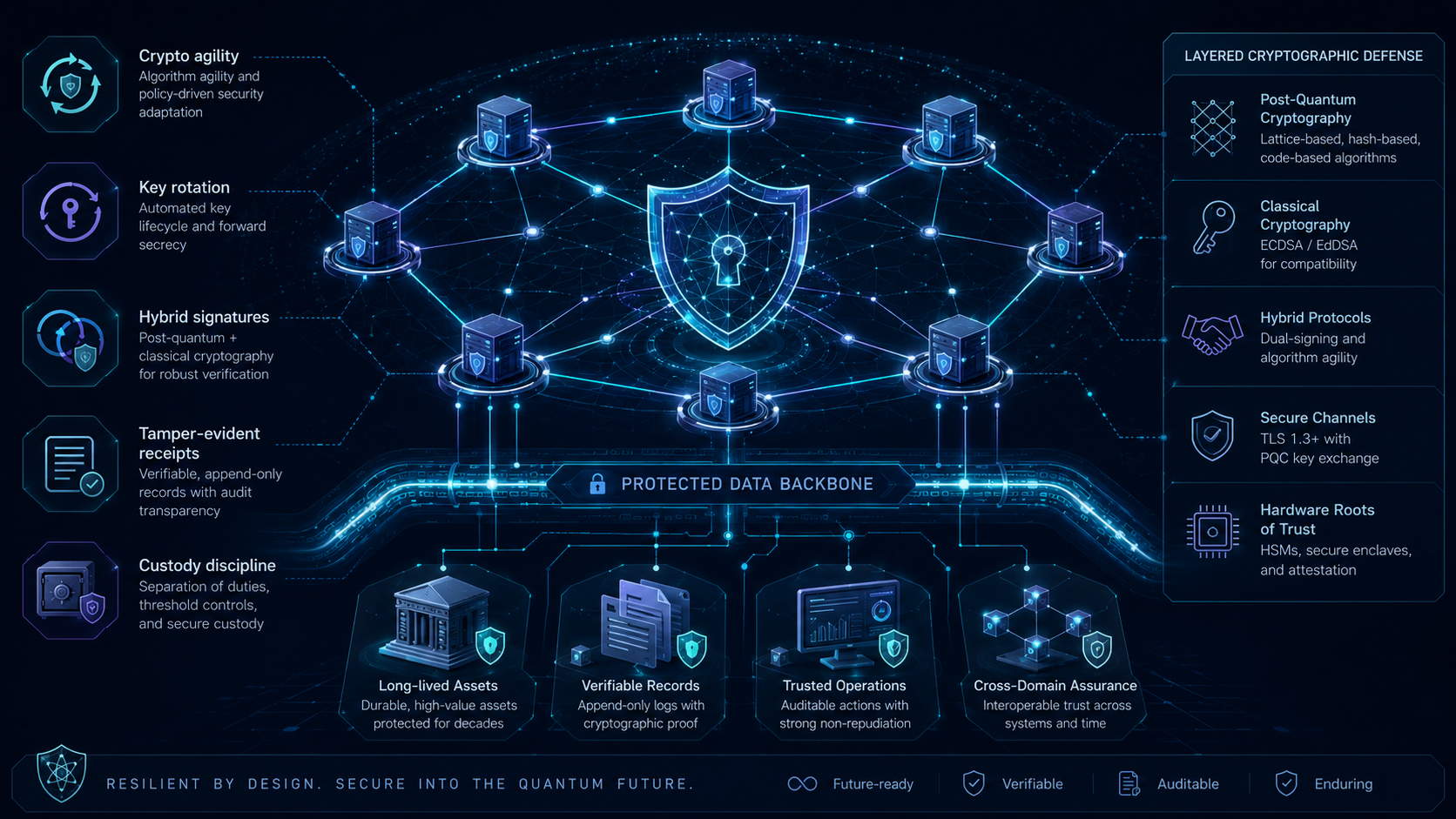
Quantum Coin: Quantum-Resilient Token and Trust Network
Quantum Coin is a research and engineering program for a crypto-agile token infrastructure designed to remain governable as classical cryptography is progressively exposed to quantum-scale attack models.
The design is based on post-quantum migration discipline rather than speculation: algorithm agility, staged key rotation, dual-signature transition periods, deterministic test vectors, hardware-backed custody, audit receipts, and governance rules that can be upgraded without breaking the economic layer.
Threat model
The central risk is harvest-now-decrypt-later and signature-forgery capability against assets, identities, authorizations and settlement instructions that must survive for years. The network is therefore designed around long-horizon cryptographic evidence, migration paths and provable event semantics.
Architecture
Post-quantum layer
The technical direction follows NIST-style post-quantum families: lattice-based signatures and key encapsulation for practical performance, hash-based signatures for conservative fallback, and hybrid operation during transition.
Governance and ethics
Quantum Coin is presented as infrastructure, not as a public token sale. Any future tokenization must be governed by compliance review, utility definition, custody discipline, fraud prevention, and explicit ethical limits.
Roadmap
Phase 1: threat model, reference architecture, deterministic key lifecycle tests and prototype wallet flows.
Phase 2: hybrid signature receipts, API/SDK sandbox, ledger event schema and adversarial testing.
Phase 3: pilot deployment for scientific provenance, water-system receipts, data-quality attestations and programmable grant accountability.