
Biological Quality Monitoring and Integrated Microbial Assessment in Wastewater
1. Effect-Directed Bioassays
Wastewater samples are applied directly to HPTLC silica gel plates using automated large-volume application to preserve the native chemical composition. Plates are chromatographically separated using optimized solvent systems to fractionate polar and semi-polar contaminants. After development and drying, plates are ready for biological testing.
HPTLC-umuC assay: Plates are overlaid with Salmonella typhimurium TA1535/pSK1002, carrying a lacZ reporter under the DNA damage-inducible umuC promoter. Exposure to genotoxic compounds triggers SOS response-mediated β-galactosidase expression. Following incubation, a chromogenic substrate produces blue-colored zones at locations of genotoxic compounds. Digital imaging and automated quantification generate spatially resolved genotoxicity maps, enabling detection of previously unknown genotoxic transformation products and persistent mobile organic contaminants.
HPTLC-Ames assay: Complementary mutagenicity testing uses S. typhimurium strains with and without metabolic activation (S9). Compounds inducing reverse mutations are visualized via colorimetric or colony-based indicators, detecting direct and indirect mutagens.
HPTLC-pYES/pYAS assays: Endocrine activity is assessed using yeast reporter strains expressing human estrogen (ER) or androgen (AR) receptors. Compounds activating these receptors induce reporter gene expression, visualized with chromogenic or fluorescent substrates, producing spatially resolved endocrine activity maps.
2. Flow Cytometry for Microbial and Microplastic Monitoring
Microplastic detection: Microplastic particles are quantified and sized using flow cytometry, applying light-scattering or fluorescent signals to differentiate plastics from organic and inorganic material. The plastic fraction is collected for size-resolved analysis and microbiome profiling of larger fragments to study biofilm formation and potential vectors of antimicrobial-resistant bacteria.
Bacterial load and viability: Microbial populations are quantified using SYBR Green I nucleic-acid staining for total bacterial counts. Combined SYBR Green I / Propidium Iodide staining differentiates intact and membrane-compromised cells, while high (HNA) and low nucleic acid (LNA) populations indicate microbial activity. Measurements follow Swiss water quality standards using 488 nm laser flow cytometry.
3. Culture-Enriched Metagenomic Approach for Antimicrobial Resistance
To detect clinically relevant AMR in wastewater Enterobacterales, a culture-enriched metagenomic workflow combines selective cultivation, CFU enumeration, and high-throughput sequencing.
Selective cultivation: Wastewater samples are plated on TBX-Agar (E. coli) and MacConkey Agar (Enterobacterales) with or without antibiotics representing:
Third-generation cephalosporins (cefotaxime)
Carbapenems (imipenem)
Fluoroquinolones (ciprofloxacin)
Antibiotic concentrations are set at twice the EUCAST clinical breakpoint, ensuring selective growth of resistant populations. Non-supplemented plates quantify total cultivable Enterobacterales. After 18-24 h incubation (37 °C), CFUs are counted to determine resistance fractions.
Pooling and DNA extraction: Colonies from antibiotic plates are pooled to capture the full resistant community. DNA is extracted using standardized Gram-negative optimized protocols.
High-throughput sequencing and analysis: Shotgun metagenomics provides:
Taxonomic profiling of resistant populations
Detection and quantification of resistance genes (ARGs)
Characterization of mechanisms including ESBLs, carbapenemases, and qnr-mediated fluoroquinolone resistance
Integration: CFU data are combined with resistome profiling, HPTLC bioassays, flow cytometry counts, and microbiome composition to generate predictive models linking chemical stressors to resistance emergence.
4. Total Wastewater Microbiome Profiling
Aliquots of untreated wastewater are concentrated by filtration or centrifugation for DNA extraction. 16S rRNA gene amplicon sequencing targets the V3-V4 or V4 regions to determine microbial community composition. Bioinformatic analysis yields:
Taxonomic profiles at genus/species level
Relative abundance of potentially pathogenic taxa
Diversity metrics across treatment stages
This approach complements culture-enriched metagenomics, linking overall microbial community structure to resistance prevalence and chemical stressors. Sequencing and analysis are compatible with outsourced services for reproducibility and scalability.
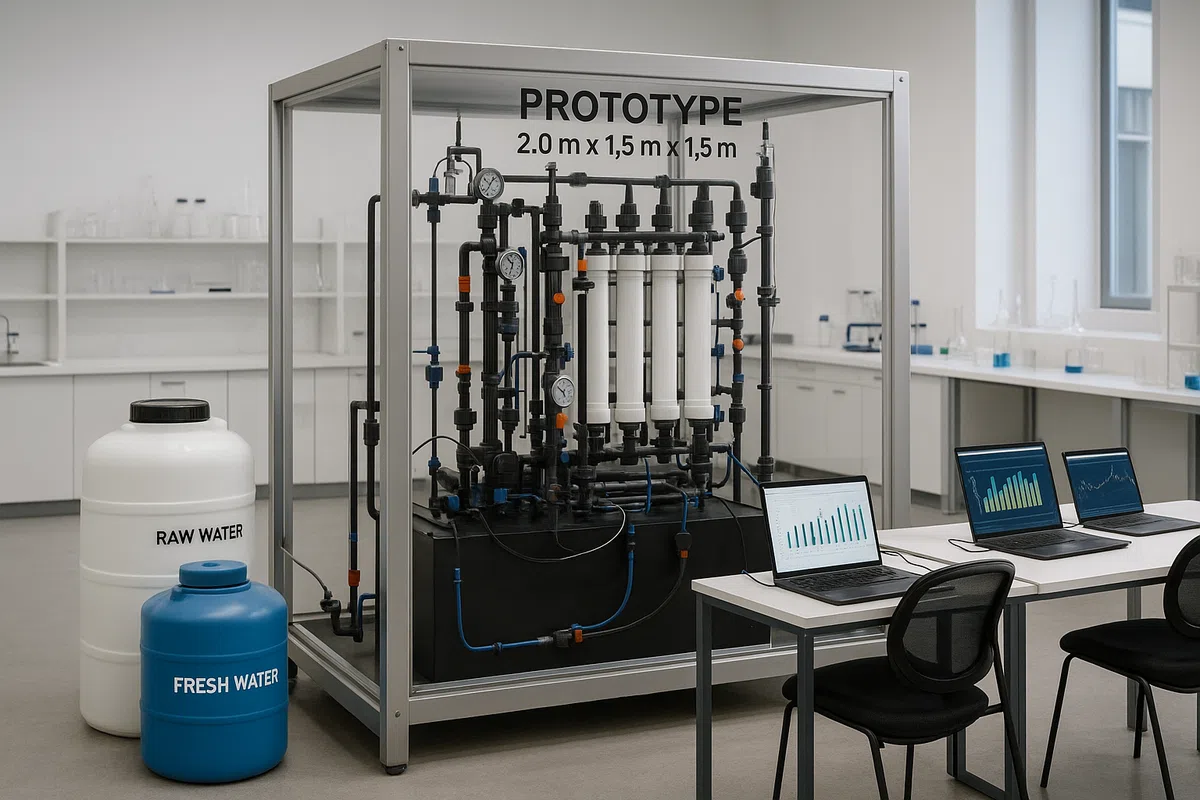
5. Reverse Osmosis Laboratory Pilot
A laboratory-scale RO pilot evaluates the removal of:
Biologically active chemical fractions
Total bacterial populations
Resistant Enterobacterales fractions
Samples pre- and post-RO are analyzed across all endpoints (HPTLC bioassays, flow cytometry, AMR profiling, microbiome sequencing) to assess treatment efficiency and changes in microbial community composition.
6. Data Integration and Predictive Modeling
Data from all endpoints are integrated using multivariate statistics and machine learning to explore relationships between:
Chemical mixture toxicity
Microbial load and viability
Antimicrobial resistance prevalence
Microbiome composition
This supports the biological quality gate, enabling identification of treatment stages where residual toxicity or resistance persists and providing predictive insights for wastewater management under climate-stressed conditions.