
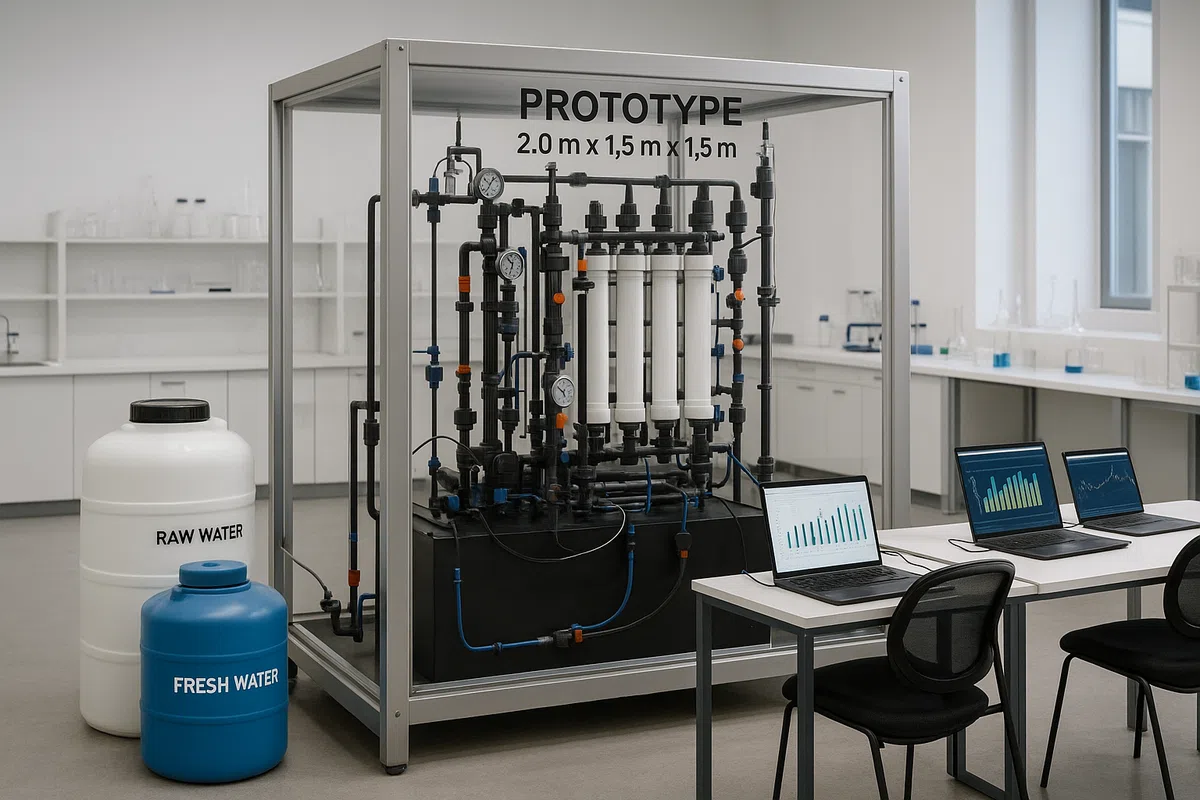
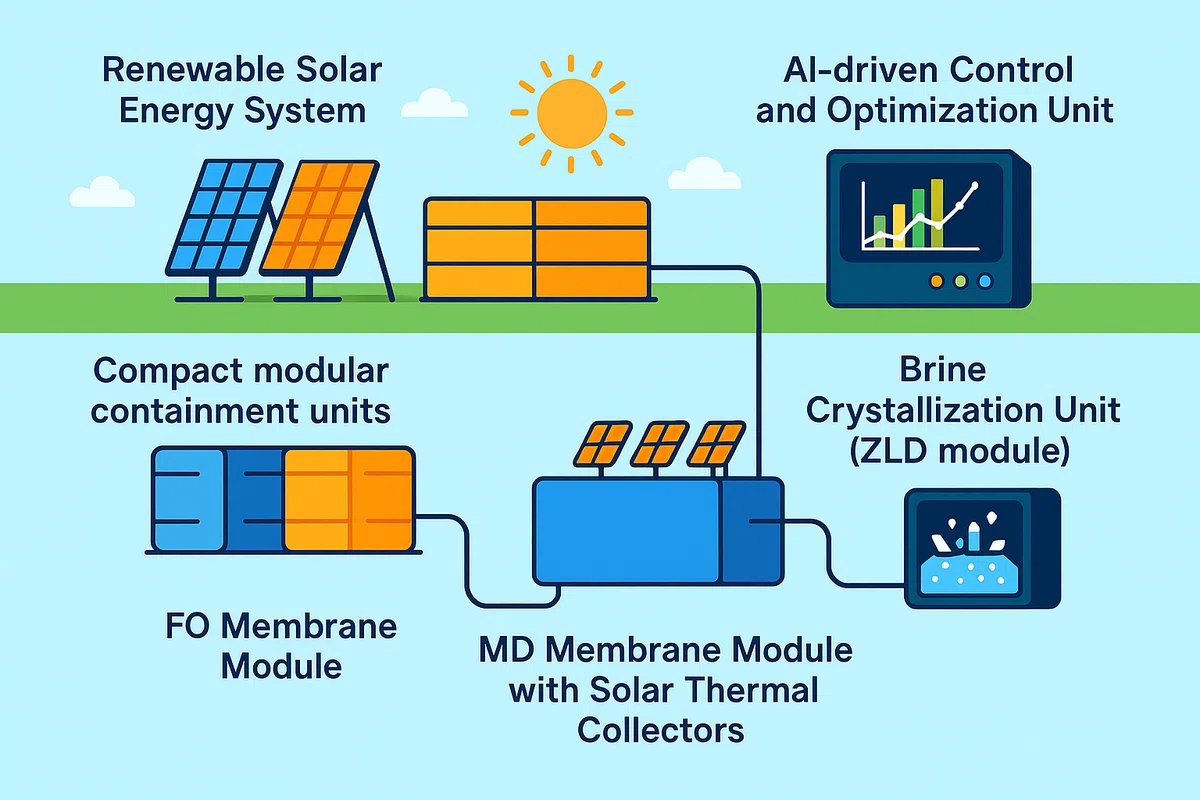
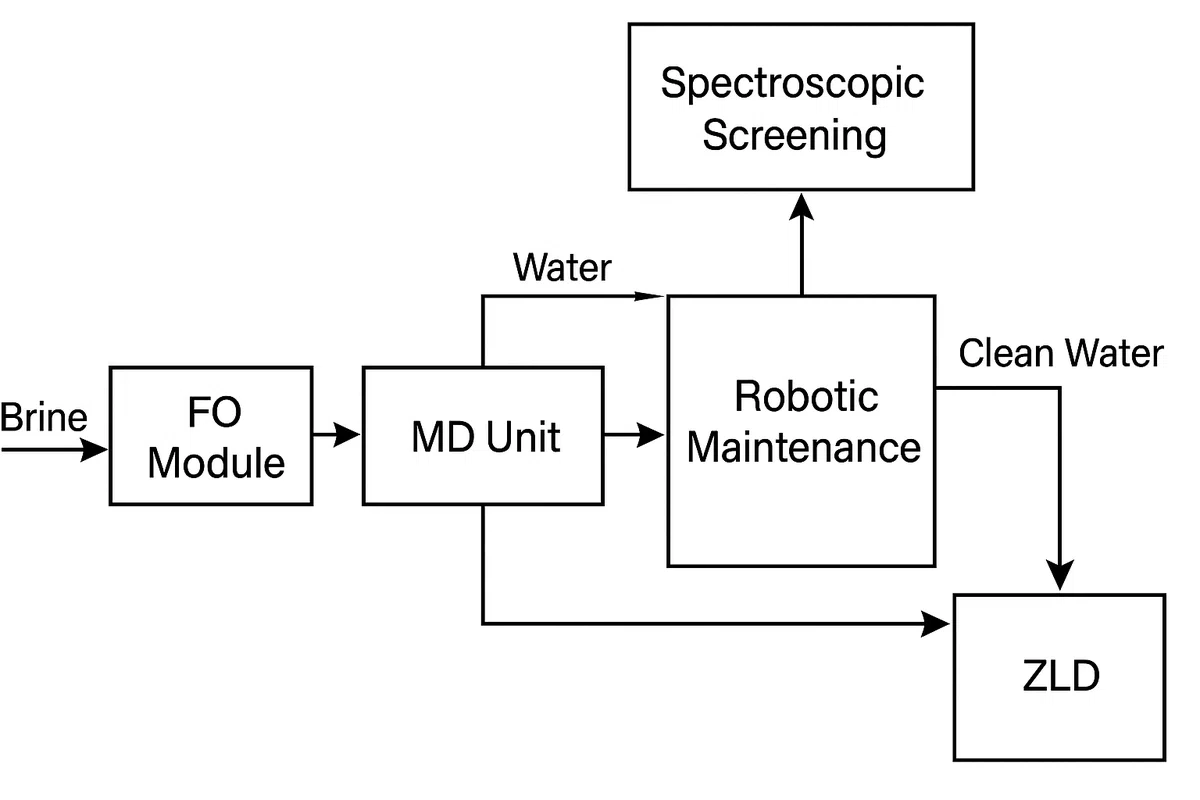
Water infrastructure, modular treatment, AI supervision, field deployment and scientific validation for resilient freshwater missions.
The program is presented as a scientific notebook: architecture, assumptions, applications, validation logic and visual evidence for researchers, innovators, students, professors, commercial partners and philanthropic organizations.
Deployable CBRN-informed water decontamination and continuity capability for military-relevant nodes
Core proposition
A modular, AI-native capability for early warning, contamination classification, bounded decontamination, and continuity support at military-relevant water support nodes.
Why it matters now
Contaminated water nodes can degrade force protection, logistics, public continuity and local stability within hours under accidental, hybrid or intentional events.
Bottom line
Aqua
Vitaque
is a field-capable water protection architecture: detect, classify, decide, deploy, decontaminate and verify.
Desired outcome with the Ministry
Validate the defence narrative, test EDF relevance, receive strategic steering, and identify the most credible national or EU route for the consortium.
Why this matters to defense operation
Mission-critical water nodes
Forward bases, logistics hubs, ports, airfields, camps, reservoirs and dual-use supply interfaces remain exposed to contamination pulses, microbial events, toxic discharges and salinity stress.
Continuity under disruption
Operational continuity requires early alert, fast anomaly interpretation and bounded intervention before degradation propagates into logistics, health protection and service instability.
Defence value
Water protection is now part of critical-infrastructure security: hybrid threats, sabotage, industrial incidents and contested-environment operations require rapid decision support and deployable response.
Threat-to-action chain
Weak
signals
→ AI
classification
command
decision
rapid
deployment →
decontamination
continuity
support →
verified
recovery
Weak signals
Sensor drift
Microbial
burden
Anomalous
chemistry
Toxicity
signatures
AI classification
Anomaly scoring Pattern clustering Threat ranking Predictive logic
Command decision
Alert escalation Sampling and routing Containment logic Playbooks
Rapid deployment
Container
unit
Adaptive
treatment Field
validation
support
Verified evidence
Logs and traces Lab / molecular evidence
Pilot validation Decision record
Reduced
logistics
Faster recovery
Safer
reuse
Operational advantage enabled by transport-informed treatment control
Physically grounded transport logic translated into deployable advantage
Higher-confidence decontamination
Transport-informed modules can tune barrier and treatment
behaviour
under chemical and biological stress rather than operating as blind black boxes.
Lower burden under salinity and degraded raw water
Deployable desalination and treatment modules can restore bounded continuity with lower energy, material and operational burden
Stronger command support
The digital twin is informed by membrane-level transport logic as well as data, improving simulation, prediction and operator guidance.
This is where Aqua
becomes a serious field capability rather than a generic treatment concept.
Deployable treatment module: RO within the decontamination chain
Reverse osmosis is one deployable treatment module within the broader Aqua
decontamination and continuity architecture.
High-selectivity barrier under chemical and biological stress
RO provides a controllable separation stage that strengthens decontamination, bounded recovery and safer downstream treatment.
Continuity under salinity, drought and compromised intake conditions
RO
stabilises
high-value
defence
relevant and dual-use water assets when raw-water quality collapses.
Containerised
deployment in the field
Integrated into deployable units, RO becomes a tactical asset: fast to
mobilise
, modular in scale and compatible with disaster, civil
and critical-node missions.
RO links early warning, membrane intelligence and deployable action in one operational chain.
EDF fit: main doorway and narrative discipline
Primary doorway
EDF-2026-RA-MCBRN-DST | CBRN
Best overlap with decontamination, on-site response, decision support and deployable recovery. The project must be framed as protection and restoration of
relevant water nodes under accidental, hybrid or intentional contamination.
Enabling logic only
The AI and digital-twin core should strengthen the main decontamination narrative, not replace it. Its value lies in rapid interpretation, bounded response planning and command support.
The AI and digital-twin core should strengthen the main decontamination narrative, not replace it. Its value is rapid interpretation, bounded response planning and command support.
A modular AI-native early-warning, classification and response system for contaminated
relevant and dual-use water assets.
We deliver
A decontamination and continuity capability with rapid deployment, evidence traceability and command-support logic.
Implication
Primary storyline =
relevant decontamination and recovery. Supporting storyline = AI, digital twin and operator decision support.
Project
fit
narrative
Decentralised
decontamination-and-recovery capability with decision support and deployable treatment modules for military-relevant water support nodes
Mission statement
is a modular, AI-native early-warning, classification and response system for contamination affecting
relevant and dual-use water infrastructures. It is designed to detect weak signals, classify chemical and biological risk, activate bounded field responses and verify recovery under accidental, environmental or intentional threat conditions.
From
Generic environmental project
Treatment-centric story
Civilian utility optimization
Broad sustainability framing
To
Critical water-node protection
Early warning + classification + response
first positioning with dual-use value Deployable decontamination and continuity support
System architecture
Protected
military
assets
Forward bases Logistics hubs
Intakes
Reservoirs
Signals and evidence
Online sensors
Plant log
Weather / EO
Lab assays
Operator observations
AI and digital twin
Multi-layer AI
igital
twin
Pattern discovery
Alert thresholds
Agentic supervision
Decision layer
Risk ranking
Playbooks
Alerting
Containment choices
Response routing
Modular action
Deployable
restoration
treatment
Modular
purification
pathways
Traceable
evidence
Biological evidence
Containerised on-site response, source-water mapping, contaminant pathways and hotspot intelligence.
Molecular biology
Viral and bacterial markers, molecular assays and fast biological evidence for event classification.
Engineering and pilots
Engineering design, certification, cyber robustness, real infrastructure access and execution discipline.
dual-use
Municipal and dual-use interfaces
Operational scenarios
Forward-base or camp contamination
Unexpected chemistry, toxicity or microbial burden affects a
relevant supply node; the system triggers alert escalation, pathway prediction and bounded mitigation.
Biological event
Bacteria, AMR markers or viral indicators rise in source waters; molecular evidence and AI interpretation classify the event and guide containment.
Intentional or hybrid contamination
A suspicious event affects a strategic or tactical water asset; the system supports triage, rapid deployment and evidence logging for command decisions.
Source degradation under contested or contaminated conditions
Source degradation under contested or contaminated conditions requiring emergency purification and continuity support.
Portable field response
unit can be
mobilised
on site when rapid deployment matters more than large fixed capacity; the module supports emergency decontamination, continuity and bounded recovery.
Wh
at
this consortium can credibly deliver
Maurizio / Aqua Vitaque
Existing prototype, AI and computing architecture, digital twin, pattern extraction, membrane-physics-informed control and system-level response models.
Environmental Institute / Jaroslav
Rapid deployment flagship: container-based on-site response, source-water mapping, contaminant pathway logic and hotspot intelligence for tactical and civil-defence scenarios.
Astrid team
Molecular biology flagship: qPCR, dPCR, nanopore sequencing, wastewater epidemiology, pathogen markers and fast biological evidence.
Graz laboratory
Scientific backbone and prototype-construction lead: environmental microbiology, AMR, toxicity and genotoxicity bioassays, flow cytometry and integrated demonstrator build.
TSQ
Mechanical design, FEM, CE/compliance, design for manufacturing, production transfer, biological risk assessment and engineering certification.
Polistudium
System integration for requirements, baselines, KPI logic, pilot protocols, validation discipline, exploitation framing and cross-WP coherence.
Other enabling actors
One4 = cybersecurity and continuity logic | Utilities = pilots and infrastructures | Yaiste = KPI, quality and procurement-readiness discipline.
WP1. Strategic coordination, ethics, security and Ministry interface
Keep the consortium coherent,
relevant, secure, and institution-ready while managing Ministry-facing alignment and system-level integration.
WP lead
Core contributors
• Polistudium
• TSQ
• Graz laboratory
• Environmental Institute
Support contributors
• Astrid
• Utilities
• One4
• Yaiste
WP mission
Maintain strategic coordination, ethics, security, and institutional alignment across the
programme
, ensuring that the consortium remains coherent,
relevant, and ready for Ministry-facing evaluation and follow-on positioning.
Execution logic
Lead = primary owner of scope, outputs and integration within the consortium.
Core contributors = main executors and technical builders inside the WP.
Support contributors = bounded but relevant input, validation or enabling support.
WP2
. Threat scenarios, operational use cases and requirements
Define the threat scenarios, operational use cases, system requirements, and deployment conditions that determine how the capability should detect, classify, respond, and support continuity at
relevant and dual-use water support nodes.
Environmental Institute
• Maurizio / Aqua Vitaque
Define realistic contamination scenarios, operational requirements and the rapid-deployment envelopes that make the system defence-relevant.
WP3. Biological quality intelligence, source-water mapping and evidence pipelines
Build the scientific evidence backbone for contamination understanding through microbiology, AMR, toxicity, molecular biology and source-water mapping.
Generate the validated biological and environmental evidence needed to classify contamination events, support operational interpretation, and feed trusted inputs into AI, decision support, and field validation.
WP4. Multi-layer AI, digital twin and early-alert / prediction engine
Create the intelligence core that turns heterogeneous signals into early alerts, predictive risk, and bounded response options..
Create the intelligence core that turns heterogeneous signals into early alerts, predictive risk and bounded response options.
WP5. Engineering modules, certification and deployable response hardware
Convert system intelligence into certifiable, manufacturable, and rapidly deployable response modules for operational field use and protected water-support nodes.
Convert system intelligence into certifiable, manufacturable and rapidly deployable response modules for field and infrastructure use.
WP6. Cybersecurity, data-sharing, software validation and continuity logic
Ensure the full architecture remains secure, interoperable and operational under degraded or hostile conditions.
One4
WP7. Pilots, stress tests and validation on representative operational and dual-use infrastructures
Demonstrate the architecture through staged pilots, field drills, operator feedback loops, and structured validation evidence on representative operational and dual-use infrastructures.
Demonstrate the architecture on real infrastructures through staged pilots, field drills, operator feedback loops and structured validation evidence.
WP8. Exploitation, replication, procurement-readiness and dissemination
Prepare the system for scaling, institutional uptake, procurement dialogue and coherent exploitation while preserving integration discipline and strategic clarity.
Prepare the system for scaling, institutional uptake, procurement dialogue and coherent exploitation while preserving integration discipline and strategic clarity.
Why the capability is strategically interesting
Scientific depth |
Transport-informed membrane logic gives the system a stronger basis for prediction, tuning and recovery than empirical-only treatment approaches.
Operational relevance |
The object is not only sensing or treatment: it is a deployable capability linking detection, classification, decontamination and continuity support.
Command value |
AI and digital twin convert heterogeneous evidence into rapid risk ranking, playbooks and bounded operational choices.
Rapid deployment |
modules create a credible route to field use under tactical, dual-use or civil
conditions.
Institutional credibility |
Engineering, pilots, certification discipline and procurement-readiness make the concept more credible than a research-only consortium.
European value |
The project supports strategic autonomy in water protection, membrane know-how, decision support and deployable response technologies.
Procurement pull |
The same architecture can serve defence, civil protection and critical-infrastructure operators, improving exploitation logic.
What it becomes |
A procurement-facing demonstrator rather than a generic innovation platform.
Bottom line |
This is a serious dual-use capability with an identifiable defence object, not only a broad water-resilience narrative.
Integrated demonstrator logic
How the capability is built, tested and shown in a way ministries can evaluate.
Capability core
Aqua Vitaque + integrated consortium modules
• Graz laboratory | • Environmental Institute | • Polistudium | • Astrid | • TSQ
• Utilities | • One4 | • Yaiste
Strategic output
A ministry-facing demonstrator that integrates evidence, AI reasoning, deployable response hardware and traceable validation.
Key tasks
• Integrate sensing, lab and molecular evidence pipelines | • Run AI classification and digital-twin simulations | • Connect decision support to deployable RO / decontamination modules | • Validate rapid deployment, continuity support and evidence logging in realistic scenarios
1. Positioning check
Is the defence-first framing acceptable: protection and recovery of defence-relevant and dual-use water nodes under accidental, hybrid or intentional contamination?
2. Call steering
Is EDF-2026-RA-MCBRN-DST the right main doorway, or should the project be redirected toward another defence instrument or national-security route?
3. Italian strengthening
Which end-users, defence operators or industrial partners would most strengthen Italian-side credibility and eligibility?
4. Rapid deployment relevance
Would a containerised rapid-deployment configuration for on-site water decontamination materially strengthen the defence case for Italy and the EU?
5. Follow-on route
If EDF is too narrow, which Ministry-backed route should be pursued while preserving the same deployable capability logic?
Aqua Vitaque is positioned here as a defence-relevant, dual-use water protection and recovery capability built around AI command support, biological evidence, deployable treatment and integrated engineering discipline.
What we ask from the Italian Ministry of
Which
military end-users or CBRN operators
should be involved early to ensure operational relevance