
Water infrastructure, modular treatment, AI supervision, field deployment and scientific validation for resilient freshwater missions.
The program is presented as a scientific notebook: architecture, assumptions, applications, validation logic and visual evidence for researchers, innovators, students, professors, commercial partners and philanthropic organizations.
Aqua Vitaque | CL6-2026-02-CLIMATE-02 Work Package Program
Partner-fit implementation logic | 48-month baseline
Modular water infrastructure — consortium work packages
48-month baseline for decontamination, early alert, reuse, secure data and modular conditioning pathways.
Partner-fit allocation
Detailed WP decomposition
Working logic
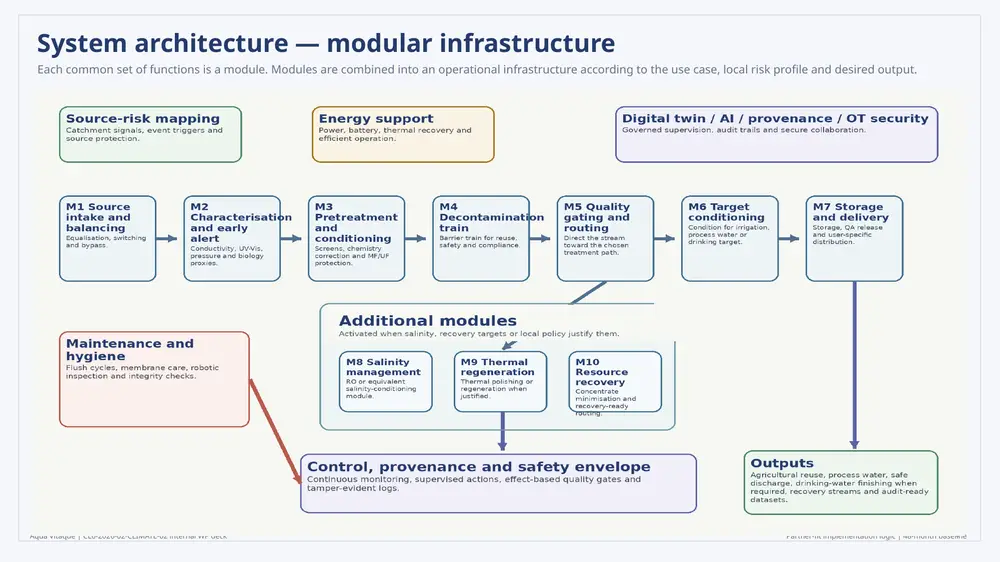
The infrastructure is conceived as a modular system in which common features are independent modules that can be composed together. The baseline service is wastewater decontamination, early warning and safe reuse. Additional conditioning modules are activated when needed by the reuse target, salinity profile, contaminant burden, local policy or final human-use requirements.
Program structure
• fixes partner-WP assignments according to evidenced capabilities • explodes each WP into detailed tasks and support tasks • shows the interconnection web across all WPs and all partners • keeps the 48-month implementation path controlled
Implementation anchors now finalised around real execution
The scientific and technical core remains the same, but hosted tests and execution ownership are now tightened.
Wastewater test facility / marine outfall host
Provides operating baselines, real wastewater and discharge conditions, hosted test windows, maintenance feedback and acceptance evidence for decontamination / reuse sequences.
Municipal aqueduct host
Supports source-water and human-use conditioning cases, continuity-of-service requirements, operator constraints and evidence for optional potable-use pathways.
Current positive position
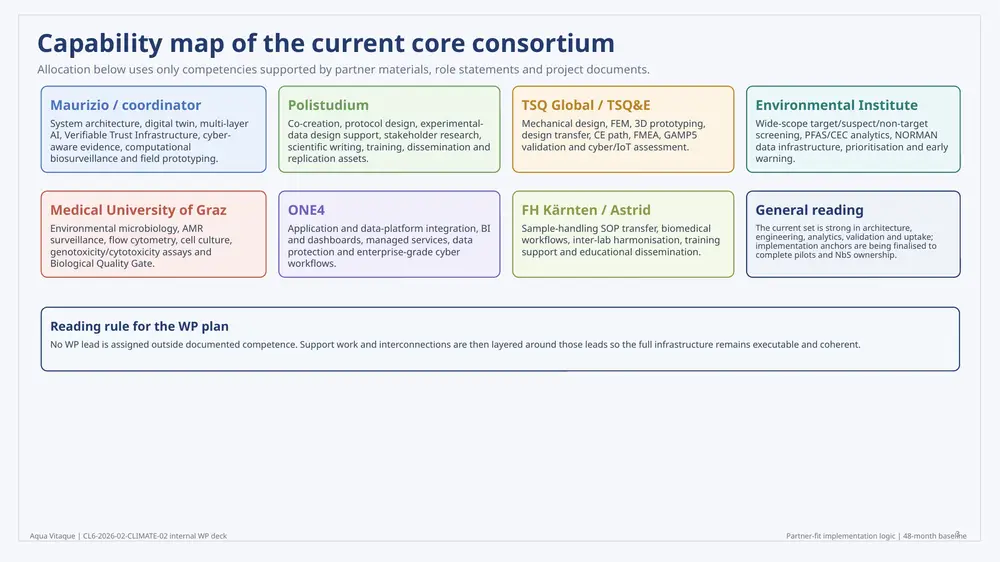
The consortium already covers modular water engineering, source-risk analytics, digital twin + AI, toxicological / AMR evidence, rapid diagnostics and deployment-focused exploitation.
Definitive 9-WP architecture — revised ownership logic
Ownership reflects documented competence, requested leadership positions and workload balance across the consortium.
WP1
Project management, scientific integration, ethics and QA
Assigned lead: Maurizio / Aqua Vitaque
WP2
Baselines, requirements, co-creation and KPI truth table
Assigned lead: Polistudium
WP3
Modular treatment engineering and field-prototype integration
WP4
Monitoring, chemical intelligence and source-water mapping
Assigned lead: Environmental Institute
WP5
Multi-layer AI, Digital Twin and Verifiable Trust Infrastructure
WP6
Biological intelligence, AMR surveillance and toxicological evidence
Assigned lead: Medical University of Graz
WP7
Rapid molecular diagnostics and inter-lab transfer
Assigned lead: FH Kärnten
WP8
Pilots, stress tests, validation and test-facility execution
WP9
Replication, training, dissemination and exploitation
Support logic kept explicit
Yaiste works inside Maurizio’s package as the execution sub-team for data engineering, workflow coding, testing and deployment support.
ONE4 remains a focused digital-implementation contributor rather than the owner of a full standalone WP.
Test-facility integration
Wastewater treatment / marine outfall operator and municipal aqueduct are inserted as small but real execution actors for baseline data, hosted tests, operating feedback and validation evidence.
Integrated participation across M1–M48 — revised partner load
Every partner stays active, but the density of tasks now follows the requested workload logic and evidenced capabilities.
M1–M12
M13–M24
M25–M36
M37–M48
Maurizio / Aqua Vitaque
Yaiste sub-team
Polistudium
Environmental Institute
Medical University of Graz
FH Kärnten
ONE4
Wastewater test facility
Municipal aqueduct
Reading rule
Darker bars = heavier execution phases. The strongest sustained loads sit with Graz and Maurizio’s group, while EI and Polistudium remain major continuous contributors and the test hosts peak during validation windows.
Cross-WP interconnection web — revised execution mesh
The programme still behaves as a mesh. Chemistry, biology, engineering, AI and pilots continuously exchange constraints and evidence.
Architecture and field system
WP1 and WP3 stabilise module boundaries, interfaces, field hardware, conditioning pathways, maintenance logic and prototype-upgrade decisions.
Evidence and intelligence
WP4, WP5, WP6 and WP7 turn samples, sensors and laboratory outputs into source-risk maps, AI predictions, toxicological evidence, AMR intelligence and rapid diagnostic feedback.
Validation and adoption
WP2, WP8 and WP9 convert the technical stack into pilot requirements, stress-tested acceptance evidence, training assets and Europe-facing uptake materials.
Critical flows
WP2 baselines feed all design and validation choices.
WP4 chemical and source-water evidence trains WP5 and constrains WP3/WP8 decisions.
WP6/WP7 biological and molecular results close the loop on safety.
AI-centred mesh
WP5 receives data from engineering, chemistry, biology and hosted pilots.
Predictions feed operator guidance, anomaly prioritisation, digital twin state estimation and test sequencing.
Yaiste executes implementation-heavy sub-tasks under Maurizio’s leadership.
Real-world validation
WP8 uses the two added utility hosts for real operating windows, sample campaigns and acceptance checks.
WP9 packages only validated outputs for replication and dissemination.
WP1. Project management, scientific integration, ethics and QA
Active M1–M48, with steady coordination work and higher intensity when interfaces, validation and proposal-wide decisions must be frozen.
Core objective
Establish the command layer of the action: one architecture baseline, one decision log, one ethics-security frame, one reproducibility discipline and one coordinated delivery rhythm across engineering, analytics, laboratory work and hosted tests.
Lead-task technical fit
Maurizio remains the only actor with documented system-of-systems ownership across modular water engineering, Digital Twin reasoning, Multi-layer AI, trust architecture, field prototyping and cross-domain scientific integration.
Lead and role
Maurizio / Aqua Vitaque | Lead for programme command, architecture governance, evidence traceability, ethics-security coordination and cross-WP integration.
Main contributors
Polistudium supports process discipline and stakeholder-governance quality; EI and Graz support scientific decision points; FH Kärnten and ONE4 support operational implementation issues; test hosts support pilot governance interfaces.
Key outputs
Consortium handbook; integrated risk register; architecture baseline; ethics and data-governance frame; decision and change-control log; acceptance discipline for deliverables and pilot gates.
Working rhythm across M1–M48
Continuous contribution across the full action. Early months are interface-heavy; middle months coordinate test execution and corrective decisions; late months consolidate validated outputs and Europe-facing packaging.
WP1 task breakdown
Detailed tasks, support work, dependencies and cross-WP integration logic.
T1.1 Governance and milestone control
Run consortium cadence, issue tracking, milestone reviews, resource adjustments, decision escalation and closure logic across the whole 48-month action.
T1.2 Architecture board and interface freeze
Freeze module boundaries, naming rules, sample/data interfaces, pilot assumptions and revision discipline so all WPs remain technically aligned.
T1.3 Ethics, GDPR and dual-use oversight
Supervise data handling, laboratory sensitivity, operator-facing functions, export-sensitive elements and security-sensitive evidence pathways.
T1.4 QA and reproducibility
Define evidence folders, acceptance rules, validation packaging, naming conventions and reproducibility checks for all technical and scientific outputs.
T1.5 Test-host coordination and acceptance gates
Synchronise facility access, sampling windows, operational permissions, hosted-test readiness and action-level go/no-go decisions before validation phases.
T1.6 Proposal coherence and excellence-control
Keep the implementation narrative coherent with Technical Excellence, including the statement that the prediction algorithm relies on Maurizio’s domain know-how and the proprietary methodology.
Receives all WP dependencies and sends architecture, governance and acceptance decisions back to the full consortium.
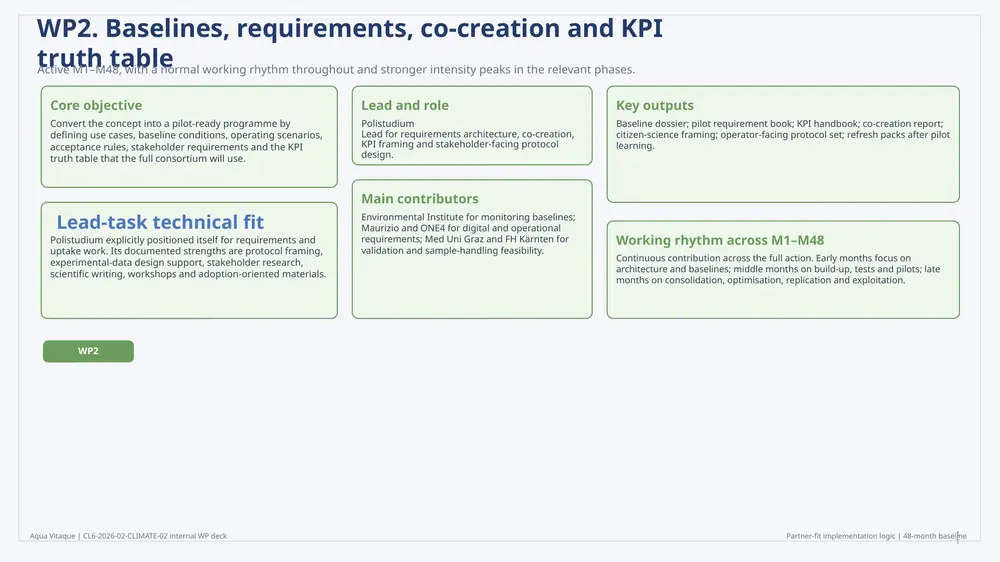
WP2. Baselines, requirements, co-creation and KPI truth table
Definition of baseline conditions, KPI criteria and reference requirements for pilot preparation
Operational baseline
Shared criteria
Pilot preparation
Convert the concept into a pilot-ready framework by defining baselines, use cases, stakeholder requirements, KPI thresholds and reference criteria across wastewater-reuse, drinking-water and mixed-conditioning contexts.
Baseline
elements
Shared baselines
Use cases, boundary conditions and success criteria are defined early and used consistently across the action
KPI truth table
Resilience, safety, energy, GHG, cyber and reuse criteria are specified with associated thresholds and references
Operator input
Operator and stakeholder input is translated into reference criteria relevant to pilot preparation and validation.
Cross-WP consistency
Downstream WPs use shared definitions, thresholds and assumptions for design, piloting and validation activities.
Role
in the action
WP2 provides a shared operational reference for WP3 engineering, WP5 digital logic, WP8 validation and later replication, while technical ownership remains within each WP.
Operational
framework
WP2 integrates operator needs, stakeholder input and technical constraints into a shared reference framework for design, piloting and validation activities.
Utility & policy context
Operators, municipalities, regulators and site realities.
Shared operational reference
Aligned definitions, thresholds and acceptance criteria.
Design / pilot interface
Reference criteria for engineering, digital logic and validation.
T2.1 Stakeholder mapping
Evidence capture from utilities, municipalities, operators and regulators.
T2.2 Pilot archetypes
Wastewater, drinking-water and mixed-conditioning use cases.
T2.3 KPI truth table
Resilience, safety, energy, GHG, cyber and reuse criteria
with
associated
thresholds
T2.4 Operational alignment
Delphi and NGT sessions support expert convergence on KPI thresholds, protocol elements and validation criteria.
T2.5 Operator & citizen interface
Alarm handling, training needs and user-facing protocol requirements.
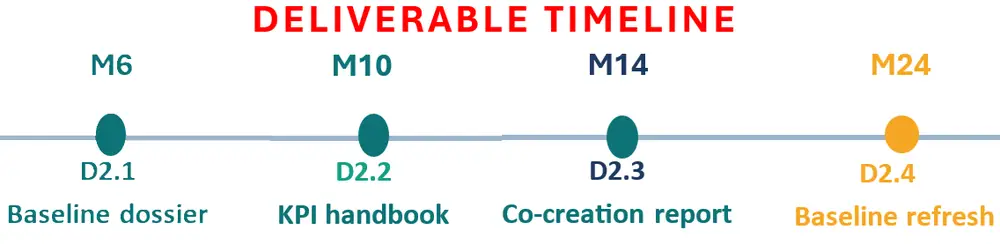
T2.6 Baseline refresh
Requirement updates after engineering choices and pilot learning.
Shared reference, interfaces and outputs
Baseline dossier,
requirement
book and KPI
handbook
provide
reference
criteria
for WP3, WP5, WP8 and WP9
as
in the
Dewliverable
Table
Define
Baselines and pilot contexts are specified early.
Align
Criteria are shared while technical ownership remains within each WP.
Support
Engineering, AI and validation use a common reference.
Refresh
The framework is updated at pilot checkpoints.
WP3. Modular treatment engineering and field-prototype integration
Active M1–M48, with early design concentration, mid-term build / integration peaks and later optimisation based on pilot evidence.
Engineer the modular water infrastructure itself: wastewater decontamination as the baseline service, optional desalination and human-use conditioning pathways, residual-stream handling, maintenance logic and field-prototype integration.
Aqua Vitaque’s own materials provide the closest fit for a real modular system that already exists as a coherent field-oriented architecture rather than as a generic engineering placeholder.
Maurizio / Aqua Vitaque | Lead for treatment-chain architecture, module composition, field-prototype evolution and bench-to-skid integration.
Environmental Institute supports contaminant-driven design constraints; Graz and FH Kärnten support biological / diagnostic interfaces; ONE4 supports digital hooks; test hosts contribute operating feedback and utility constraints.
Reference module architecture; decontamination-desalination-reuse pathway logic; field prototype integration dossier; interfaces for sensors, sampling and AI; maintenance and serviceability package.
Continuous contribution across the full action. Highest engineering intensity runs from baseline definition into integrated prototype upgrades and then into pilot-driven optimisation.
WP3 task breakdown
T3.1 Module architecture freeze
Define the modular baseline: pretreatment, decontamination, RO-based desalination option, optional polishing / conditioning, residual-stream management and utility-facing interfaces.
T3.2 Field-prototype upgrade path
Translate the current Aqua Vitaque prototype into a research-action execution baseline with instrumentation ports, maintainability access, sample points and configurable module combinations.
T3.3 Process envelopes and set-point logic
Define bounded operating envelopes for hydraulic variability, contaminant classes, fouling risk, membrane stress, energy use and safe-response actions.
T3.4 Service and maintenance engineering
Create serviceability logic for membrane maintenance, consumables, replacement sequences, cleaning protocols and recoverability after disturbances.
T3.5 Integration of monitoring and AI interfaces
Embed sampling, telemetry and Digital Twin hooks so chemistry, biology and operator actions can be fused without retrofitting the system twice.
T3.6 Pilot-ready skid and deployment package
Prepare the build configuration, commissioning scripts, hosted-test setup, interface files and engineering evidence needed for validation activities in WP8.
Receives baseline requirements from WP2 and intelligence needs from WP4–WP5, then sends integrated hardware, interfaces and operating envelopes to WP5, WP6, WP7 and WP8.
WP4. Monitoring, chemical intelligence and source-water mapping
Active M1–M48, with strongest intensity in baseline mapping, analytical campaigns and pilot-linked evidence updates.
Build the contaminant-intelligence layer: target, suspect and non-target analytics; PFAS / CEC / transformation-product logic; source-water and catchment-risk mapping; event libraries and operator-relevant monitoring rules.
The Environmental Institute documents and latest amended source-water text provide the strongest evidence for wide-scope screening, prioritisation, NORMAN-compatible structuring and authority-facing chemical interpretation.
Environmental Institute | Lead for chemical intelligence, source-risk evidence, monitoring strategy and regulatory-grade interpretation.
Graz links chemistry to biological effects and AMR dynamics; Maurizio and Yaiste use the evidence in predictive layers; test hosts provide matrices and operational windows; Polistudium supports requirements and uptake framing.
Monitoring strategy; target / suspect / non-target campaign design; source-water and catchment risk atlas; trigger library; prioritisation framework; authority-facing evidence packages.
Continuous contribution across the full action. The early phase builds the monitoring architecture; the middle phase populates the evidence base; the late phase consolidates regulatory and replication assets.
WP4 task breakdown
T4.1 Monitoring architecture
Define what is monitored, where, when and with what escalation logic across source water, process streams, reject lines, reuse water and pilot-host contexts.
T4.2 Target, suspect and non-target analytics
Run or specify HRMS-based workflows for PFAS, pharmaceuticals, PMOCs, CECs, transformation products and unexpected event signatures.
T4.3 Prioritisation and trigger libraries
Translate chemical evidence into early-warning indicators, priority contaminant lists, event classes, sampling escalation rules and operator-facing trigger thresholds.
T4.4 Dynamic source-water mapping
Build catchment-to-intake source-risk maps by combining analytical evidence, source type, basin pressures, historical records and observed event patterns.
T4.5 Data packages for AI and validation
Curate traceable datasets that can train predictive modules, support Digital Twin calibration and be reused in cross-pilot comparison and replication.
T4.6 Authority-facing evidence
Prepare readable chemical-evidence files for reuse, discharge, hosted-test acceptability and Europe-facing regulatory narratives.
Receives site definitions from WP2 and interfaces from WP3; sends trigger libraries, prioritised datasets and source-risk evidence to WP5, WP6, WP8 and WP9.
WP5. Multi-layer AI, Digital Twin and Verifiable Trust Infrastructure
Active M1–M48, with continuous computational work from architecture freeze to pilot optimisation and exploitation packaging.
Implement the computational intelligence of the programme: Digital Twin state estimation, bounded Multi-layer AI, operator guidance, anomaly prioritisation, predictive maintenance and auditable evidence fusion across chemistry, biology and process telemetry.
This WP directly matches Maurizio’s documented arc. It also explicitly protects the requested leadership position: the names Maurizio as the owner of both “Multi-layer AI” and “Digital Twin”. The prediction algorithm is framed as based on the proprietary methodology plus Maurizio’s specific know-how.
Maurizio / Aqua Vitaque | Lead for Digital Twin, Multi-layer AI, operator decision logic, evidence fusion and verifiable trust architecture. Yaiste executes the delegated implementation-heavy sub-tasks under this leadership.
ONE4 provides focused platform engineering support; Environmental Institute, Graz and FH Kärnten provide training / validation data; Polistudium supports human-override and user-facing protocol framing.
Digital Twin core; Multi-layer AI model pack; explainability and human-override rules; provenance / tamper-evident evidence layer; operator cockpit logic; deployable analytics interfaces.
Continuous contribution across the full action. Early months define architecture and datasets; middle months build, train and integrate; late months consolidate explainability, hosted-test optimisation and exploitation-ready evidence.
WP5 task breakdown
T5.1 Digital Twin core
Model hydraulics, module state, fouling, contaminant trajectories, energy demand, conditioning pathways and recovery behaviour across the modular infrastructure.
T5.2 Multi-layer AI stack
Implement edge anomaly detection, supervisory optimisation, predictive maintenance, workflow prioritisation and operator-support logic within bounded safety envelopes.
T5.3 Prediction methodology and evidence fusion
Fuse chemistry, biology, telemetry, event history and operator actions using the proprietary prediction methodology and Maurizio’s specific domain know-how.
T5.4 Verifiable Trust Infrastructure
Create provenance chains, tamper-evident logs, role-aware evidence access, certification-ready claims and a defensible audit trail for critical-infrastructure decisions.
T5.5 Yaiste implementation block
Data engineering, model-pipeline coding, integration tests, containerisation, experiment tracking, dashboard hooks and deployment support executed by Stefano Corsetti under Maurizio’s package.
T5.6 Explainability, override and bounded action
Define readable explanations, confidence windows, human-override rules, safe actuation constraints and uncertainty communication for utilities and evaluators.
Receives baselines from WP2, module states from WP3, chemical evidence from WP4 and biological evidence from WP6/WP7; sends predictions, alarms, digital evidence and operator playbooks outward to WP8 and WP9.
WP6. Biological intelligence, AMR surveillance and toxicological evidence
Active M1–M48. Graz provides the scientific evidence base; Maurizio / Aqua Vitaque own the full AI and Digital Twin layer.
Deliver the large science package around effect-directed toxicity mapping, microbial dynamics, AMR surveillance, microbiome profiling, microplastic-aware flow cytometry and biologically informed interpretation of treatment performance.
The newest Graz material defines the science input stack: HPTLC bioassays, flow cytometry, culture-enriched metagenomics, microbiome analysis, RO-linked validation, logs, API outputs, libraries and dense biological datasets. These are upstream inputs for Maurizio’s AI and Digital Twin layer, not AI delivered by Graz.
Medical University of Graz | Lead for biological intelligence, AMR-sensitive monitoring, toxicological evidence, assay generation and validated biological datasets that feed the system-wide intelligence layer.
Graz supplies the science evidence base; Environmental Institute adds contaminant context; Maurizio / Aqua Vitaque and the Yaiste sub-team own pattern extraction, model building, agent and super-agent logic, and the translation of sensitive sensor data into operational decisions.
Continuous contribution across the full action. Early months build protocols and panels; mid-term months generate dense data; late months consolidate predictive interpretation and Europe-facing scientific evidence.
WP6 task breakdown
T6.1 Effect-directed bioassay platform
Deploy HPTLC-based bioassays for genotoxicity, mutagenicity, endocrine activity and general toxicity to identify biologically active fractions in complex water matrices.
T6.2 Flow cytometry and microplastic intelligence
Quantify microbial populations, viability shifts and microplastic-related fractions using flow-cytometric workflows suitable for treatment-performance interpretation.
T6.3 AMR surveillance
Run culture-enriched AMR monitoring combined with sequencing-based characterization of resistant populations, resistance genes and clinically relevant mechanisms.
T6.4 Wastewater microbiome profiling
Profile untreated and treated microbiomes to detect community shifts, persistence signals and links between treatment stressors and microbial ecology.
T6.5 Predictive biological models
T6.6 Biological evidence packages
Build traceable datasets and interpretable biological dossiers that feed the Biological Quality Gate, pilot validation and scientific dissemination.
Receives matrices and interfaces from WP3–WP4 and sends biological evidence, AMR / microbiome insights and predictive features to WP5, WP7, WP8 and WP9.
WP7. Rapid molecular diagnostics and inter-lab transfer
Active M1–M48, with a smaller but focused workload centred on portable diagnostics, confirmatory testing and transferability of laboratory practice.
Provide the rapid molecular and diagnostic sub-layer needed for targeted surveillance, inter-lab harmonisation and transfer of methods into operationally lighter workflows.
FH Kärnten’s documents point to a concise but valuable niche: nanopore sequencing, qPCR / dPCR, wastewater-based epidemiology, respiratory and enteric virus tracking, bacterial targets and standard microbiology support.
FH Kärnten | Lead for rapid molecular diagnostics, inter-lab SOP transfer and compact confirmatory workflows.
Graz supports alignment with the larger biological package; Maurizio / Yaiste integrate data structures; Polistudium supports protocol readability; test hosts support sample logistics and implementation reality.
Rapid diagnostic panel; portable / transferable SOPs; qPCR-dPCR assay library; nanopore-ready sequencing pipeline; inter-lab harmonisation instructions; targeted confirmatory datasets.
Continuous but focused contribution. Work peaks when assays are frozen, transferred and applied to hosted-test or validation campaigns.
WP7 task breakdown
T7.1 Target panel definition
Freeze the diagnostic target set for viruses, bacteria and selected resistance markers relevant to wastewater, reuse and optional human-use contexts.
T7.2 qPCR / dPCR workflows
Develop or adapt rapid quantitative workflows for targeted confirmation without overloading the larger biological package.
T7.3 Nanopore sequencing support
Deploy portable sequencing and basic analysis pipelines for selected high-value cases where rapid sequence-level evidence adds operational value.
T7.4 Inter-lab SOP transfer
Prepare concise, transferable SOPs so diagnostic workflows can be repeated consistently across collaborating laboratories and later training actions.
T7.5 Confirmatory deployment in pilots
Use targeted diagnostic workflows to confirm or contextualise selected events, alarms or biological anomalies observed in WP6 / WP8.
T7.6 Diagnostic evidence formatting
Package results in a way that can be consumed by WP5, WP8 and WP9 without losing traceability or operational readability.
Receives biological questions from WP6 and pilot timing from WP8; sends compact confirmatory evidence and SOP-transfer outputs to WP5, WP8 and WP9.
WP8. Pilots, stress tests, validation and test-facility execution
Active M1–M48, with the heaviest load from mid-term integration onward when hosted tests, stress ladders and acceptance evidence are generated.
Prove that the integrated infrastructure behaves robustly under realistic stress: hosted tests, bench-to-skid-to-site validation, Biological Quality Gate closure, cross-pilot comparison and acceptance evidence for utilities and evaluators.
Graz’s toxicological and microbiological validation role, combined with the added utility hosts, makes this the second large Graz-centred WP. It is the execution bridge between science and real operations.
Medical University of Graz | Lead for validation logic, stress-test design, Biological Quality Gate closure and cross-pilot evidence synthesis. The wastewater test facility and municipal aqueduct act as hosted execution partners.
Maurizio / Aqua Vitaque supplies the integrated system; EI supplies contaminant evidence; FH Kärnten provides targeted diagnostics; ONE4 supports digital capture; Polistudium supports protocol framing and uptake packaging.
Stress-test ladder; hosted-test dossiers; biological and operational acceptance package; cross-pilot comparison report; utility-facing validation evidence; replication-ready acceptance scripts.
Continuous contribution with a strong late peak. Early work defines ladders and evidence needs; mid-term work runs integration and hosted tests; late work consolidates acceptance and replication materials.
WP8 task breakdown
T8.1 Validation panel and ladder design
Define the bench, integrated-skid and hosted-test ladders, including acceptance criteria, uncertainty treatment, sample plans and recovery-time metrics.
T8.2 Hosted-test execution in wastewater facility
Run real operating windows at the wastewater / marine outfall site, including baseline capture, sampling, operator feedback and disturbance-response observation.
T8.3 Hosted-test execution in municipal aqueduct
Run source-water and continuity-oriented validation cases relevant to optional conditioning / human-use pathways and service continuity requirements.
T8.4 Biological Quality Gate closure
Combine chemistry, microbiology, AMR, effect-based assays, diagnostics and process evidence into a clear go / no-go acceptance framework.
T8.5 Cross-pilot comparison and evidence synthesis
Compare different source waters, module combinations, stressors and recovery behaviours to extract transferable design and operation lessons.
T8.6 Utility-ready acceptance package
Turn hosted-test results into readable acceptance scripts, validation dossiers and authority / operator evidence that can survive scrutiny.
Receives integrated hardware from WP3, intelligence from WP4–WP7 and governance from WP1–WP2; sends acceptance evidence and validated lessons to WP9 and the Europe-facing narrative.
WP9. Replication, training, dissemination and exploitation
Active M1–M48, with moderate continuous work and a strong finalisation peak when validated outputs are turned into adoptable assets.
Turn technical results into assets that evaluators, utilities and follow-on partners recognise as exploitable and replicable: SOPs, training packs, dissemination outputs, uptake logic, implementation narratives and future deployment pathways.
Polistudium remains the natural owner because this is exactly the role it asked to keep. The program logic reflects the consortium architecture and hosted-test evidence.
Polistudium | Lead for replication assets, training, dissemination, scientific writing and evidence-based exploitation packaging.
Maurizio safeguards scientific narrative and strategic positioning; Graz and EI translate evidence; ONE4 supplies implementation-facing material; test hosts validate practicality; FH Kärnten contributes transferable laboratory SOPs.
Replication kit; operator and lab training pack; dissemination and publication package; exploitation roadmap; follower-site materials; Europe-facing implementation narrative.
Continuous contribution across the full action. Early work frames the narratives and templates; middle work absorbs validated content; late work packages the final Europe-facing bundle.
WP9 task breakdown
T9.1 Replication kit
Prepare procurement-ready specs, SOPs, acceptance scripts, operator manuals and implementation playbooks aligned with the validated modular infrastructure.
T9.2 Training programme
Build training tracks for operators, laboratories, utilities, follower sites and implementation partners using the validated hosted-test evidence.
T9.3 Scientific and technical dissemination
Convert strong results into publications, conference outputs, webinars, briefings and technical communications that remain faithful to the real evidence base.
T9.4 Exploitation roadmap
Define deployment pathways, partnership logic, market-entry options, follow-on projects and scaling routes for decontamination, reuse and optional desalination services.
T9.5 Utility / authority-facing narratives
Prepare readable narratives for utilities, municipalities, regulators and European reviewers, explicitly grounded in chemistry, biology, AI and hosted-test evidence.
T9.6 Final Europe-facing package
Assemble the coherent final package, keeping Technical Excellence, Impact and Implementation fully aligned with the revised WP ownership and real pilot logic.
Receives validated outputs from all WPs and sends adoption-ready materials outward to utilities, authorities, follower sites and Europe-facing proposal documents.
Responsibility matrix and protected deep scope — revised
L = lead, M = major contributor, S = support. Maurizio’s group provides the cross-WP intelligence layer: Multi-layer AI, Digital Twin, pattern extraction, agents and super-agents, and operations on sensitive sensor data. Graz supplies the scientific evidence, logs, APIs, libraries and datasets into that layer.
Partner
Maurizio deep scope to protect
System architecture and cross-module integration; Multi-layer AI; Digital Twin; proprietary prediction methodology; pattern discovery across logs and sensor streams; agent and super-agent design; secure operations on sensitive data; translation between field hardware, chemistry, biology and validation.
Interpretation rule
Maurizio remains M across all non-led WPs because the infrastructure intelligence layer spans every module. EI is S in WP7 because environmental evidence and deployment context still support that package.