
Water infrastructure, modular treatment, AI supervision, field deployment and scientific validation for resilient freshwater missions.
The program is presented as a scientific notebook: architecture, assumptions, applications, validation logic and visual evidence for researchers, innovators, students, professors, commercial partners and philanthropic organizations.
Aqua Vitaque Consortium
Work Package Allocation
for Horizon Europe CLIMATE-02 discussion
Do-able, partner-fit, call-fit design. Water-infrastructure resilience first; optional desalination where technically justified; digital twin + AI + secure data + biological quality gate integrated from the start.
9 work packages
partner-fit allocation
Europe-facing discussion Program
Program focus
1. Assigns each WP only to entities that can credibly deliver it.
2. Preserves the Aqua Vitaque scientific spine while aligning to CLIMATE-02.
3. Flags the missing partner categories that must still be added before final submission.
Current engineering basis
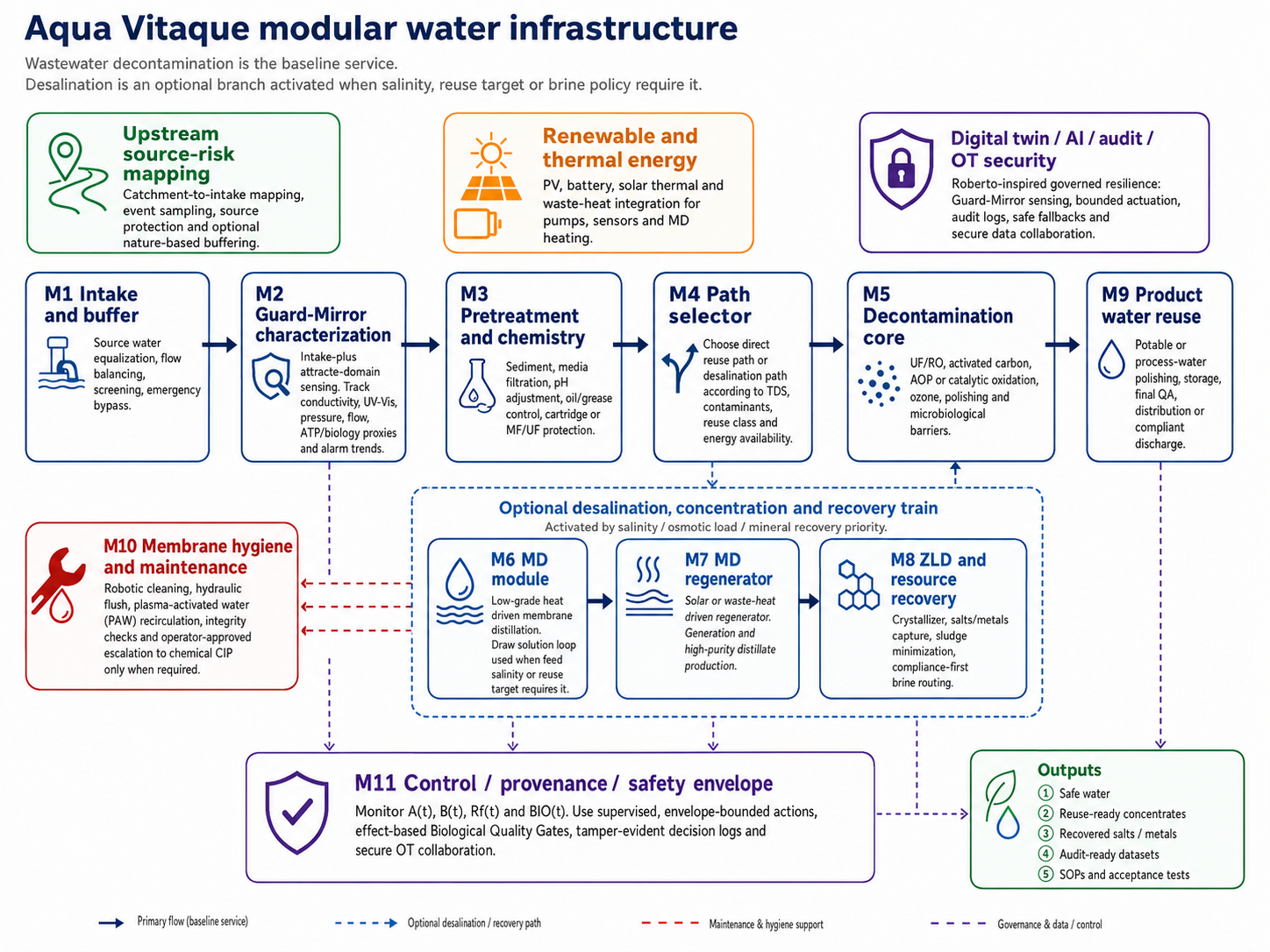
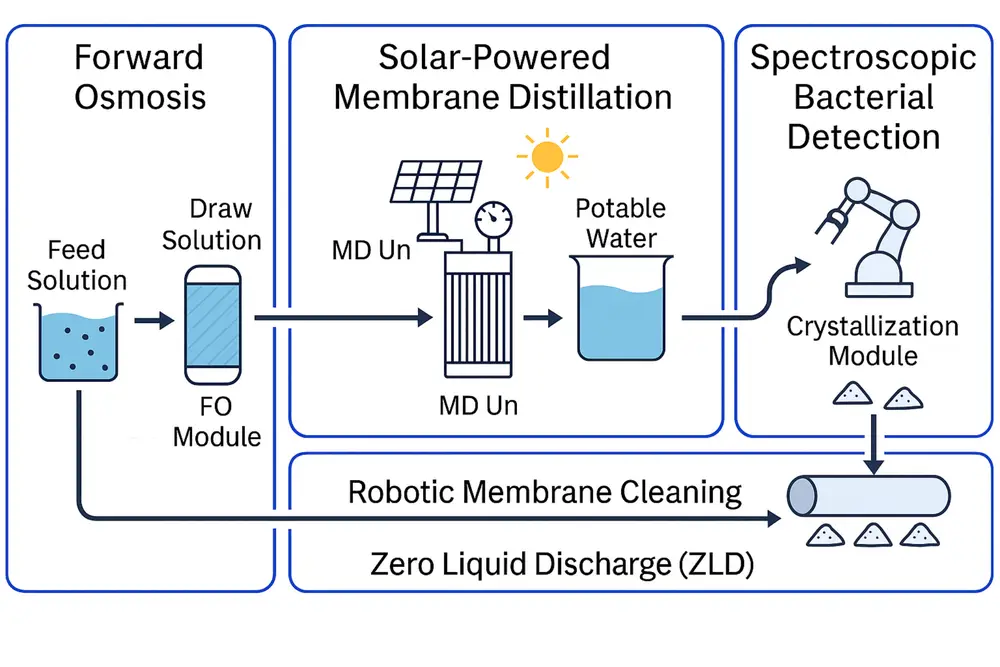
Bench prototype + modular FO/MD/ZLD concept + AI / trusted-data layer + bio-safety validation logic. The proposal narrative remains resilient wastewater and drinking-water infrastructures, not desalination alone.
Internal consortium discussion draft | generated from partner folders + call-alignment dossier
Aqua Vitaque | CLIMATE-02 WP design
Capability map of the currently evidenced partner set
The allocation below only uses competencies that are explicitly supported by the partner folders, publications, emails, or official webpages.
Maurizio / Aqua Vitaque
System-of-systems architecture; digital twin; multi-layer AI; verifiable trust infrastructure; cyber-aware data governance; optional microbial-genomics / AMR intelligence; field prototyping.
Polistudium (L. Giacomelli / R. Eggenhoffner)
Co-creation methods; stakeholder research; Delphi/NGT consensus; protocol framing; scientific writing; training; replication assets; dissemination and uptake.
TSQ Global / TS Quality & Engineering
Mechanical design; FEM; rapid prototyping; design transfer; CE / regulatory path; risk management; software validation; GAMP5-style V&V; cyber/IoT assessment.
Environmental Institute (Jaroslav Slobodnik / Nikiforos Alygizakis)
Water policy and reuse framing; basin and source-water monitoring; target/suspect/non-target screening; PFAS / CEC analytics; environmental data systems; contaminant prioritisation.
Med Uni Graz (Clemens Kittinger)
Environmental microbiology; antibiotic resistance in wastewater; flow cytometry; cell culture; genotoxicity/cytotoxicity bioassays; accredited water hygiene diagnostics; Biological Quality Gate.
ONE4 (Mario Peveraro)
IT system integration; BI / analytics; data-platform engineering; application development; managed services; data protection; enterprise-grade cybersecurity and monitoring workflows.
FH Kärnten / Astrid
Implication for WP design: the present consortium is strong in architecture, monitoring, digital systems, validation, and uptake; it is not yet complete for named utility-led pilot hosting.
Internal consortium discussion draft
Supportive but real role: biomedical-science laboratory workflows, sample-handling SOP transfer, training support, inter-lab harmonisation, educational dissemination. Evidence is not strong enough for heavy engineering ownership.
Critical gaps that should not be hidden in the Europe-facing version
This is the honest consortium reading. It strengthens, rather than weakens, the proposal because it prevents impossible partner-task allocations.
Missing category 1 – Wastewater utility host
Needed to own a real wastewater pilot, provide operational baselines, permit access, and validate resilience under hydraulic and pollution variability.
Missing category 2 – Drinking-water utility / operator
Needed to demonstrate source-water intelligence, continuity-of-service logic, and pricing-grade monitoring in a drinking-water context.
Missing category 3 – Municipality / NbS asset owner
Needed for wetlands, retention basins, bioswales, permits, urban integration, and measurable ecological co-benefits.
Optional but valuable – EO/Copernicus specialist
Not mandatory if EI + Maurizio + One4 ingest public datasets, but stronger if a named EO analytics partner is added.
What the current core consortium can already do well
• Define the scientific architecture and the full bench-to-skid technical logic.
• Build digital twin, AI, data-space, and trusted audit / provenance layers.
• Design credible chemical, microbiological, toxicological, and regulatory validation.
• Produce a strong stakeholder, dissemination, and replication package.
What should be added before final submission
• At least one wastewater utility and one drinking-water operator with named pilot responsibilities.
• One municipality or public asset owner for nature-based buffering and social uptake.
• If possible, one implementation-side site in a second EU/associated country to strengthen replication.
the present group is kept as the scientific-and-technical core, then add utility / municipality pilot owners as implementation anchors.
Definitive 9-WP architecture
This keeps the earlier RETRO-RO / Aqua Vitaque logic, but redistributes ownership only where there is credible execution capacity.
WP1
Project management, scientific integration, ethics, QA
WP2
Baselines, requirements, co-creation, KPI truth table
Polistudium
WP3
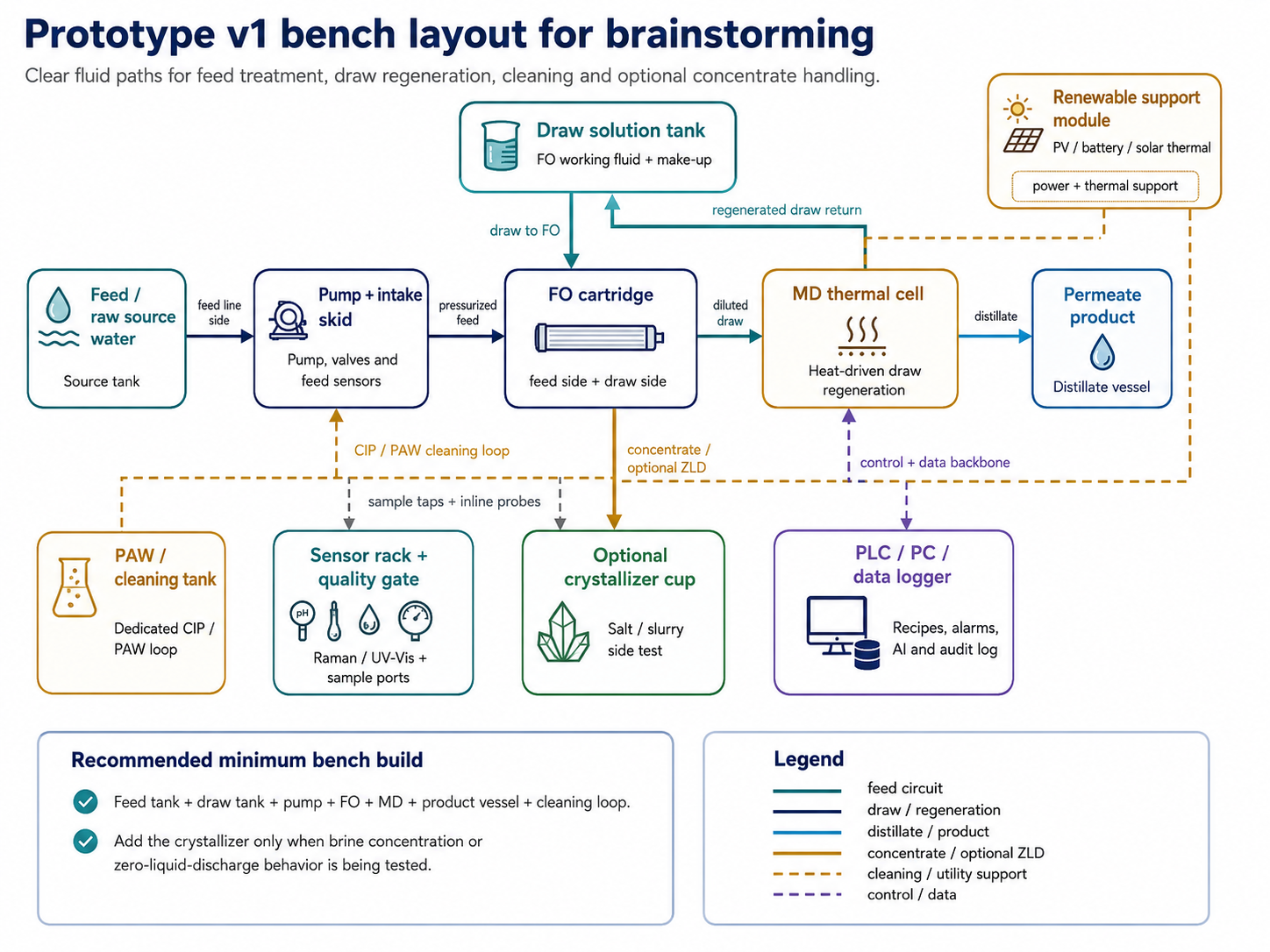
Retrofit treatment engineering and bench-to-skid build
TSQ Global / TSQ&E
WP4
Monitoring, chemical intelligence, source-water characterisation
Environmental Institute
WP5
Digital twin, AI decision support, Verifiable Trust Infrastructure
WP6
Data space, interoperability, dashboards, smart-metering stack
ONE4
WP7
Cyber-physical resilience, validation, compliance-by-design
WP8
Biological Quality Gate, pilots, stress tests, cross-pilot validation
Med Uni Graz
WP9
Replication, training, dissemination, exploitation, uptake
Governance principle
• No WP lead is assigned outside documented competence.
Design principle
• Desalination remains optional inside a broader resilient-water infrastructure programme.
WP1. Project management, scientific integration, ethics and quality assurance
Definitive do-able allocation aligned to the present partner evidence and to the CLIMATE-02 logic
Lead: Maurizio / Aqua Vitaque
Core objective
Establish the scientific command layer of the action: one decision log, one architecture baseline, one ethics-and-security governance frame, and one lump-sum execution rhythm across all technical and pilot activities.
Why this lead is credible
Maurizio is the only current actor with explicit system-of-systems ownership across water engineering, AI, cyber-aware trust architecture, field prototyping, and cross-domain scientific integration. This is a real coordination role, not a ceremonial one.
Main tasks
• T1.1 Consortium governance, reporting cadence, risk register, and milestone control.
• T1.2 Scientific architecture board: freeze interfaces, module boundaries, and versioned technical decisions.
• T1.3 Ethics, GDPR, dual-use and security oversight linked to data, field testing, and citizen-facing tools.
• T1.4 Reproducibility, QA, data-management, and evidence-traceability rules across all WPs.
• T1.5 Partner-contract logic and change-control procedure for lump-sum execution.
Key deliverables
• Consortium handbook + governance model.
• Architecture baseline and versioned decision log.
• Ethics/security framework + risk register.
Main contributing partners
• Major: Polistudium (QA + stakeholder process discipline).
• Major: TSQ (quality / compliance interface).
• Support: all partners.
WP2. Baselines, requirements, co-creation and KPI truth table
Lead: Polistudium
Convert a technically promising idea into a grantable, pilot-ready action by defining use cases, stakeholder requirements, baseline protocols, acceptance rules, and the KPI truth table that the whole consortium will use.
Polistudium explicitly proposed leadership or co-leadership for requirements and uptake work; its documented strengths are consensus methods, qualitative and quantitative stakeholder research, protocol framing, scientific writing, and adoption-oriented materials.
• T2.1 Stakeholder mapping and structured interviews with utilities, municipalities, operators, and regulators.
• T2.2 Definition of pilot archetypes, use cases, boundary conditions, and baseline operating scenarios.
• T2.3 KPI truth table: resilience, water safety, energy/GHG, recovery, cyber posture, social uptake.
• T2.4 Co-creation formats: Delphi / nominal-group / workshop cycles to stress-test the proposal logic.
• T2.5 Citizen-science and user-facing protocol design, aligned with privacy and feasibility.
• Baseline dossier and pilot requirement book.
• KPI handbook and acceptance criteria.
• Co-creation report + operator/user requirements.
• Major: Environmental Institute (monitoring baselines).
• Major: Maurizio / One4 (digital requirements).
• Support: Med Uni Graz, FH Kärnten.
WP3. Retrofit treatment module design, engineering and bench-to-skid integration
Lead: TSQ Global / TSQ&E
Translate the Aqua Vitaque scientific architecture into a manufacturable, maintainable, validation-ready hardware chain: hydraulic buffer, pretreatment, decontamination core, optional FO/MD/ZLD branch, cleaning loops, and inspection-ready enclosures.
TSQ explicitly documented mechanical design, FEM, rapid prototyping, BOMs, design transfer, CE path, risk analysis, and software / equipment validation. This is exactly the competence needed for the engineering spine.
• T3.1 Process flow diagrams, P&IDs, module interfaces, service clearances, and maintainability rules.
• T3.2 Mechanical design of skids, housings, manifolds, supports, and cleanability-oriented layouts.
• T3.3 FEM, DfM/DfA, BOMs, assembly drawings, and prototype build packages.
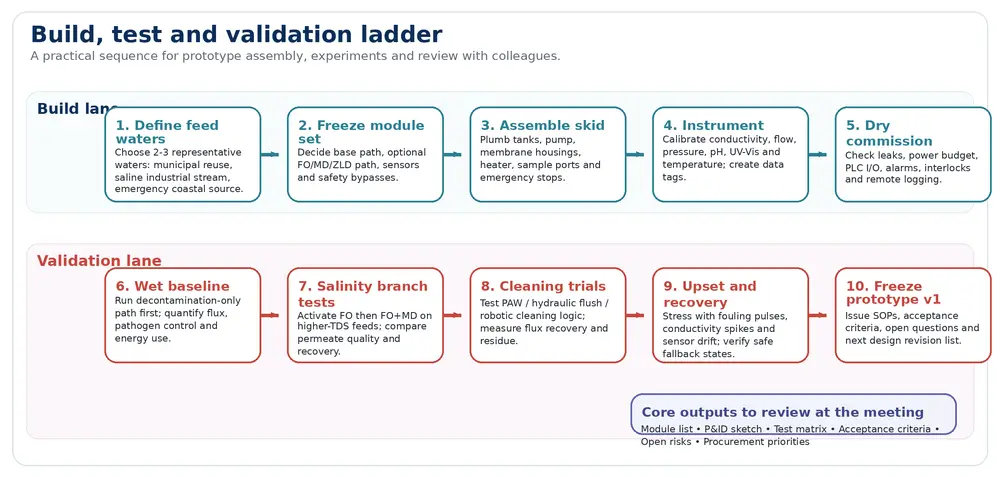
• T3.4 Bench skid, integrated skid, and pilot skid implementation with instrumented test points.
• T3.5 URS/FDS/HDS/SDS and design-transfer documents for reproducible build-up.
• Complete engineering package + BOMs.
• Rapid-prototype and skid-build files.
• Validation-ready design documentation.
• Major: Maurizio (scientific architecture + module logic).
• Support: One4 (embedded / platform interfaces).
• Support: EI + Med Uni (sampling and validation interfaces).
WP4. Monitoring, chemical intelligence and source-water characterisation
Lead: Environmental Institute
Build the contaminant-intelligence layer of the project: source-water diagnostics, wastewater and reuse-water monitoring, target/suspect/non-target screening, pollutant prioritisation, and regulatory-grade environmental interpretation.
The Environmental Institute has current strengths in integrated river-basin management, environmental monitoring, analytical chemistry, ecotoxicology, data systems, and EU water-policy implementation; Jaroslav Slobodnik and Nikiforos Alygizakis are especially credible for this scope.
• T4.1 Monitoring strategy for influent, process, effluent, reuse water, and source-water hot spots.
• T4.2 HRMS-based target / suspect / non-target screening for PFAS, pharmaceuticals, CECs and unknown patterns.
• T4.3 Contaminant prioritisation and early-warning indicators linked to operational decision support.
• T4.4 Regulatory mapping for water reuse, safe secondary resources, and evidence packages for authorities.
• T4.5 Reference datasets and stressor libraries for digital twin training and pilot comparison.
• Monitoring plan and contaminant atlas.
• Reference spectral / suspect libraries.
• Regulatory monitoring matrix.
• Major: Med Uni Graz (effect-based and microbial linkage).
• Major: Maurizio + One4 (AI/data ingestion).
• Support: Polistudium (protocol and uptake framing).
WP5. Digital twin, AI decision support and Verifiable Trust Infrastructure
Implement the computational intelligence of the project: bounded digital twin, anomaly detection, predictive maintenance, optional microbial/AMR intelligence, and a verifiable-trust layer that makes water-quality and operating claims auditable rather than declarative.
This WP directly matches Maurizio’s documented arc in Verifiable Trust Infrastructure: compute as evidence, cryptographic provenance, privacy-preserving data coordination, AI for complex bioscience and water systems, and cross-domain architecture under adversarial constraints.
• T5.1 Hybrid digital twin for hydraulics, membrane state, thermal performance, fouling, energy, and contaminant dynamics.
• T5.2 Multi-layer AI stack: anomaly detection, predictive maintenance, bounded actuation, and operator-support rules.
• T5.3 Optional biosurveillance layer: microbial signatures, AMR / pathogen genomics-metagenomics, and chemical-effect data fusion.
• T5.4 Verifiable Trust Infrastructure: tamper-evident logging, provenance chains, role-aware access, optional permissioned ledger, ZK-ready certification patterns.
• T5.5 Explainability, operator override, model governance, and evidence traceability.
• Digital twin core + AI model pack.
• Trusted audit/provenance stack.
• Operator cockpit and explainability rules.
• Major: One4 (platform engineering + analytics UI).
• Major: EI + Med Uni (data for training and validation).
• Support: TSQ (secure instrumentation interfaces).
WP6. Data space, interoperability, dashboards and smart-metering stack
Lead: ONE4
Operationalise the data layer for utilities and pilots: secure ingestion, historian / event bus / APIs, dashboards, BI, citizen-science interfaces, and smart-metering-ready analytics that can support monitoring and pricing decisions.
ONE4’s official profile is that of a solution integrator focused on application development, infrastructure integration, BI/big-data, managed services, and cybersecurity. That makes it a practical delivery partner for platform engineering rather than abstract AI theory.
• T6.1 Interoperable data architecture: APIs, event bus, historian, metadata model, and role-based access.
• T6.2 Utility-grade dashboards, command centre views, alarms, ticketing and maintenance workflows.
• T6.3 Smart-metering connectors and consumption-analytics blocks for pricing-grade monitoring.
• T6.4 Citizen-science / anomaly-reporting interface with guided data-quality rules.
• T6.5 FAIR / INSPIRE-oriented publishing layer for non-sensitive outputs and replication assets.
• Data model + API spec.
• BI dashboards and operator portal.
• Citizen / smart-meter integration package.
• Major: Maurizio (trust architecture + AI interfaces).
• Major: EI (environmental data semantics).
• Support: Polistudium (user-facing protocols).
WP7. Cyber-physical resilience, validation and compliance-by-design deployment
Ensure that the system is not merely innovative but deployable: validated, threat-modelled, traceable, and defensible against cyber-physical failure, misuse, or non-compliance.
TSQ documented IoT/cybersecurity assessments, ISO-oriented quality systems, FEM / process FMEA, biological risk assessment, CE-oriented design controls, and GAMP5 validation. This is the natural home for compliance-grade deployment logic.
• T7.1 OT / IoT threat modelling and secure-by-design architecture for instrumentation and control loops.
• T7.2 Access control, segmentation, tamper detection, fallback modes and recovery logic.
• T7.3 Validation master plan: URS, IQ/OQ/PQ, software validation, change control, and evidence capture.
• T7.4 FMEA, safety case, biological-risk considerations, and conformity roadmap.
• T7.5 Cyber-physical drills and recovery exercises connected to WP8 pilot operations.
• Threat model + security baseline.
• Validation master plan and compliance dossier.
• Drill package + recovery playbooks.
• Major: Maurizio (verifiable trust + audit logic).
• Major: One4 (cyber monitoring workflows).
• Support: Polistudium (training/drill communication).
WP8. Biological Quality Gate, pilots, stress tests and cross-pilot validation
Lead: Med Uni Graz
Provide the scientific proof that treated water is safe and that the infrastructure behaves robustly under realistic stress: microbiology, cytotoxicity, genotoxicity, antibiotic-resistance markers, pilot acceptance tests, and cross-pilot evidence synthesis.
Med Uni Graz explicitly proposed leadership of a work package on toxicological and microbial safety validation. Their documented assets include accredited water hygiene diagnostics, BSL-3 infrastructure, flow cytometry, cell culture, and advanced bioassays.
• T8.1 Validation panels for microbiological, ecotoxicological, and effect-based endpoints.
• T8.2 Biological Quality Gate integrating microbiology, AR markers, genotoxicity, cytotoxicity and process go/no-go thresholds.
• T8.3 Stress-test ladder from bench to in-situ pilot, including recovery-time and alarm-quality metrics.
• T8.4 Cross-pilot comparison, uncertainty treatment, and evidence-pack consolidation.
• T8.5 Inter-lab training and sample-handling harmonisation with FH Kärnten support.
• Biological Quality Gate specification.
• Pilot validation package and safety acceptance report.
• Cross-pilot evidence dossier.
• Major: Environmental Institute (chemical evidence).
• Major: Maurizio / One4 (digital evidence and alarms).
• Support: FH Kärnten (SOP transfer and training).
WP9. Replication, training, dissemination, exploitation and uptake
Turn technical results into assets that a Horizon evaluator can recognise as exploitable and replicable: SOPs, procurement-ready materials, training packages, publications, communication outputs, and uptake pathways.
Polistudium explicitly requested leadership or co-leadership of this area and documented strengths in scientific dissemination, editorial outputs, webinars, training, publication support, and translation of technical results into adoptable formats.
• T9.1 Replication kit: procurement specs, SOPs, acceptance tests, operator manuals and implementation playbooks.
• T9.2 Scientific publications, conference outputs, webinars, and editorial dissemination.
• T9.3 Exploitation roadmap: market pathways, partnership logic, deployment models and follow-on projects.
• T9.4 Training package for operators, laboratories, municipalities and follower sites.
• T9.5 Policy and uptake narratives for utilities, public authorities and European replication.
• Replication kit and training pack.
• Exploitation and dissemination plan.
• Follower-site and uptake package.
• Major: Maurizio (scientific narrative + partnership strategy).
• Major: One4 / TSQ (implementation assets).
Responsibility matrix and Maurizio / Aqua Vitaque deep scope
L = lead | M = major contributor | S = support. Maurizio is assigned real technical ownership, not generic coordination only.
WP
Maurizio
TSQ
EI
MedUni
FHK
Maurizio / Aqua Vitaque – deep technical scope that should stay with the coordinator
• System architecture and technical integration across all modules.
• Digital twin and bounded AI decision support.
• Verifiable Trust Infrastructure for water-quality provenance, audit, and controlled data sharing.
• Cyber-aware evidence model for sensors, operators, and field outcomes.
• Optional microbial / AMR / genomics intelligence where it improves water-safety reasoning.
• Cross-domain translation between hardware, data, biosurveillance, and exploitation.
Important constraint
Do not overload Maurizio with routine dissemination or pure regulatory paperwork. His best is architecture + AI + trust + cyber + computational biosurveillance, while other partners carry methodology, engineering, validation, and uptake.
36 vs 48 months
The WPs above work in either duration, but the current consortium maturity points to one option being materially safer.
36-month option – feasible only if pilot hosts are already warm
Best when utilities and municipalities are named immediately, prototype hardware is mature, and procurement/logistics are pre-cleared.
Advantages: faster exploitation narrative, lower management overhead, stronger urgency.
Risks: less time for inter-lab validation, cyber drills, and multi-site replication; higher pressure on hardware integration and pilot approvals.
48-month option – safer for this consortium composition
Recommended if the current group needs time to lock pilot hosts, execute bench-to-skid de-risking, complete biological / chemical validation, and build a serious replication kit.
Advantages: more realistic pilot phasing, stronger evidence under stress, room for follower sites and security exercises.
Risk: needs tight scope control to avoid narrative dilution.
My recommendation
• Approve the WP structure now.
• Present the consortium as 48 months by default.
• Keep a compressed 36-month fallback only if pilot hosts are secured quickly.
Freeze these decisions in today’s call
• Confirm every WP lead and major contributor.
• Fix missing pilot-host categories.
• Freeze which Aqua Vitaque modules are mandatory in v1 and which remain optional; the missing parties
wps
will be eliminated without affecting the main infrastructure.
Decision program point | recommended baseline = 48 months